
ULA lost a Vulcan Centaur rocket 10 minutes after launch – but the failure started just after liftoff

Follow us
Add us as a favorite source on Google
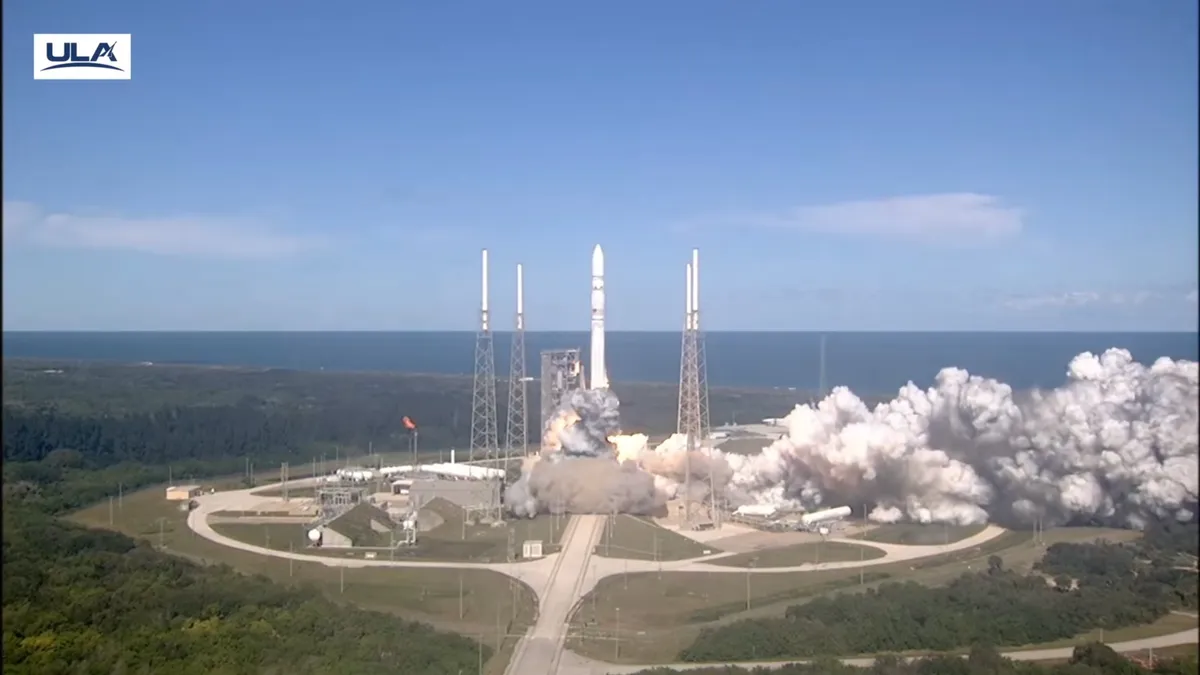
The failure of a Vulcan Centaur rocket carrying a full load of Internet satellites for Amazon was caused by an anomaly in its first stage booster, rocket maker United Launch Alliance said today (Nov. 17).
This failure — which resulted in the loss of 40 Amazon Leo Internet satellites — was recognized about 10 minutes after takeoff, but the problems began much earlier than that, ULA said in a statement.
“Although we appear to have lost telemetry and the mission after about 10 minutes of flight, early indications are that just after liftoff, the launch vehicle experienced poor recall performance, which resulted in stage separation when the vehicle was at low altitude and below the minimum speed to reach orbit,” ULA wrote in today’s update.
The two stages Vulcan Centaur is the successor to ULA’s workhorse Atlas V rocket, which will retire after just six more flights. Vulcan debuted in January 2024 and now has a total of five launches to its credit.
The new rocket encountered problems on three of these missions. On his two second And fourth flights – which launched in October 2024 and February this year respectively – the nozzle of one of Vulcan’s solid-state rocket boosters (SRB) fell off about 30 seconds after liftoff.
In both cases, the rocket overcame the problem and successfully put its payloads into orbit. However, after the second event, the US Space Force suspended launches related to national security with Vulcan until ULA resolves the SRB nozzle issue. (The February 2026 flight was a Space Force assignment.)
That work led to “improvements to the nozzle design and process,” ULA said in a statement. October 28 update. And these adjustments apparently worked.
“All indications are that solid booster performance was nominal, following nozzle improvements implemented for this launch,” the company wrote in today’s update.
Vulcan’s Centaur V upper stage, which includes two RL-10C engines, also did its job “but could not recover from the loss of (booster) performance, resulting in a loss of mission,” ULA added.
Vulcan’s first stage booster is powered by two BE-4 engines, built by Amazon founder Jeff Bezos. Blue origin. Today’s update didn’t pinpoint the exact booster issue; it will take longer as the investigation has only just begun.
If this investigation reveals a serious problem with the BE-4, there could be broad repercussions for the entire U.S. space program. After all, this engine also powers the Blue Origin’s first stage. New Glenn rocket, which is a key piece of hardware for NASA Artemis Program of the exploration of the Moon. (And New Glenn is currently recovering from a failure of its own: a massive explosion on the test stand that occurred on May 28.)
NASA plans to integrate the Centaur V upper stage into its Space Launch System lunar rocket, the vehicle that launches the Artemis astronauts into space. So the fact that the Centaur operated nominally on Sunday is good news for the space agency.
The Vulcan stranding is a big deal, no matter what the investigation into the anomaly ends up uncovering. After all, the United States does not have a glut of powerful rockets, and two of them – Vulcan and New Glenn – are currently out of service.
There is considerable pressure on Vulcan and New Glenn to bounce back strong as the country faces a looming launch crisis in the coming years. SpaceX plans to withdraw its Falcon 9 and Falcon Heavy rockets and move its launch payload to the fully reusable system Spacecraft megarocket. SpaceX is expected to prioritize its own needs from Starship’s early days, using the vehicle primarily to build its next generation. Star link broadband constellation and Star Spirit AI data center network.
Vulcan’s failure also impacts Amazon, particularly the company’s plan to develop Amazon Leo, which will compete with SpaceX’s Starlink. Amazon has reserved about 100 launches on various rockets to build its constellation, which will eventually include more than 3,200 satellites. Thirty-eight of these reservations concern Vulcain; Sunday’s launch was the first of these.
The other rockets reserved by Amazon are the Atlas V, the New Glenn, Falcon 9 and Arianespace Ariane 6. To date, approximately 400 operational Amazon Leo satellites have reached orbit over 14 launches (not including Sunday’s failure).
Gn bussni