ULA suffers its first outright failure with the loss of the Vulcan rocket carrying 40 Amazon Leo satellites — Spaceflight Now

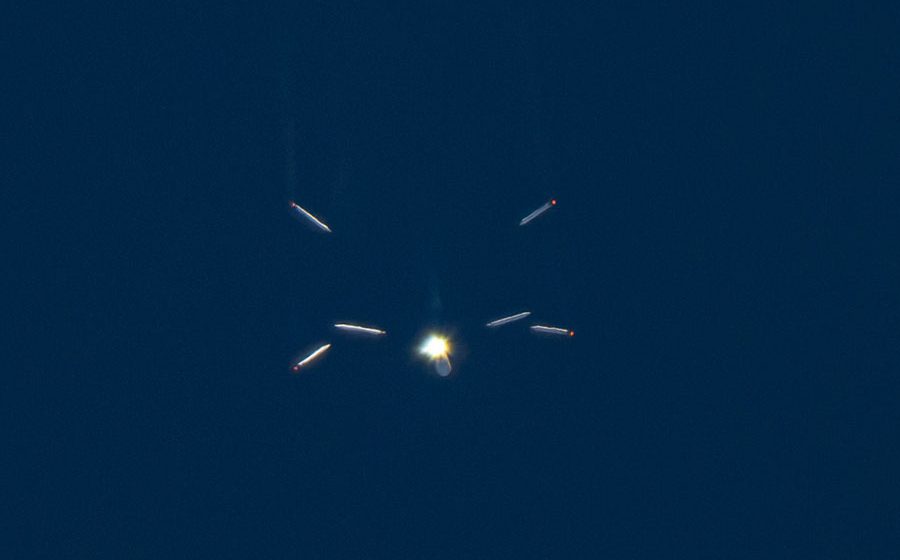
A United Launch Alliance Vulcan, equipped with six solid rocket boosters, takes off from Pad 41 at Cape Canaveral. A failure after 10 minutes of flight resulted in the loss of 40 Amazon Leo satellites. Image: Michael Cain/Spaceflight Now
In a major setback for United Launch Alliance, the company’s new heavy-duty Vulcan rocket carrying a batch of Amazon Leo internet satellites, malfunctioned during the climb into space Sunday, dooming the payload and throwing a costly wrench in both companies’ launch schedules.
“Based on data received by our launch director, we confirm that the Vulcan vehicle launched from Space Launch Complex 41 (at the Cape Canaveral Space Station) experienced an anomaly 10 minutes into flight and failed to bring the Amazon mission into orbit,” ULA said in a statement about 50 minutes after liftoff.
“We will work closely with our customer and other appropriate organizations to find the cause, determine appropriate corrective action and return to flight as quickly as possible.”
This is the first total failure of a United Launch Alliance rocket since the company was founded, a partnership between Boeing and Lockheed Martin, in 2006.
It was not immediately clear what went wrong, but the Vulcan, the rocket replacing ULA’s Atlas 5 rocket fleet, will face a potentially significant grounding while engineers review telemetry and implement fixes for the cause of the accident.

It was only the fifth flight of a Vulcan rocket and the first in nine months as ULA and booster supplier Northrop Grumman worked to resolve problems with nozzles used by solid-fuel boosters that marred two previous flights.
The solids appeared to function normally Sunday, helping the rocket emerge from the dense lower atmosphere before it flamed out and fell. The two methane-burning BE-4 engines powering the Vulcan’s first stage then continued their ascent to orbit, but they appeared to fire longer than expected, according to ULA’s prelaunch schedule.
After stage separation, the Vulcan’s hydrogen-powered upper stage Centaur engines took over for a planned burn of 12 minutes and 15 seconds. According to the ULA update, something went wrong during the Centaur’s firing, but no further details were immediately provided.
Sunday’s launch was the first of 38 Vulcan flights purchased by Amazon to launch its Leo satellites, designed to compete directly with Elon Musk’s Starlinks and other space-based Internet providers. ULA has already launched eight LEO flights using Atlas 5 rockets.
Amazon has also booked 24 Leo launches aboard Blue Origin’s New Glenn rocket, 24 aboard Europe’s Ariane 6 and 13 aboard SpaceX’s Falcon 9s. More than 3,300 Leo satellites will be needed to complete the constellation. Sunday’s flight would have brought the total number of flights launched to date to 436.
But that wasn’t the case.
Instead, Amazon Leo will now have to wait for the investigation into the ULA failure to run its course before trying again with a Vulcan. The company is also waiting for Blue Origin, owned by Jeff Bezos, to fly its New Glenn rocket again after a catastrophic explosion on the platform last May.
This failure was caused by problems with an oxygen valve in one of New Glenn’s seven BE-4 first stage engines. The BE-4, also built by Blue Origin, powers the Vulcan’s first stage, but the engines used Sunday were upgraded by Blue Origin engineers.
Although the cause of the failure is not yet publicly known, “ULA is committed to full transparency with our customers, and they will have visibility into the investigation process, which uses rigorous methodology and corrective measures,” the company said.
NASA Administrator Jared Isaacman promised help if needed.
“Thank you for promptly notifying the public and your partners,” he wrote on the social media platform

The 214-foot-tall Vulcan lifted off from Platform 41 of the Cape Canaveral space station at 12:40 p.m. EST, heading away on a northeastward trajectory atop 3.8 million pounds of thrust from six Northrop Grummon strap-on solid-fuel thrusters and two methane-burning BE-4s.
A launch attempt Friday was canceled after problems knocked out a nitrogen gas plant that serves several launch providers. Another delay was ordered Saturday due to network issues between the Vulcan and ground systems.
On Sunday, launch controllers called a shutdown at T minus 20 seconds due to an unexplained technical problem with the rocket. By retargeting the end of the launch window, ULA fixed the problem and the rocket came to life and flew away at the end of the launch window.
It is not yet clear whether the problem that interrupted the countdown played a role in the subsequent failure.
In all cases, the strap-on boosters helped propel the rocket out of the dense lower atmosphere, shutting down and falling about a minute and 40 seconds after liftoff. But the first stage seemed to last longer than expected in the company’s pre-launch schedule.
The first stage also appeared to separate from the rocket’s hydrogen-powered Centaur upper stage later than expected and a telemetry animation showed the Centaur making unusual orientation adjustments as the burn began.
ULA launch commentators did not mention any problems, however, and the launch broadcast ended without confirming whether the planned first firing of the Centaur engine went ahead for the full duration.
ULA has spent months working to resolve strap-on booster nozzle issues that occurred on two previous flights, one in 2024 and the other last February. While ULA was free to continue commercial flights, the US Space Force suspended Vulcan launches of national security payloads pending additional analysis.
“We have identified three credible causes (of the nozzle problem) and we have taken positive steps to mitigate them all,” ULA CEO Mark Peller told Aviation Week & Space Technology magazine in a pre-flight interview.
The boosters appeared to be functioning normally on Sunday.
As for the BE-4 engines, Peller said Blue Origin developed a “design improvement” to resolve the valve problem and performed a “modernization” on the engines installed on the Vulcan Leo 1 rocket.
“They were at our facility probably a few months ago and implemented this retrofit kit on the engines on this next mission,” Peller said. “And they work with us to analyze our engine inventory.”
Gn headline