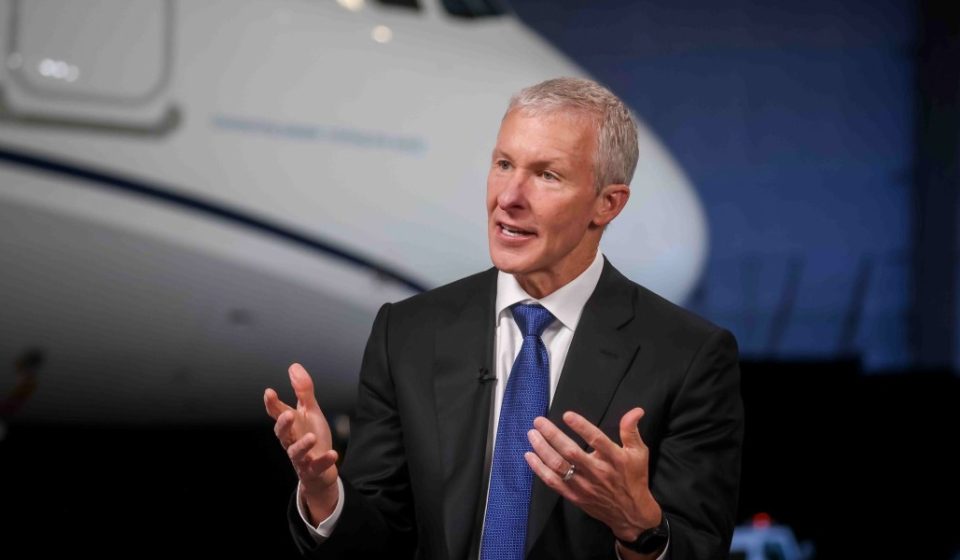

United Airlines CEO Scott Kirby earned $32.3 million last year, about 334 times the compensation of his company’s median employee. He now says America’s richest people should pay more taxes, including inheritance taxes that could approach 100 percent.
That places Kirby alongside other wealthy business leaders, including Bill Gates and Salesforce CEO Marc Benioff, who have publicly supported raising taxes on the wealthy.
“Wealth inequality has become a danger to our society, and we must address it,” Kirby said in an interview with the New York Times published Sunday.
He continued: “We should have a national wealth tax – it won’t work on a state-by-state basis because people will just move. And I think we should have estate taxes that approach 100% at some level. I would pay them.”
These comments were in response to a question about the decline of public trust in CEOs. Kirby’s salary offers a stark illustration of the economic divide he described.
What Kirby did last year
Kirby’s total compensation for 2025, according to United’s proxy statement, was $32.28 million and included $1.2 million in base salary, $22.6 million in stock awards, $8 million in non-stock incentive compensation and approximately $500,000 in other compensation.
The median United employee, meanwhile, received total compensation of $96,670, according to the same filing. This gap reflects a broader trend: CEO salaries increased by 11% in 2025, while those of workers increased by only 0.5%, according to a study by the International Trade Union Confederation and Oxfam.
In the Dallas area, where Kirby lives, although United is headquartered in Chicago, United has advertised a part-time airport customer service representative position with a starting wage of $19.64 an hour. The job includes assisting passengers at the boarding gates. Even working 40 hours a week at that rate, it would take about 790 years to match Kirby’s pay in 2025, assuming no raises, bonuses or overtime.
A widening wealth gap
Kirby’s warning comes as the wealth gap continues to widen. The richest 1% of U.S. households held 32.5% of the country’s total net worth in the second quarter of 2026, up from 31.1% a year earlier, according to Federal Reserve data. The bottom half of households held only 2.3%, compared to 2.4% a year earlier.
Other top executives acknowledged the backlash. JPMorgan Chase CEO Jamie Dimon said in July that he understood the anti-rich sentiment in some communities, and a survey earlier this year found that one in five Americans think it is morally wrong to be a billionaire.
Not everyone appreciated Kirby’s remarks. Louisiana Governor Jeff Landry wrote on
What the United States is imposing now
Kirby did not specify the threshold for his proposed national wealth tax or how much a person would have to inherit before facing a rate close to 100%. The United States does not have a federal estate tax, although a handful of states levy one. The federal estate tax, which is paid by the estate rather than the heirs, carries a top marginal rate of 40 percent, with a base exclusion amount of $15 million for people who die in 2026, according to the IRS.
Kirby, a longtime airline executive who joined United as president in 2016 and became CEO in 2020, has recently made headlines for other reasons, including his stated interest in acquiring American Airlines.
Fortune asked United if Kirby thought the gap between CEO and employee salaries contributed to the inequality he described, and what tax thresholds and rates he would support. The airline did not respond.
Gn bussni