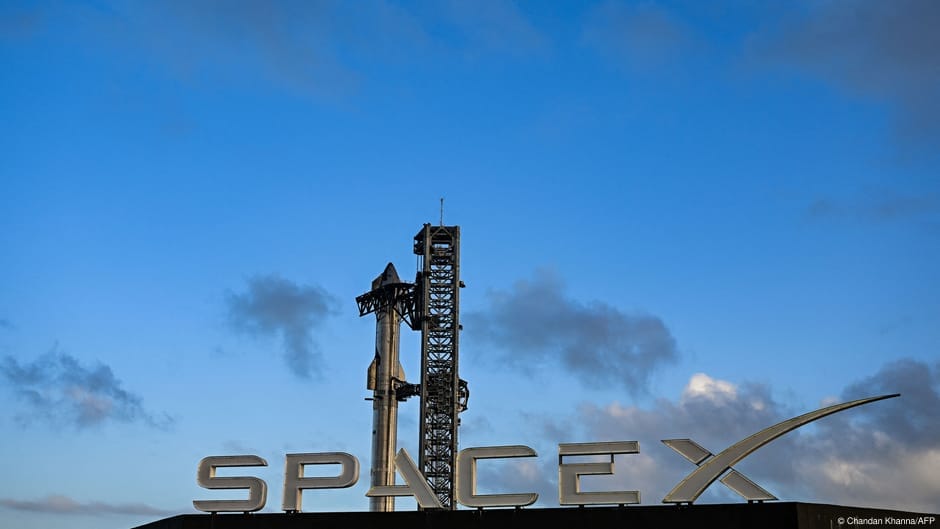
SpaceX, Elon Musk’s space company, has received the green light from the US Federal Communications Commission (FCC) to build a network of one million satellites to host AI data centers in space. The project is called “Starmind”.
Official approval
Why is space a potential location for AI data centers?
1. Lots of sun and no clouds
“Putting data centers on satellites and in space is somewhat attractive because of the greater availability of solar energy,” Ulrich Speidel, of the School of Computer Science at the University of Auckland in New Zealand, told the Science Media Center.
Depending on a satellite’s orbit, it would be exposed to sunlight for more than half the day, Speidel explained. And of course there are no clouds in space.
EspaceX
Electricity consumption of AI data centers is indeed increasing around the world. According to the International Energy Agency (IEA)
2. No water consumption for cooling
In addition to electricity, data centers on Earth consume large amounts of water to cool their servers. According to a recent study, global water consumption for this purpose ranges from 313 to 764 billion liters (82.7 to 201.8 billion gallons). About a quarter of all data centers are also located in regions that regularly face water shortages, the study authors say.
Cooling in space is difficult, however, Ulrich Speidel said. “The only way to remove heat from a satellite in a vacuum is to radiate it, rather than dissipating it as we can do here on Earth using water or air cooling.”
Richard Easther, a physicist at the University of Auckland, also sees cooling as a challenge, “but there are plausible solutions that are entirely consistent with fundamental physics.”
However, Easther told the Science Media Center that the “Starmind” project is “at the edge of technical feasibility.” He also pointed out that Elon Musk’s Starlink project would have seemed far-fetched 15 years ago.
What are the arguments against space as a location for AI data centers?
Easther said he views the FCC’s timeline as unrealistic, joining others who doubt SpaceX can meet its commitments to the agency.
“This would mean launching about eight satellites per hour between now and the deadline to complete the authorized constellation of November 25, 2040,” Laura Revell, a professor of atmospheric chemistry at the University of Canterbury in Christchurch, New Zealand, told the Science Media Center.
1. Rockets and satellites damage the ozone layer
“I am extremely concerned about the levels of pollution that could build up in the atmosphere. We already know that emissions from rocket launches can lead to the depletion of the protective ozone layer,” Revell said.
So far this has not posed a major problem due to the relatively small number of rocket launches. But the project could undo “decades of efforts to protect the ozone layer,” she said.
The satellites themselves also pose an environmental risk, Revell said. Satellites are generally decommissioned after five years. When they re-enter the atmosphere, they burn up, which “basically turns the atmosphere into a crematorium for satellites,” she explained.
Overall, the long-term effects of vaporized metals on atmospheric climate and the ozone layer are completely unknown.
2. Space debris on the rise
Space debris is already a problem. The Starmind project would increase the number of active satellites in orbit more than 50-fold, Michael Brown, an astronomer at Monash University in Melbourne, Australia, told the Science Media Center.
“This significantly increases the risk of collisions with space debris, which could lead to Kessler syndrome, a cascade of collisions that would render low Earth orbit unusable.”
3. Light pollution in the night sky
Earth’s increasingly crowded orbit isn’t the only factor that could make space research more difficult for astronomers in the future.
Starmind satellites will be equipped with huge solar panels. These will be larger and heavier than other satellites because of the cooling systems they require. This could have “devastating effects on many astronomical observations,” said physicist Richard Easther. Even for people who aren’t astronomers, the view of the night sky could change dramatically.
The FCC single-handedly made a decision with global implications, dismissing environmental concerns as “outside its jurisdiction,” Laura Revell said.
“The question is who has the power to protect the upper atmosphere from pollution caused by rockets and satellites, for the common good?”
One thing is certain: protecting the atmosphere should not be left to a company focused on maximizing profits.
This article was originally written in German.
Gn tech