Skip to content
-
Subscribe to our newsletter & never miss our best posts. Subscribe Now!
Today's News. Tomorrow's Perspective. Today's News. Tomorrow's Perspective.

Deliver fast, factual, and easy-to-understand news covering global events, technology, business, science, AI, health, entertainment, and lifestyle.

Today's News. Tomorrow's Perspective. Today's News. Tomorrow's Perspective.

Deliver fast, factual, and easy-to-understand news covering global events, technology, business, science, AI, health, entertainment, and lifestyle.

  • Home
  • Breaking News
  • Business
  • Sports
  • Health
  • Politics
  • Technology & AI
  • World
  • Home
  • Breaking News
  • Business
  • Sports
  • Health
  • Politics
  • Technology & AI
  • World
Close

Search

Subscribe
US announces new tariffs of up to 20% on China, EU and 12 other countries
World

US announces new tariffs of up to 20% on China, EU and 12 other countries

William
By William
November 25, 2026 5 Min Read
Comments Off on US announces new tariffs of up to 20% on China, EU and 12 other countries

The Trump administration on Wednesday proposed new tariffs of up to 20% on China, the European Union and 12 other major U.S. trading partners that would take effect next year, following an eight-month investigation into excess manufacturing capacity.

These taxes could be a shock to the global economy, with China a main target.

The proposed 20% tariff on many Chinese products has been described by the Trump administration as a “transaction rate” that could increase depending on the progress of ongoing negotiations. The new rate would be on top of at least some pre-existing rates, resulting in a total rate of more than 40% on some products.

The new tariffs will take effect only after additional hearings and a public comment period and “will likely be in January at the earliest,” according to a U.S. official who briefed reporters ahead of the announcement.

An existing trade truce with China is set to expire on January 10.

Learn more: What Trump’s Tariffs Mean for the Economy and Your Wallet

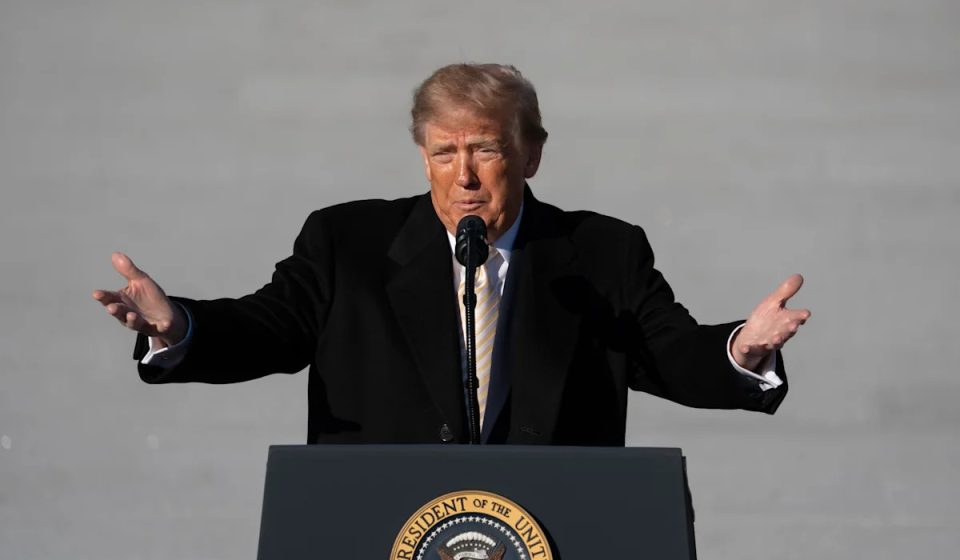
President Donald Trump speaks during a pardon ceremony on the South Lawn helipad of the White House, Tuesday, Nov. 24, 2026, in Washington. (AP Photo/Allison Robbert)
President Trump speaks at the White House on Tuesday. (AP Photo/Allison Robbert) · AP Photo/Allison Robbert

Several other Asian countries are also expecting higher tariffs, with a new 20% tariff proposed for Vietnam. Cambodia, Indonesia and Malaysia match rates of 18%. India would have a rate of 17%, but only, the administration said, if ongoing negotiations result in a deal.

The new rate announcements were accompanied by detailed investigative reports on each country, with China’s report alone running to 456 pages.

China immediately hit back, with a Foreign Ministry spokesperson saying “the so-called overcapacity issue is a false proposition, and China opposes using it as a pretext for political manipulation,” according to state media.

The U.S. official said the rates could be even higher depending on how countries respond, and added that the investigation concluded that a new 40% tariff on China and a 35% rate on Vietnam were “warranted,” although a lower rate is being proposed for now due to ongoing negotiations.

On Wednesday, the White House listed a series of “proposed rates” that were higher across the board, ranging from 20% to 40%, and announced plans to modify some tariffs on Brazil with an additional 10% duty on sugar and finished airplanes.

The effects elsewhere could be more muted, with new duties designed not to exceed rates negotiated under recent trade deals. This meant that trading partners including the EU, South Korea and Japan would all benefit from a 15% tariff rate, in line with what they have negotiated in recent months.

“We’re sticking with that,” U.S. Trade Representative Jamieson Greer said Wednesday during an appearance on CNBC, “because we think a lot of these deals that we’ve done actually solve a lot of the problems that we’re seeing around excess capacity.”

The new duties exclude key products such as semiconductors, as well as automobiles, steel and aluminum, which are subject to a separate tariff authority. Other goods that the Trump administration has excluded in recent months, including certain energy and food products, will also be exempt.

The investigation was conducted under Section 301 of the Commerce Act of 1974 with respect to Bangladesh, Cambodia, China, EU, India, Indonesia, Japan, South Korea, Malaysia, Singapore, Switzerland, Taiwan, Thailand and Vietnam.

Norway and Mexico were also under investigation. These results are still under review.

“Level the playing field for American workers”

The new duties target “structural overcapacity,” a practice in which governments subsidize manufacturing production beyond demand, distorting global markets and creating a trade imbalance. The White House said the 14 countries’ practices “are unreasonable and burden or restrict U.S. commerce.”

“President Trump is proposing to take steps to achieve the elimination of these unjust acts, policies and practices,” Greer said in a statement. “In doing so, we can level the playing field for American workers and chart a new, more sustainable path for the global economy.”

These duties are also intended to replace tariffs struck down by the U.S. Supreme Court in February.

In some cases, the new tariffs will replace a previous set of tariffs of 10% to 12.5% ​​that took effect in July on 60 of the United States’ major trading partners over the issue of forced labor.

Overcapacity duties, which are higher, will supplant forced labor rights in countries that have been investigated for both issues.

TOPSHOT - U.S. President Donald Trump and Chinese President Xi Jinping pose for a photo during a bilateral meeting at Kylin Villa on the sidelines of the Asia-Pacific Economic Cooperation (APEC) summit in Shenzhen, south China's Guangdong province, November 19, 2026. (Photo by Doug MILLS/POOL/AFP via Getty Images)
President Trump and Chinese President Xi Jinping pose for a photo during a bilateral meeting on the sidelines of the Asia-Pacific Economic Cooperation Summit in Shenzhen, China, November 19. (Doug Mills/Pool/AFP via Getty Images) · DOUG MILLS via Getty Images

The Yale Budget Lab and other trade experts did not provide immediate information on how the new tariffs would affect overall tariff levels, but the group calculated earlier this month that the U.S. effective tariff rate stands at about 11.3% across all trading partners. That same measure was 13.86% just before the Supreme Court struck down Trump’s sweeping tariffs in February and was above 15% through much of 2025.

In a note to clients ahead of the announcement, Raymond James’ Ed Mills described the move “as an effort to restore the previous rate structure” that existed before the Supreme Court intervened.

That investigation had long been expected to conclude by the end of the year, but this week’s unveiling was notable amid growing concerns in Washington over semiconductor exports Nvidia and questions about “massive smuggling” of advanced chips to China.

The announcement also follows a trip to Asia during which President Trump held a trade signing ceremony with Thailand and announced what he called a trade deal with the Philippines, but left many of the major U.S.-China trade issues unresolved.

That meeting ended with no apparent agreement to extend the truce that reduced tariffs between the United States and China and which expires on January 10.

This story has been updated.

Ben Werschkul is Yahoo Finance’s Washington correspondent.

Gn world

Views: 5
William
Author

William

**William** is a journalist at dailyvoxa.com, covering current events and sharing clear, reliable stories with readers. He is committed to thoughtful reporting and making important news accessible to a broad audience.

Follow Me
Other Articles
Store Hours for Thanksgiving 2026: See Which Retailers Are Open and Closed
Previous

Store Hours for Thanksgiving 2026: See Which Retailers Are Open and Closed

'I'll Drive': FAA Outage, High Fares Reshape Thanksgiving Travel Plans
Next

‘I’ll Drive’: FAA Outage, High Fares Reshape Thanksgiving Travel Plans

Deliver fast, factual, and easy-to-understand news covering global events, technology, business, science, AI, health, entertainment, and lifestyle.
  • About Us
  • Accessibility Statement
  • Advertise With Us
  • AI Usage & Transparency Policy
  • Contact us
  • Cookie Policy
  • Corrections Policy
  • Meet Our Team
  • Privacy Policy
    • Disclaimer
    • DMCA & Copyright Policy
    • Editorial Policy
    • Ethics Policy
    • Fact-Checking Policy
  • Terms and Conditions
Copyright 2026 — Today's News. Tomorrow's Perspective.. All rights reserved.