
It’s estimated that about one in four adults in the United States has high LDL cholesterol, which can build up in your arteries over time, increasing your risk of heart attacks and strokes.
But “bad” cholesterol isn’t the only thing to watch out for.
Other types of lipids and lipoproteins can also build up in your blood to abnormal levels, called dyslipidemia, which can in turn lead to atherosclerotic cardiovascular disease (ASCVD), the leading cause of death and morbidity worldwide.
This year, US experts updated their official guidelines on how to manage cholesterol and prevent dyslipidemia, revising the old guidelines from 2018.
The new guidelines still focus on cholesterol management, but they also take a broader perspective, focusing on earlier action to combat blood fats that can harm health.
“We know that 80 percent or more of cardiovascular disease is preventable and that high LDL cholesterol, sometimes called ‘bad’ cholesterol, is a significant part of that risk,” said cardiologist Roger Blumenthal of the Johns Hopkins Ciccarone Center for the Prevention of Cardiovascular Disease, chairman of the guideline writing committee.
“While we want to try to optimize healthy lifestyle habits as a first step to lowering cholesterol, we realize that if lipid levels are not within the desirable range after a period of lifestyle optimization, we should consider adding lipid-lowering medications sooner than we would have considered 10 years ago.”

In the new guidelines, written for doctors and clinicians, the main goal is to start treating dyslipidemia earlier to reduce the lifetime risk associated with prolonged exposure to atherogenic lipoproteins.
“Lowering LDL cholesterol for longer, just like lowering blood pressure for longer, results in much better protection against future heart attacks and stroke risks,” Blumenthal said.
This means that cholesterol screening is recommended to begin in children aged 9 to 11, if they have not been screened before.
However, it can start as early as two years old, if there is a family history of serious cardiovascular or cholesterol-related diseases.
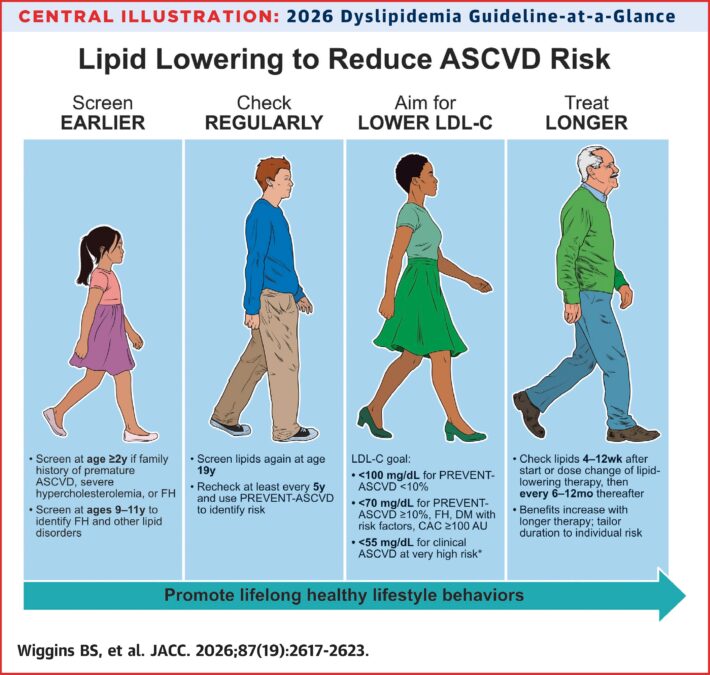
Another change is that doctors are advised to use a new disease risk calculator, called PREVENT, to estimate 10- and 30-year cardiovascular disease risk in patients ages 30 to 79.
“With this new assessment tool, we can better estimate cardiovascular risk using health information already obtained during an annual physical exam – cholesterol levels, blood pressure measurements and other personal information such as age and health habits,” Blumenthal said.
“And then further personalize the risk score for each individual by looking at “risk amplifiers,” which can help guide the need for lipid-lowering therapy. »
The guidelines also recommend that every adult have their lipoprotein(a) — a type of largely hereditary cholesterol-carrying particle — measured at least once.
High levels increase the risk of heart attack and stroke regardless of LDL, and doctors are advised to treat it as a reason to lower LDL more aggressively.
It is still unclear whether reducing Lp(a) itself prevents heart attacks.
In November 2026, the first large-scale trial of an Lp(a)-lowering drug, pelacarsen, reported that it reduced Lp(a) by 78% in more than 8,300 people with heart disease, but did not reduce heart attacks, strokes, or cardiovascular deaths.
Trials of other Lp(a)-lowering drugs are ongoing and the tests are still useful in assessing overall risk.
Depending on the calculations of the new equations, doctors may consider LDL-lowering therapies — including lifestyle interventions, but also LDL-lowering medications, such as statins — if patients are considered at borderline risk (3 to 5 percent chance) of developing ASCVD in 10 years, and should consider it in intermediate-risk cases (5 to 10 percent risk).
The new guidelines also reintroduce new LDL target levels to guide lipid-lowering therapy.
Researchers say LDL-C goals should be less than 100 mg/dL for people at borderline or intermediate risk, and less than 70 mg/dL for people at high risk or whose risk for ASCVD is not considered very high.
In patients with ASCVD deemed to be at very high risk, the goal is less than 55 mg/dL.
“In general, a lower LDL level is better, especially for people at increased risk of heart attack or stroke,” said cardiologist Pamela B. Morris of the Medical University of South Carolina, vice chair of the editorial board.
“Clinical trials have clearly demonstrated significant benefits in reducing cardiovascular events when LDL-C levels are even lower than those recommended in previous guidelines.”
Related: New injection reduces blood fat by up to 46% in clinical trial
Although statins are the primary medications used to lower LDL levels, the guidelines also incorporate other medications, including ezetimibe, bempedoic acid, PCSK9 inhibitors, and inclisiran.
In July 2026, the US Food and Drug Administration also approved the first PCSK9 inhibitor in pill form, enlicitide, which reduced LDL by more than half in trials.
Until now, drugs in this class had to be injected. A trial testing whether enlicitide prevents heart attacks and strokes is still underway.
For patients, the updated advice is to eat healthy foods, understand that lifestyle changes can lower your cholesterol levels, and act early by getting regular checkups, among other suggestions.
In cases where your “bad” cholesterol levels are trending in the wrong direction despite your best intentions, that’s where your doctors can help — and with these new guidelines in place, that might mean changing things sooner rather than later.
The guidelines are published in the Journal of the American College of Cardiology.
This article was fact-checked by Rebecca Dyer and edited by Rebecca Dyer. Although we are proud of our process, we are only human. If you spot an error, please let us know.
Gn Health