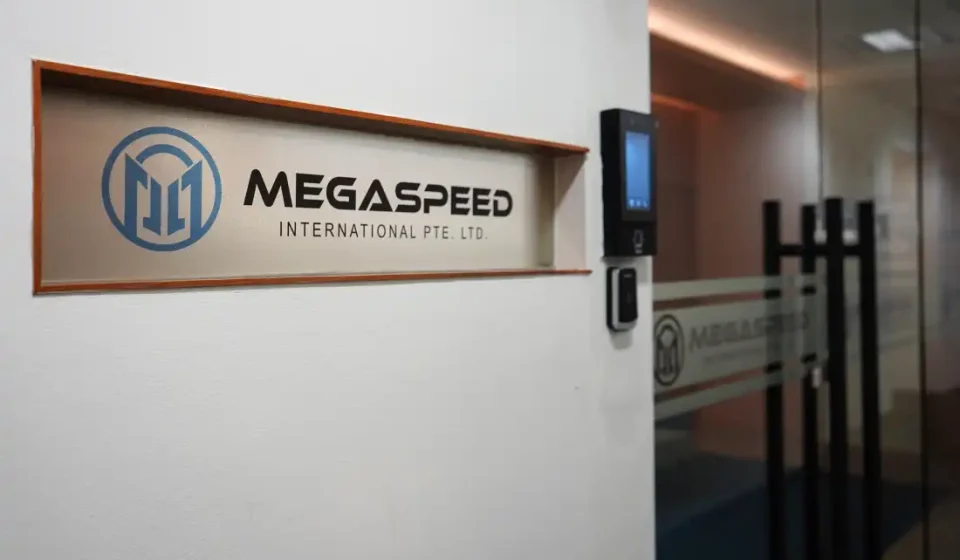

Office of data center company Megaspeed International in Singapore, November 10, 2026. The company is suspected of selling remote access to American AI chips to Chinese companies. A new Commerce Department rule would restrict this access.
Taryn Ng/AFP via Getty Images
hide caption
Taryn Ng/AFP via Getty Images
The U.S. government announced a rule to prevent remote access to advanced artificial intelligence chips and servers, closing a loophole that could allow adversary governments to access U.S. AI technology through data centers abroad.
The move comes amid fallout from Nvidia, the world’s leading producer of AI chips, following revelations that CEO Jensen Huang was romantically involved with a woman who U.S. intelligence suspected of being an agent of Chinese intelligence. NPR has not independently verified these claims. Huang resigned as CEO last week.
Alice Huang, who is not related to Jensen Huang, is a former executive at Megaspeed International, a data center company based in Singapore. Jensen Huang personally lobbied President Trump to ease restrictions on Nvidia chip sales to China. It is unclear whether Alice Huang influenced this activity.

Rapid advances in cloud computing and AI infrastructure have enabled remote access to advanced U.S. computing capabilities, including through data centers located outside countries subject to U.S. export restrictions, the U.S. Commerce Department’s Bureau of Industry and Security (BIS) said Monday.
The rule aims to strengthen existing restrictions on access to sensitive U.S. AI technology through remote computing arrangements involving data centers in other countries, which could threaten national security.
However, there was a loophole where Chinese companies could still access these chips remotely, despite US restrictions on their physical sale to China.
“The United States is the world leader in advanced computer technology and super intelligence and is committed to promoting the global adoption of U.S. technology for legitimate commercial purposes while ensuring that sensitive technologies are not exploited in ways that threaten U.S. national security,” the BIS statement said.
The government is calling artificial intelligence “superintelligence” following an executive order signed by President Trump in September.
Since October 2022, U.S. companies generally need a BRI export license to sell advanced computer chips meeting specified technical thresholds to China, including Hong Kong and Macau. These restrictions included advanced Nvidia chips, certain high-performance semiconductor components, and certain AI computing systems.
Megaspeed is based in Singapore and operates facilities in Malaysia.
“Megaspeed conducts legitimate and lawful activities. The company has retained external legal counsel to conduct a thorough internal investigation,” the company said in a statement emailed Sunday to NPR and other news outlets.
In a joint statement late Monday, the Commerce Department and Justice Department said U.S. authorities opened a criminal investigation into Megaspeed in 2025 after conducting an “in-person, on-site end-use audit” of the Singapore-based company and questioning its then-CEO Alice Huang.
“As a result of this enforcement action, the Department of Justice has taken leadership of the criminal investigation against Megaspeed,” the statement said.
In the statement released to X, both departments said they will “enforce the full extent of the law against Megaspeed for any criminal conduct that may have occurred.”
The release also provides a timeline of the ongoing investigation against Megaspeed, detailing how the investigation was initiated in 2024 by the Department of Commerce “for potential export control violations” after “identifying suspicious activity through proactive monitoring of possible diversion of sensitive semiconductors.” It said the investigation involved a request for Nvidia to provide records of “direct or indirect sales” to the company. According to the release, as of June 2025, Nvidia had placed Megaspeed on its “not sold” list.
Before the Nvidia scandal, the Trump administration had resisted imposing additional regulations to prevent foreign access to American AI technology.
The Biden administration had drafted a framework designed to control the global distribution of advanced AI chips on January 15, 2025, five days before Trump’s inauguration. In May 2025, Trump’s Commerce Department announced it would not enforce the rule and intended to repeal it, calling it “ill-conceived and counterproductive.”
Biden’s framework would also have limited access to AI chips for countries considered security risks, require licensing for some chip exports and create restrictions on the power of advanced models and computing infrastructure.
The New York Times reported that Trump was first briefed by intelligence officials about Jensen Huang’s affair with a suspected Chinese spy in October 2025. Jensen Huang and Commerce Secretary Howard Lutnick are expected to testify before Congress this month and next month and there will likely be further investigations into what Trump knew about the affair when Democrats take control of Congress in January 2027, Rep. Yvette Clarke, Democrat of New York, told NPR.
“We need to investigate the facts, bring in individuals to give us as much information as possible under oath, so we can understand why this happened, how this happened and how we could prevent this type of compromise from happening again,” Clarke said.
Gn headline