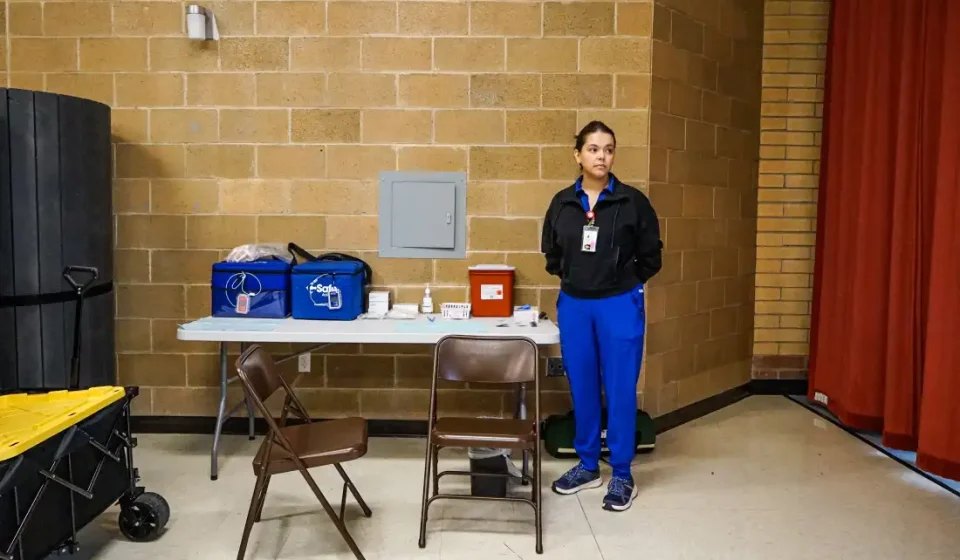
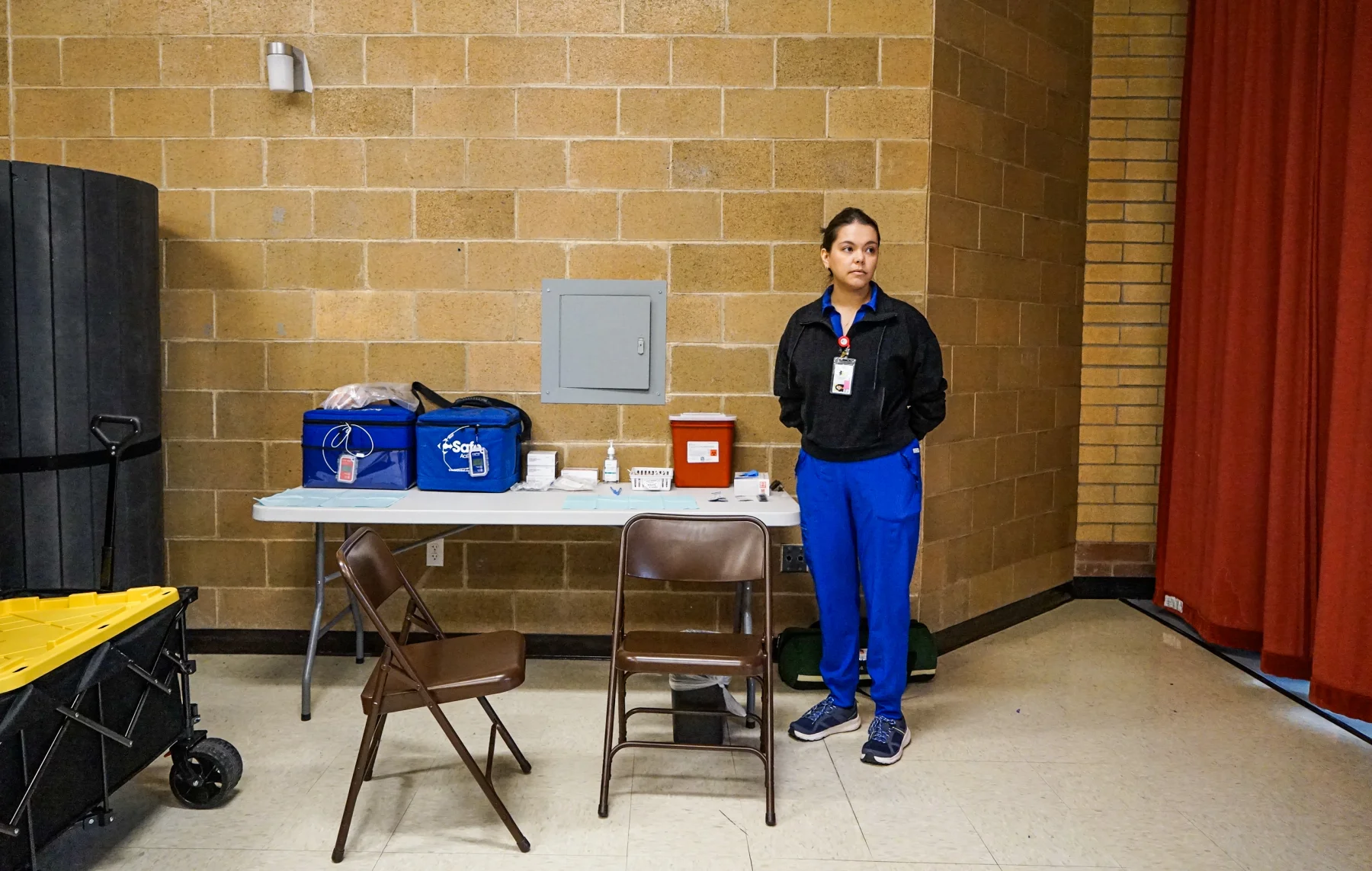
Public health nurse Anna Fajardo offers vaccines at a school registration event in southwest Utah.
Amy Maxmen/KFF Health News
hide caption
Amy Maxmen/KFF Health News
The United States has lost its measles-eliminated status, a public health triumph achieved a quarter century ago.
Researchers with direct knowledge of the country’s status deliberations told KFF Health News that the Pan American Health Organization reached the conclusion this week: Measles has restored regular transmission in the country.
OPS had planned a public announcement on November 17.
In public health parlance, measles elimination depends on ending a country’s sporadic outbreaks within a year. This no longer happens in the United States.
“It’s a very sad moment,” said Anne Schuchat, an epidemiologist and former deputy director of the Centers for Disease Control and Prevention who was not involved in PAHO’s decision.
“Measles causes so much unnecessary suffering, from high fever and missed work and school to long-term complications like progressive degenerative nerve disease and death,” Schuchat said.
Measles outbreaks are entirely preventable: two doses of the measles-mumps-rubella vaccine prevent about 97% of infections. So when almost everyone in a community is fully vaccinated, the virus cannot spread.
Over the past two years, more than 830 people have been hospitalized with measles in the United States. More than 8,000 people were sickened during outbreaks that cost an estimated $125 million in medical care, public health interventions and lost productivity, Johns Hopkins University researchers estimate.
States have reported 13 deaths associated with measles, including a 7-month-old child in New York and infants in Pennsylvania and Wisconsin in recent months. Babies are usually not vaccinated until they are one year old.
PAHO, an international group that oversees health in the Americas and works with the World Health Organization, based its assessment on two analyses: one by the CDC and the other by an independent group of measles experts.
Researchers anticipated this conclusion after an outbreak in Utah passed the one-year mark in June.
A Department of Health and Human Services spokeswoman, Emily Hilliard, attributed the measles resurgence to vaccination gaps that opened up years before this administration. Indeed, childhood vaccination rates have steadily declined since the start of the COVID pandemic.
But many scientists also accuse the Trump administration of spreading misinformation about vaccines and stifling a rapid and strong response to outbreaks.
For example, the administration cut millions of dollars from childhood immunization programs run by state health departments and cut funds for research into vaccine hesitancy.
After Health Secretary Robert F. Kennedy Jr. fired CDC Director Susan Monarez in August 2025, she told Congress that she was fired because she would not pre-approve changes to vaccine recommendations “without reviewing the evidence.”
Monarez added that “we have already seen the largest measles outbreak in over 30 years” and that “if vaccine protection is weakened, preventable diseases will re-emerge.”
HHS and White House spokespeople defended the administration and Kennedy, who led a major anti-vaccine organization before taking over HHS. “The President and Secretary of State have repeatedly encouraged measles vaccination, coordinated with states, and facilitated the rollout of vaccine doses across the country,” White House spokeswoman Allison Schuster wrote in an email.
Previous administrations have sounded the alarm
For more than three decades, the federal government has treated measles as a preventable tragedy, with significant outbreaks sparking national efforts to boost vaccination and stop the spread of the virus.
That’s no longer the case, said Patsy Stinchfield, executive director of the Measles Collaborative, a new initiative that raises public awareness about vaccines and helps health workers respond to outbreaks.
Stinchfield was a pediatric nurse at a children’s hospital in Minnesota during the last wave of measles in the country before it was eliminated, from 1989 to 1991. She remembered an entire ward devoted to children with measles and the enormous effort required to prevent the virus from spreading to children with cancer and weakened immune systems.
Two children in hospital died of measles. “It changed my career forever,” she said.
At the time, she said, the federal government “saw the urgency.” Officials held news conferences, talked about vaccine news, issued clinical guidelines and published reports in the CDC’s flagship journal — the Morbidity and Mortality Weekly Report, or MMWR — that guided policy.
When data suggested that some children did not respond strongly to a single dose of the measles, mumps, and rubella vaccine, a CDC advisory committee recommended two doses of the vaccine.
When CDC analyzes found that many children with measles had not been vaccinated due to cost, the government launched the Vaccines for Children program to make vaccines available at no cost to underinsured families.
Cases have dropped. In 2000, the CDC and PAHO determined that measles was no longer a national threat: measles transmission had been eliminated.
“Elimination” allows for occasional outbreaks because measles is not eradicated worldwide and a small fraction of the population, such as young infants, cannot be protected by vaccines.
People infected abroad sparked occasional outbreaks after the U.S. eliminated it, but – so far – these have subsided due to herd immunity, when 95% of people within a community are immune. In these situations, epidemics die out and vulnerable people are protected.
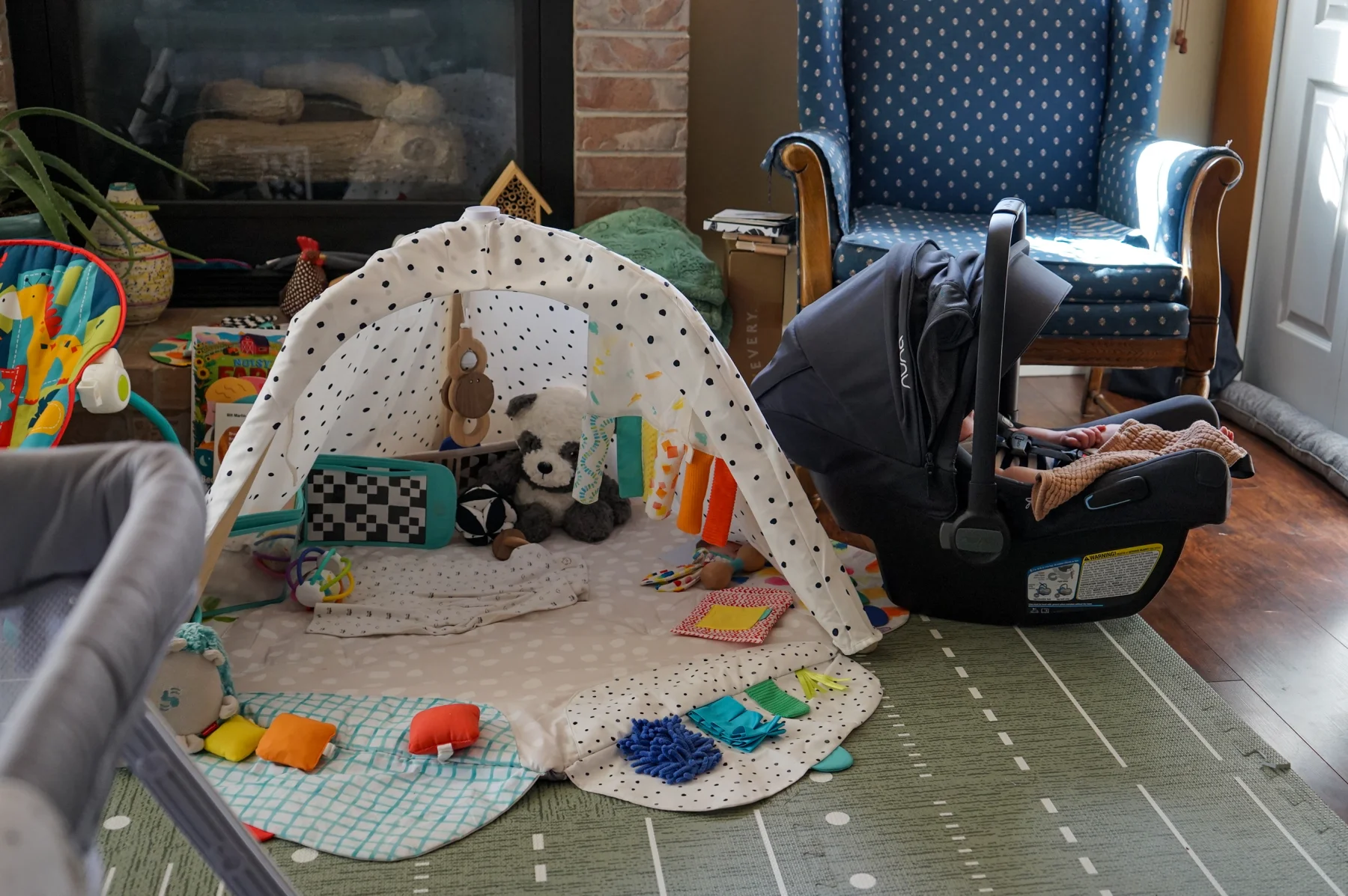
A Utah doctor and mother worries about her 4-month-old baby, sleeping here at home, who is too young to be vaccinated as measles spreads in the community.
Amy Maxmen/KFF Health News
hide caption
Amy Maxmen/KFF Health News
It would be 14 years before another significant epidemic occurred in the United States. Then, in 2015, the virus spread among unvaccinated children at Disney parks in California, giving rise to outbreaks elsewhere. Congress deemed some 125 cases an emergency and summoned Schuchat of the CDC to testify about the situation.
“Vaccination was not a partisan issue,” she recalled. “It was about solving a problem: What can we do about this?”
National television aired a video of Vivek Murthy, then the U.S. surgeon general, discussing vaccination with Elmo from Sesame Street. HHS officials have worked with vaccine experts on strategies to build public confidence in vaccines. California and Vermont have tightened their vaccine requirements.
In 2019, House and Senate committees met again on measles, as a large outbreak broke out in Orthodox Jewish communities in New York and New Jersey. Congress asked HHS leaders how the administration plans to curb the rise of vaccine misinformation online.
“Internet fraudsters who claim vaccines are unsafe prey on the unfounded fears and daily struggles of parents, and create a public health risk that is entirely preventable,” Lamar Alexander, then a Republican senator from Tennessee, said at the time.
Alex Azar, Secretary of Health in the first Trump administration, and then-CDC Director Robert Redfield held a press conference emphasizing “the importance of timely vaccination.”
And during the 2014, 2015, and 2019 outbreaks, the CDC’s MMWR published detailed articles within weeks of data collection. Timing is important since reports guide emergency responses. “The MMWR is the voice of the CDC,” Schuchat said, “alerting the nation, the media, clinicians and public health experts of events that require action.”
“The dog didn’t bark”
Just after President Donald Trump took office in 2025, a measles epidemic exploded in West Texas. In seven months, it exceeded the magnitude seen in the United States since 1992, spread to Mexico and at least three other states, sickened more than 4,500 people in both countries and killed at least 16.
Instead of delivering clear, repeated messages about the importance of measles vaccines, Kennedy falsely claimed on Fox News that they cause “deaths every year.”
Congress did not call a hearing, and HHS did not send funds until after the emergency in West Texas ended. Aside from an annual update on measles, the MMWR did not issue a single report on outbreaks that year.
“A lot of it has to do with the fact that the dog didn’t bark,” said Dorit Reiss, a vaccine policy researcher at the University of California, San Francisco. “What normally happens doesn’t happen.”
Politicians delayed or blocked several MMWR stories, according to several CDC officials whom KFF Health News agreed not to identify because they feared retaliation for speaking to the press. “The administration is deliberately working to minimize vaccine-preventable diseases,” one official said.
“Measles reports from West Texas and New Mexico were intentionally sidelined,” another agency scientist said. In April, the Washington Post reported…
Gn Health