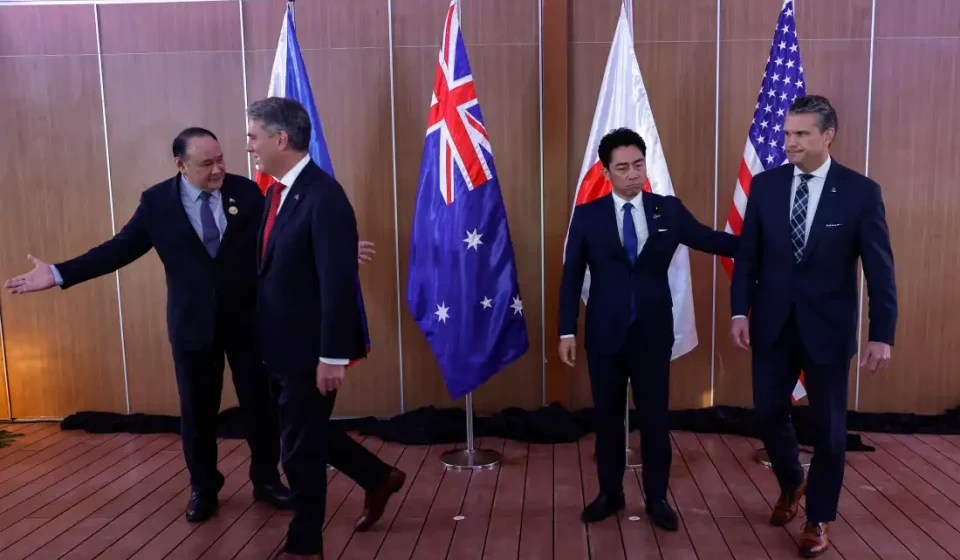
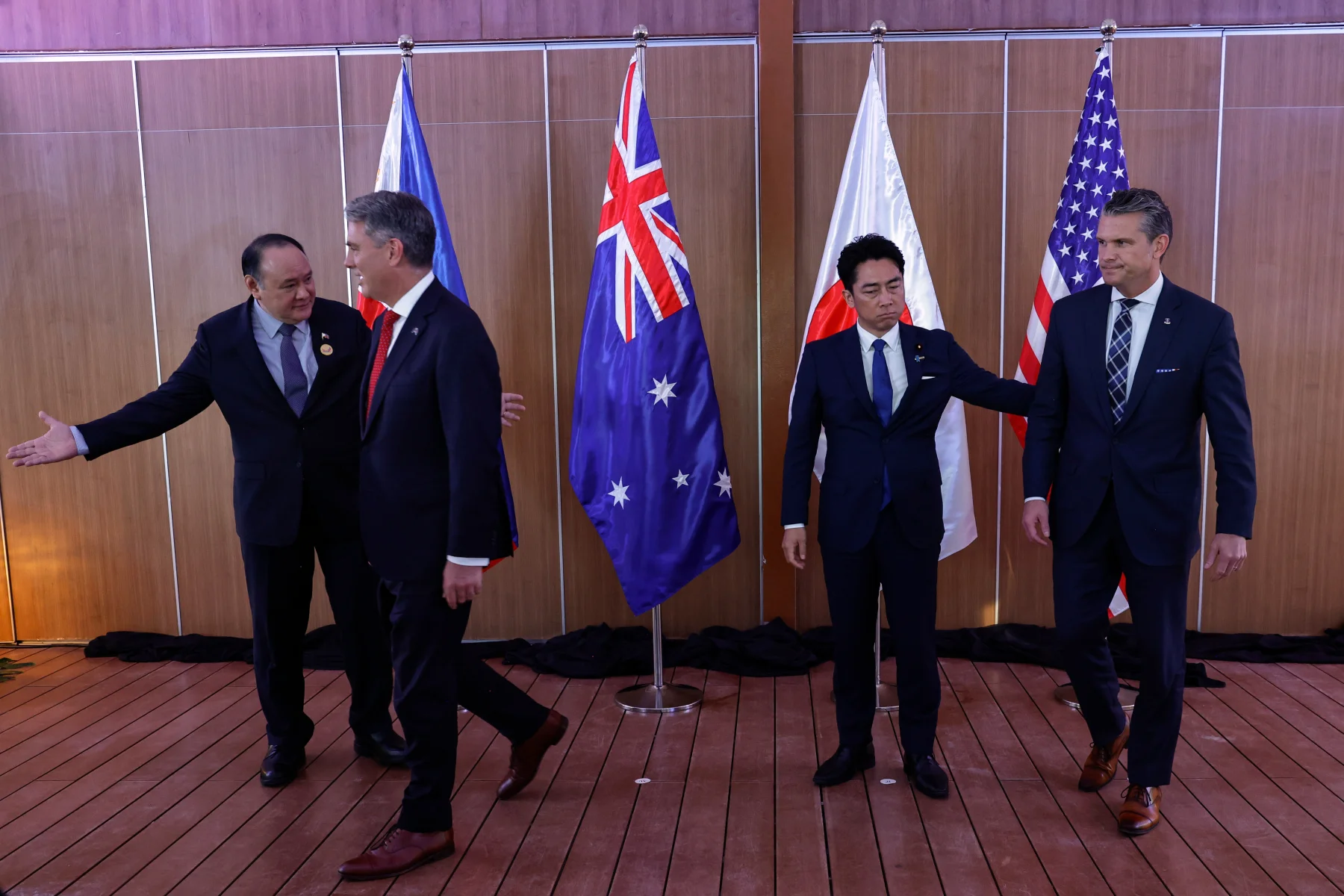
From left, Philippine Defense Secretary Gilberto Teodoro, Australian Defense Minister Richard Marles, Japanese Defense Minister Shinjiro Koizumi and U.S. Defense Secretary Pete Hegseth prepare to leave after posing for photos before holding a quadrilateral meeting on the sidelines of the 20th Association of Southeast Asian Nations (ASEAN) Defense Ministers’ Meeting (ADMM) and the 13th ADMM-Plus Meeting. in Cebu, Philippines on Wednesday, October 28, 2026.
Rolex Dela Pena/Pool EPA via AP
hide caption
Rolex Dela Pena/Pool EPA via AP
CEBU, Philippines — The United States and Japan have agreed to establish a Japanese facility for the joint production of advanced medium-range air-to-air missiles, Japan’s defense chief said.
It is the latest move by the allies, who have repeatedly expressed concern over China’s growing assertiveness in Asia.
Japanese Defense Minister Shinjiro Koizumi made the announcement at a news conference Wednesday evening in the central Philippine province of Cebu, where he met with U.S. Defense Secretary Pete Hegseth on the sidelines of an annual meeting of Southeast Asian defense chiefs and their top Asian and Western counterparts.
Koizumi renews his concern over Chinese naval activity
Koizumi on Thursday raised concerns about China’s growing naval activity in southwest Japan. He said three Chinese destroyers and a coast guard ship together crossed the Osumi Strait south of the southern main island of Kyushu and headed east toward the Pacific Ocean this week. This is the first such fleet configuration spotted by his ministry, he said.
Koizumi said he cited the incident as “an example illustrating the difficult security environment in the region” in his remarks at a session Thursday. His ministry will continue to follow Chinese activity with great interest, he said. Japan has accelerated the buildup of its military forces in southwest Japan to deter China.
The annual meetings aim to avoid major regional conflict and strengthen defense cooperation. On the sidelines of the meetings, however, the United States, China and their allies often exchanged criticism.
Japan and the United States to strengthen their joint missile production capacity
The missiles that will be produced in a joint effort called “Operation Supercharge” are essential for the F-35 fighter jets, Koizumi said. The two sides agreed to build a final assembly and inspection plant for the advanced medium-range air-to-air missile, or AMRAAM, in Japan, it said. The American-made F-35s are one of the most advanced aircraft in the world and are also used by the Japanese military.
During his brief meeting with Hegseth in Cebu, Koizumi said he “shared a sense of crisis…regarding the increasingly serious regional situation and that we agreed to strengthen the deterrence and response capabilities of the Japan-U.S. alliance with greater speed and intensity than ever before.”
“We reaffirmed the importance of a free and open international order based on the rule of law, which rejects any attempt to unilaterally alter the status quo through the use of force, coercion or other means,” Koizumi said.
Hegseth reassures American commitment in the region
Hegseth on Wednesday renewed the Trump administration’s repeated assurances of its commitment to helping deter aggression in the region during a separate meeting Wednesday with ASEAN defense ministers, led by host Philippine Defense Secretary Gilberto Teodoro Jr. Like Koizumi, Hegseth did not mention China by name in expressing security concerns in the region.
“We describe the approach we are taking as strong, calm and clear,” Hegseth told ASEAN defense chiefs. “Loud enough to deter coercion and aggression, quiet enough to avoid unnecessary escalation or public showmanship to let our actions speak for themselves.”
His message is “clear enough that our friends, partners and potential adversaries understand precisely where the United States stands and that we will defend our interests and those of our allies and partners,” Hegseth said.
Hegseth assured the Philippines, Washington’s oldest ally in Asia, that the Trump administration would build a strong deterrent against China’s increasingly aggressive actions in the disputed South China Sea. Beijing claims almost the entirety of the busy waterway, a key global trade route.
Australia shows commitment to upholding rule of law in the Pacific
Australian Defense Minister Richard Marles said his country’s forces, along with allies like the United States, would continue their efforts to defend the rule of law despite China’s growing assertiveness, particularly in the South China Sea. Australia protested last year after a Chinese J-16 fighter jet launched flares and came within 30 meters (100 feet) of an Australian P-8 Poseidon surveillance plane over disputed waters.
“It doesn’t stop us from doing what we need to do and that’s basically asserting a rules-based order here at the end of the Pacific,” Marles told The Associated Press in Cebu on Wednesday. “Freedom of navigation on the high seas is extremely important to Australia.”
The Philippines, Vietnam, Malaysia and Brunei, all ASEAN member states, as well as Taiwan, also have overlapping claims in the South China Sea. Clashes have particularly intensified between Chinese and Philippine coast guards and navy vessels in disputed shoals and peripheral waters.
Washington has warned that it is obligated to defend the Philippines if Philippine forces, ships and aircraft are targeted by armed attack, including in the South China Sea.
Beijing and Tokyo have a separate dispute over tiny Japanese-controlled islands in the East China Sea, with both sides often accusing the other of encroaching on their maritime territory.
Gn world