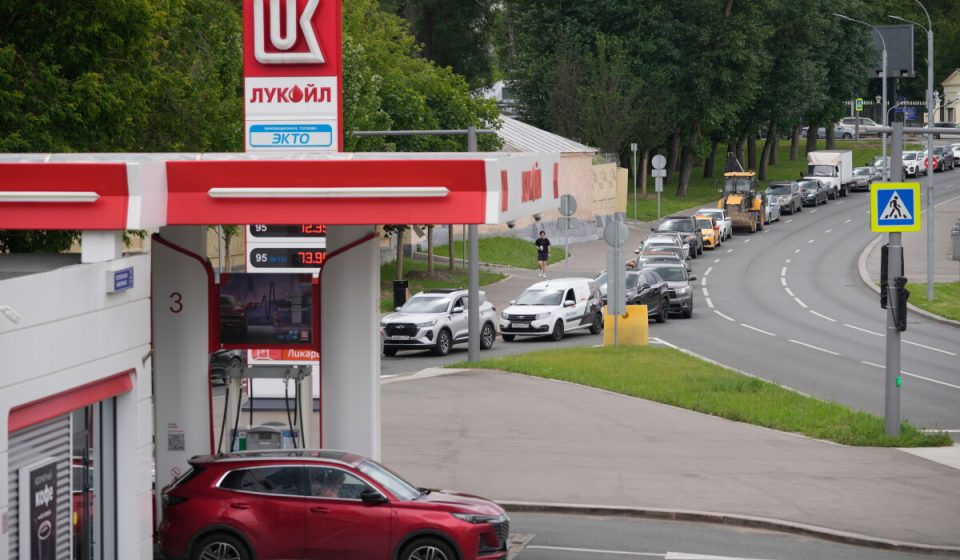
A consortium of investors including a U.S. government lender announced Friday that it has agreed to acquire the international energy assets of Russian oil company Lukoil.
The consortium, led by U.S.-based asset management firm Eldridge, includes U.S. International Development Finance Corp., a government lender, as well as Catena Investment Holding, a United Arab Emirates-based company, and New York-based investment bank Xtellus Capital Partners.
The Russian company announced earlier this year that it was considering selling its international assets to a US private equity firm. At the time, Lukoil was seeking to divest from its global portfolio in the face of the crisis. imminent US sanctions.
Under the terms of the deal, the consortium would acquire Lukoil International, which owns non-Russian energy assets, including oil and gas fields, refineries, pipelines and other infrastructure, in 11 countries. Its operations currently produce around 350,000 barrels of oil equivalent per day, the consortium said in a statement.
The consortium would exchange the restricted Russian shares of Lukoil and other Russian companies for all of Lukoil International’s cash, under the terms of the proposed deal. This would prevent the US-led consortium from making direct cash payments to Russia in exchange for the assets.
The International Development Finance Corp. would receive an equity stake on behalf of the United States. A DFC official framed the agency’s involvement in the deal as a way to protect U.S. interests and reduce the risk of competitors’ involvement. The official, who was not authorized to comment publicly and spoke on condition of anonymity, called Lukoil’s assets important to the energy security of the United States and its allies.
U.S. Rep. Gregory Meeks, a Democrat and ranking member of the House Foreign Affairs Committee, criticized the proposed deal, saying the Trump administration was circumventing Congress’ ban on the DFC from investing in Russia, which was aimed at pressuring Moscow to end its war in Ukraine.
The “DFC exists to advance the development of emerging markets, not to serve as a financial vehicle for President Trump’s wealthy and well-connected friends,” he said.
President Donald Trump has taken a series of steps in recent months to soften Moscow’s policies, including agreeing to buy Russian diesel to try to lower global energy prices, by meeting with Russian President Vladimir Putin and calling him a friendand suddenly waive new sanctions in Russia a few days before their entry into force.
The diesel deal met bipartisan opposition in Congress, where lawmakers argued that any Russian shipments would result in a ban on energy imports from Russia until 2022.
Although the Treasury Department temporarily allowed transactions in Russian diesel that would normally be subject to U.S. sanctions, two tankers originally bound for the United States changed course after state and federal officials warned port authorities, fuel distributors and banks that facilitating any shipments could result in legal consequences.
At the start of the year, Lukoil continued the sale of its international assets to the American Carlyle Group. The Treasury Department had given the company until February 28 to sell its overseas assets. Trump announced sanctions against Lukoil and Rosneft, Russia’s two largest oil companies, in October 2025 to push for a ceasefire in Russia. Russia’s war against Ukraine.
In September, Trump personally legislation signed aimed at renewing pressure on the Russian economy and disrupt financial resources fueling the war against Ukraine. But he then signed an executive order last month suspending the a new package of radical sanctions two days before an implementation deadline.
___
Didi Tang in Washington contributed reporting.
Gn bussni