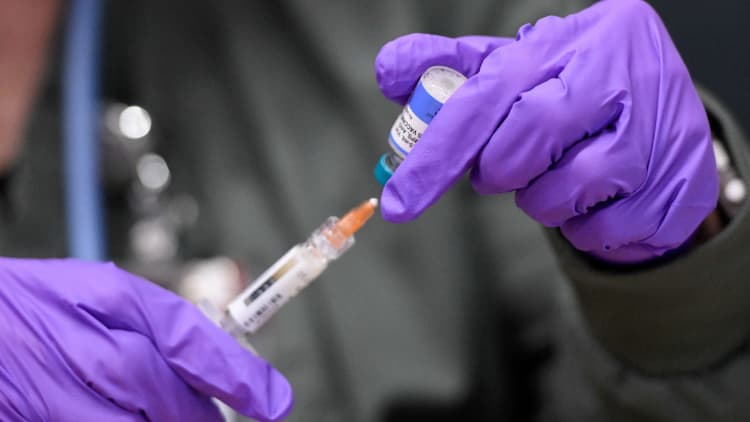

For nearly two years, the United States has had to come to terms with an uncomfortable reality: A highly contagious disease that it once eliminated is spreading again.
More than 4,400 measles cases and at least three deaths have been reported nationwide this year, marking the worst outbreak the country has seen in more than three decades. That spike follows nearly 2,300 cases in 2025. But many public health experts say the return of measles isn’t the only development problem — it’s also what the resurgence signals about America that’s causing concern.
Measles is often described as one of the most contagious viruses and is particularly unforgiving of weaknesses in public health defenses. A safe and highly effective vaccine has been available for decades.
But the spread of the virus reveals falling vaccination rates, an erosion of trust in health institutions and growing difficulties in persuading people to protect themselves, their children and their communities, experts said.
Together, these vulnerabilities have made measles a telling test of the country’s public health defenses. For some experts, the resurgence of a disease that the United States eliminated more than two decades ago is a harbinger of its ability to contain future threats, from other vaccine-preventable diseases to emerging pathogens.
“Measles is the canary in the coal mine for many different reasons,” said Jennifer Nuzzo, professor of epidemiology and director of the Pandemic Center at the Brown University School of Public Health. “It’s the canary in the coal mine for other vaccine-preventable diseases, where we could see the return of things that were harming children, but also for very acute and dangerous infectious disease emergencies without warning.”
The United States is set to lose its official measles elimination status in an upcoming review by the Pan American Health Organization, which meets in Washington, D.C., in mid-November.
“It says a lot about a country if it is unable to control measles,” said Nuzzo, who is one of 10 experts CNBC spoke with about the ongoing outbreak and its implications.
Pockets of vulnerability
A measles advisory is posted on a bulletin board outside the Gaines County Courthouse in Seminole, Texas, April 9, 2025.
Brandon Bell | Getty Images
The United States has the tools necessary to prevent the spread of measles. But pockets of low vaccination coverage make the country vulnerable.
The measles, mumps and rubella, or MMR, vaccine is about 97% effective against measles after two doses, while a single dose is 93% effective, according to the Centers for Disease Control and Prevention. Yet data aggregated by the CDC shows that vaccination coverage for this shot among kindergartners in the United States fell to 92.4% in the 2025-2026 school year, which is below the 95% threshold that public health officials generally recommend to prevent sustained transmission.
This translates to 280,000 kindergartners who have not completed their MMR vaccination series, according to the CDC. Childhood vaccination exemptions in the United States also reached a record high of 4.2% for new kindergarten students in the 2025-2026 school year, up from 3.6% the previous year, according to the agency.
“At the end of the day, not many people vaccinate their children,” Nuzzo said of Brown.
Although some cases come from international travel, much of the recent spread is due to local transmission in “too many” communities where vaccination coverage falls below 95%, she added.
Among U.S. states collecting MMR vaccine data, 67% of counties and jurisdictions now have vaccination rates below 95%, according to a September survey by NBC News.
Recent outbreaks in the United States have often occurred in “close-knit communities” where people have frequent contact and low vaccination coverage, said Dr. William Moss, a professor of epidemiology at the Johns Hopkins Bloomberg School of Public Health.
But falling vaccination rates don’t mean most Americans have turned against vaccination. Polls suggest broad support for childhood vaccines. A July KFF survey found that many Americans are in a more uncertain middle ground regarding the shots, leaving room for conflicting information to influence their decisions.
“This is not an extreme problem,” Nuzzo said, adding that the vast majority of parents continue to vaccinate their children.
Even if outbreaks are concentrated in a minority of communities, this can create a “dangerous situation” far from those areas, she said. Infants too young to be vaccinated and people who cannot be vaccinated for medical reasons may be particularly vulnerable when the virus spreads in communities with high vaccination rates.
These risks come as the Trump administration reshapes federal vaccine policy.
President Donald Trump signed an executive order in August suggesting that the combined MMR vaccine be split into separate shots, while repeating false claims about its safety. Health and Human Services Secretary Robert F. Kennedy Jr. also reshuffled a key federal advisory committee responsible for recommending childhood vaccinations, although changes are frozen amid ongoing litigation.
Several experts told CNBC that such measures risk further eroding trust in vaccines and weakening efforts to protect children.
Public health infrastructure was also “really decimated by Covid,” and the CDC in particular lost many experienced scientists and doctors “who had spent their lives working on vaccine-preventable diseases,” said Scott Weaver, a virologist and research director at Galveston National Laboratory.
He added that since September, the CDC no longer immediately includes state-reported “measles-associated” deaths in its published national tally, making it more difficult to track outbreaks in real time. The agency lists three measles-related deaths in 2026, but Pennsylvania has reported at least five deaths.
“We have federal health officials right now adding fuel to the fire, and that’s not helping the situation,” said Jess Steier, a public health scientist and founder and CEO of Unbiased Science, an organization that aims to make complex scientific concepts understandable.
Consequences beyond current epidemics
A medical assistant draws a measles, mumps and rubella vaccine to administer to a young person at the pediatric office of Dr. Gary M. Kramer in Coral Gables, Florida, August 13, 2026.
Joe Raedle | Getty Images
If the United States fails to significantly improve its vaccination rates, the resurgence of measles could extend beyond ongoing outbreaks.
At “current” state-level vaccination rates, measles could become endemic in the United States again, resulting in an estimated 851,300 cases over 25 years, according to a large-scale epidemiological model published in JAMA in April 2025 by researchers at Stanford and other institutions. In this scenario, the model predicts that measles cases could lead to 170,200 hospitalizations and 2,550 deaths during this period.
The model, which simulates the spread of infectious diseases in the United States at different levels of childhood vaccination, relies on vaccination data from 2004 to 2023 for this base case scenario. The model assumes that diseases are introduced by a person who travels abroad and brings back, most often an unvaccinated U.S. citizen.
Although many people are currently immune through vaccination, outbreaks may increase in size and frequency if vaccination rates decline over a longer period of time.
Michael Osterholm, an epidemiologist and director of the Center for Infectious Disease Research and Policy at the University of Minnesota, said he views the measles situation in Canada as a direct warning to the United States.
Canada lost its official measles elimination status in November after a multiprovincial outbreak that generated more than 5,400 cases in 10 jurisdictions in 2025. Canada has a population of more than 40 million.
“We have a population of 350 million. If you extrapolate, if we had the exact same experience as Canada over the next two years, that would be up to 50,000 cases of measles in the United States,” Osterholm said. “I think that’s a potential future that we need to be aware of.”
Other vaccine-preventable diseases
An even larger measles outbreak isn’t the only potential problem.
Vaccination coverage for other childhood illnesses has also declined. The share of U.S. kindergartners vaccinated against polio fell to 92.4% in the 2025-2026 school year, while coverage for diphtheria, tetanus and acellular pertussis, or DTaP, dropped to 92%, according to CDC data.
The United States has already seen a sharp increase in whooping cough. Reported cases in the United States will reach about 43,300 in 2024 and nearly 28,000 in 2025, a substantial increase from pandemic-era levels, according to the CDC. Brown’s Nuzzo said the resurgence reflects, in part, fewer people being vaccinated and the fact that protection against whooping cough wanes over time.
The simulation model published in JAMA also examined how declining childhood vaccination rates could affect the future spread of several diseases previously eliminated from the United States thanks to vaccines. With current vaccination levels, researchers have found that diseases such as rubella and polio are unlikely to become endemic in the United States.
But in a hypothetical scenario in which childhood vaccination rates drop by 50%, the model predicted 9.9 million cases of rubella, 4.3 million cases of polio and 197 cases of diphtheria over 25 years.
Rubella can cause devastating complications when an infection during pregnancy passes to the developing fetus, while polio can cause paralysis and death, said Dr. Nathan Lo, assistant professor of infectious diseases at Stanford Medicine.
The projections do not predict that these outbreaks will occur, but they illustrate the scale of risks that could increase if vaccination coverage deteriorates.
“What vaccines often give you is not only protection, but also less uncertainty,” said Mathew Kiang, assistant professor of epidemiology and population health at Stanford Medicine…
Gn Health