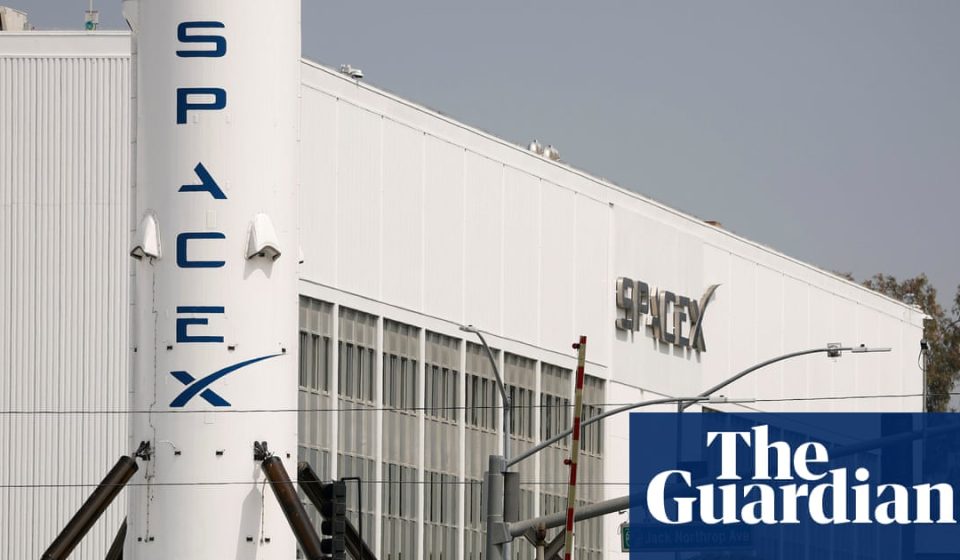

The U.S. military has given Elon Musk’s SpaceX access to restricted space tracking data, raising a new set of questions about whether the Trump administration is trying to hand control of traffic in Earth’s orbit to a controversial donor.
This access also raises new national security questions, industry observers say.
The move comes after Musk’s Doge laid off numerous staffers from the federal government’s nascent space traffic control program in 2025, and the administration twice attempted to financially gut the department, called the Traffic Coordination System for Space (Traccs).
The moves were widely seen in the industry as an attempt by Musk to privatize space traffic control. The Department of Defense has now granted SpaceX access to its most precise data on potential collisions between satellites and other space objects, which will give Elon Musk’s companies an edge over competition that offers a similar service.
SpaceX and the Space Force signed the new contract. The U.S. commercial space market is expected to reach a value of nearly $2 trillion over the next decade, and the unprecedented access to military data appears to be another step toward Musk’s assertion of monopolistic control over commercial space activity more broadly, said Cole Donovan, a former Traccs employee who now works for the nonprofit Stand Up for Science.
“This makes one company the de facto source for coordinating space traffic in the United States,” Donovan added. “It’s like giving a trucking company control of all the traffic lights, that they can turn red whenever it’s their competitors’ turn to go.”
Traccs manages thousands of satellites, debris and spacecraft and helps prevent up to 50,000 near-misses, called conjunctions, daily.
SpaceX and Space Force did not respond to the Guardian’s requests for comment, but in a statement to Breaking Defense they acknowledged the decision.
“The Space Force engages with multiple companies to exchange commercial data sources to access sections of the catalog of high-precision controlled and unclassified information, where it benefits the U.S. government,” a spokesperson told the outlet.
SpaceX has expanded its power over launches and other space services, while deepening its ties with the U.S. government. Many industry observers have said since the Trump administration took office that they fear a “supplier lock-in” scenario in which the government becomes too dependent on SpaceX because of its immense influence and advanced technology.
The first Trump administration created Traccs to regain control of commercial space traffic from the Department of Defense. But Traccs was never fully funded or staffed and struggled to gain a foothold. The military’s latest move comes at a crossroads for Traccs, as the administration, Congress and industry debate how to move forward.
In fiscal year 2026, the administration attempted to largely cut funding for the $65 million program during the budget process, but Congress reinserted the funding. The administration again proposed cutting the budget to near zero for fiscal year 2027, but the House reinserted the funding again.
Several employees of commercial space companies have told the Guardian since early 2025 that there is broad support in the industry for Traccs because it would level the playing field. But the administration’s apparent move to privatize and consolidate power with a Trump ally is consistent with its broader approach to governance, Donovan said.
However, a former National Oceanic and Atmospheric Administration (Noaa) official, who spoke on condition of anonymity, said SpaceX has largely been “remarkably responsive to space security issues” and that they don’t blame Starlink for entering space that the government has failed to adequately address.
“My greatest disappointment lies in the government’s failure to fulfill its responsibility to establish a coherent space governance framework that provides guidance, transparency and a level playing field for all operators,” the official said.
Musk’s growing empire in lower Earth orbit includes a massive constellation of satellites owned by Starlink, a broadband internet company that is a subsidiary of SpaceX. It operates around 11,000 satellites in orbit and could have up to 20,000 in the coming years.
For the first time, the Space Force has given a commercial company “enhanced” access to US Space Command’s most detailed and secure version of its High Precision Catalog (Hac) of objects in orbit.
This includes vector covariance messages (VCM) consisting of tracking data collected by military sensors, telescopes, and ground-based radars that track the trajectories of satellites and other lower-orbiting space objects smaller than about 10 cm (3.93 inches). The military uses radar and data extensively to monitor the positions of other countries’ satellites, but they are also used to track spacecraft and commercial objects to avoid collisions.
The latter is part of a responsibility the Army no longer wants and was supposed to be transferred to Traccs, Donovan said. Instead, SpaceX gained access to the data.
VCM data is valuable to Starlink because the company uses its own “Stargaze” system to track other satellites and space objects. Stargaze is made up of thousands of cameras and radars mounted on Starlink satellites. It can only see objects up to about half a meter and is not as accurate as the military system.
“Military radar data is an extremely valuable tool to complement Stargaze,” Breaking Defense cited a SpaceX employee as saying at an industry conference.
The government gets something in exchange for the data: access to Stargaze cameras and sensors. “The more observations and data the Army has, the better,” Donovan said.
However, VCM data is designated “unclassified controlled information” and has been closely guarded by the military because it could reveal the limits of defense capabilities. The Defense Department also wanted to prevent reverse engineering of satellite sensors it uses to monitor other countries’ defense satellites, observers say.
In terms of ethical conflicts, access is another example of the Trump administration rewarding a donor with business opportunities with the federal government, said Craig Holman, a Capitol Hill lobbyist for Public Citizen, a government accountability nonprofit.
“Elon Musk earned President Trump’s favor and, with it, unlimited wealth and lucrative government contracts in the space industry,” Holman added. “(His) political investment is paying off very, very handsomely – as expected.”
Gn bussni