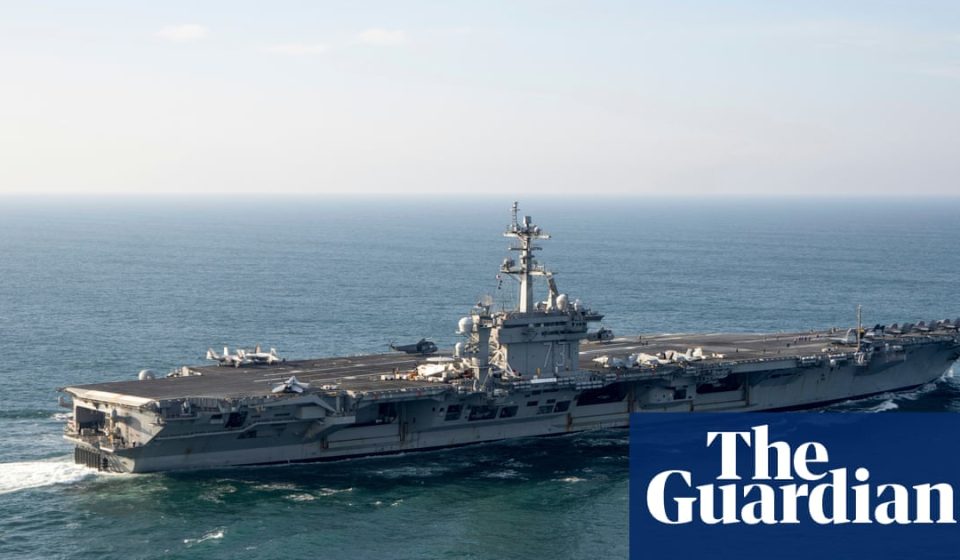
US pursuit of ‘Trump-class’ warships has driven up cost of new fleet by billions, report warns American military

The US Navy’s commitment to the new Trump-class battleships has caused the cost of its new fleet to explode by billions of dollars, according to a report submitted to the US Congress, with the acting Navy secretary acknowledging this week that the war in Iran was “stretching” the fleet’s capacity.
The challenges facing the world’s largest naval force were highlighted this week, when the return of the USS George Washington from the Middle East on Wednesday ended a rare three-month stretch in which the United States had no aircraft carriers in the entire Pacific. Deployments regularly last beyond 300 days, with ship maintenance and repairs deferred so they can stay at sea longer.
Outpaced by China in shipbuilding, the US Navy wants to increase its fleet from 286 combat ships to 381 over the next 30 years.
But the Congressional Budget Office’s analysis of the Navy’s 2027 shipbuilding plan says the Navy’s projections underestimated the costs of its new fleet by billions because the designs of some ships proved more complicated than expected, and “the estimated costs of some ships were unrealistic in previous shipbuilding plans.”
The total cost of shipbuilding would average $54 billion per year (in 2026 dollars) over the next 30 years, according to the CBO, about 18 percent higher than the Navy’s estimates.
“Much of the additional costs in the 2027 plan come from the Navy’s decision to purchase 15 large, heavily armed battleships, which would concentrate firepower on a few large ships and thus be at odds with the Navy’s stated goal of spreading it among a larger number of ships or vessels.”
The 15 new battleships are the proposed “Trump-class” warships, which the president says will be 100 times more powerful than any previous warship in the U.S. fleet and will “instill fear in America’s enemies everywhere.” Senate leaders this week proposed cutting to zero the $1 billion the Navy requested for advance purchases this fiscal year for the Trump-class ships.
Acting Navy Secretary Hung Cao acknowledged before a Senate confirmation hearing Wednesday that the war in Iran was “stretching” the fleet’s capacity.
“This war, again, I know it’s putting a strain on our Navy,” he told senators.
His tenure as acting secretary – he requires a special waiver to be permanently appointed due to his recent active duty – has been criticized by Democratic senators. “The world is less safe because of the war in Iran,” Richard Blumenthal told Cao.
“We have seen costs skyrocket, lives lost, casualties. Our relationships with our allies are deteriorating because of this war. In fact, the Navy has been strained beyond sustainable limits under your leadership, and the fleet is in worse shape than it was when you took office under this president.”
The conflict in Iran is estimated to have cost the United States $260 billion, Michigan Sen. Elissa Slotkin said at the committee hearing.
“Yet we do not have the same freedom of navigation as a year ago.”
Despite all the efforts and resources deployed by the world’s most powerful maritime navy to keep the Strait of Hormuz open, passage through the disputed waters remains barely more than a third of pre-war levels.
Shipping traffic remains around 65% below the rate before the launch of US and Israeli strikes against Iran on February 28, according to the latest weekly report of the UK’s maritime trade operations.
A year ago, the cost of insuring a commercial ship for a single passage through the Strait of Hormuz was $54,000, Cao told the Senate: “Today, it costs $64 million just to cross. »
The additional cost of each passage is borne by consumers around the world, in the form of higher prices for fuel, fertilizer and food.
U.S. Navy ships are also on increasingly longer deployments. Since the start of the war in Iran, ships have been deployed for 10 to 11 months, well beyond the usual seven months, and sailors have been told to expect extended deployments to remain the norm for several years.
Several ships have spent more than 300 days on deployment since the start of the war. The USS Abraham Lincoln spent 265 days at sea, the longest time a Navy ship has spent without visiting a port.
Asked about a “mental health crisis” aboard the Lincoln, Cao insisted that the eight suicide attempts reported on board were instead “suicide mitigation measures.”
He dismissed concerns that sailors aboard U.S. ships were going hungry. In response to testimony before the Senate committee that one sailor reported losing 45 pounds (20.4 kg) in six months of deployment “because of a lack of food,” Cao attributed this to restlessness, likening it to “my kids opening the refrigerator door and saying, There’s nothing to eat here.”
For only the second time in two decades, the US Navy did not have an aircraft carrier group in the Pacific between August and November. Washington has regained control of the US Pacific Fleet “conducting routine operations” in the Asia-Pacific region.
Professor Kevin Rowlands, editor of the Royal United Services Institute, told the Guardian the “surge” facing the US Navy was “critical but manageable – for now”.
He said: “The real problems will arise later if the war continues. Any prolonged deployment will have consequences for maintenance and people in the future.”
Naval planners work under a broad “rule of three”: To have a single platform permanently available for deployment, a navy needs three.
“When one ship is deployed, another is preparing and training to replace it, and another is under maintenance, just recovering back. Indeed, it takes at least three to keep one permanently on station. So when something ‘new’ comes along, like the war with Iran, it affects planning and allocation everywhere else.”
The United States has enjoyed unparalleled naval pre-eminence for decades, capable of projecting power across the globe. But China is quickly catching up. US naval intelligence estimates that China’s overall shipbuilding capacity is approximately 232 times that of the United States. Chinese shipyards delivered more than twice as much naval tonnage as U.S. yards in 2024 and 2025, according to the World Defense Shipbuilding report.
U.S. allies, like nations in the First Island Chain off the Chinese mainland, and Pacific allies like Australia “will always want U.S. ships available in their region.”
“But, in return, the United States would like its allies to share some of the burden it currently carries…the projection of naval power becomes a diplomatic negotiation, especially when the United States views the world through a transactional lens. »
“With Aukus, and the commitments to the Indo-Pacific, and the commitments to NATO, and now the Middle East, the United States can just about get by, but there is no capacity available. That’s why one thing that goes wrong has a negative impact everywhere. That is, in essence, overexploitation.”
Gn headline