US Trade Representative Greer says India deal not ‘imminent’ after Modi-Trump call

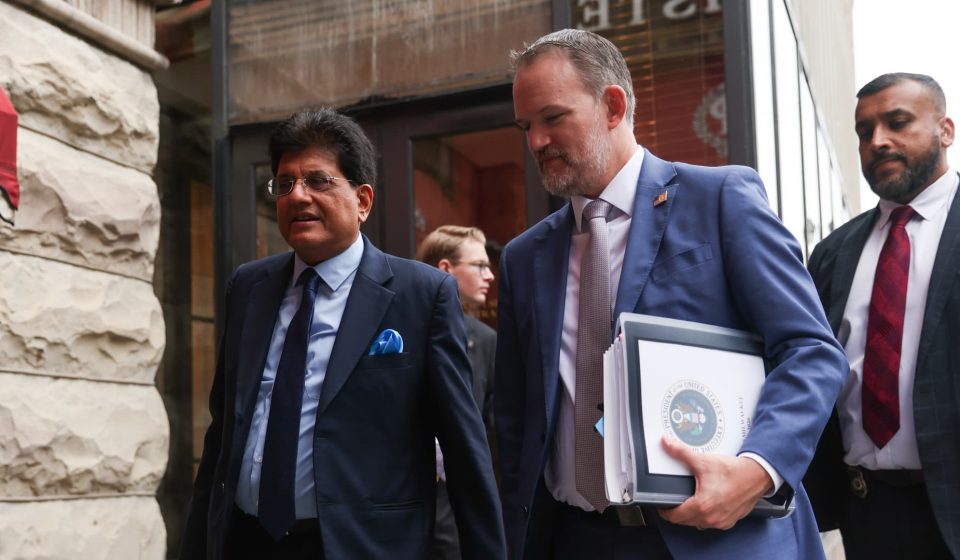
Piyush Goyal, Indian Minister of Trade and Industry, left, and Jamieson Greer, U.S. Trade Representative, after a tour of Rockwell Automation during the G-20 Trade Ministerial in Milwaukee, Wisconsin, United States, Wednesday, September 30, 2026.
Bloomberg | Bloomberg | Getty Images
U.S. Trade Representative Jamieson Greer signaled Thursday that a deal with India is off the agenda, as Washington and New Delhi continue to discuss details of a highly anticipated deal.
“I don’t think there’s anything imminent,” Greer said in response to a question from Indian news agency ANI, adding that “we’ve really identified the universe of points that are friction points.”
His comments come just a day after U.S. President Donald Trump’s phone call with Indian Prime Minister Narendra Modi, a call Greer called “very constructive.” He also held bilateral meetings with Indian Commerce Minister Piyush Goyal, who is in the United States to negotiate the trade deal and to attend the G20 trade ministers meeting in Milwaukee.
Goyal, in a social media post, seemed more optimistic about the negotiations, emphasizing that discussions with Greer were about “early conclusion of a mutually beneficial interim agreement under the India-US bilateral trade agreement.”
“Goyal counts the issues that have already been resolved, and Greer counts the issues that remain,” Ronak D. Desai, a visiting scholar at Stanford’s Hoover Institution, told CNBC, adding that the final issues in any trade deal are the hardest.
For Washington, India’s continued purchases of Russian oil remain a major sticking point, while for New Delhi the priority is protecting politically important parts of the agricultural sector and the preferential tariffs that give it an edge over its peers, experts say.
Red lines of negotiation
On Wednesday, Modi said his conversation with Trump was “productive,” and the two leaders not only reviewed bilateral trade, defense, energy and critical technologies, but also discussed “ongoing efforts to advance global peace and security.”
While the war in Iran threatens India’s energy security, pushing it to increase its dependence on Russian oil, the American administration believes that New Delhi’s purchase of barrels from Moscow is financing the war in Ukraine.
Relations between the United States and India have been tense for more than a year, and New Delhi faces a new risk of seeing Washington impose tariffs of up to 100% to continue buying Russian oil.
That could derail trade talks, in which India is seeking preferential tariffs from the United States that would make its exports to Washington more competitive.
The United States imposed punitive 25% tariffs on India last August for the purchase of Russian oil, increasing tariffs on imports from New Delhi to 50%. In February, tariffs were reduced to 18 percent, with Trump saying India had “agreed to stop buying Russian oil and buy significantly more from the United States and, potentially, Venezuela.”
New Delhi did not approve of the details shared by Trump and maintained that ensuring energy security was the sole driver of its purchases.
Since the start of the year, the United States and Venezuela have become important in India’s energy basket, but given global supply constraints due to the war in Iran, India cannot refuse supplies from Moscow.
“We may also be reaching the limits of trade complementarities between the two countries under the current circumstances,” Arpit Chaturvedi, South Asia advisor at strategic consulting firm Teneo, told CNBC.
Neither side currently seems able to accommodate the other, nor are they able to simply agree to disagree and reach an agreement around those differences, he said.
Currently, Indian exports to the United States are subject to a 10% tariff, following the conclusion of the USTR’s investigation into forced labor acts, policies and practices in 60 countries.
According to the Indian government, a substantial portion of the country’s exports to the United States, such as generic pharmaceuticals and smartphones, remain outside the scope of the 10% duty.
Gn headline