
The University of Texas at Austin will have a new academic college to oversee its recently announced new core curriculum, which sets the required core courses that all undergraduates must take.
UT President Jim Davis announced Wednesday during his State of the University address that government professor Devin Stauffer has been named dean of the new college. Stauffer led the 22-member faculty task force that reviewed the courses and recommended details for the new core curriculum, which is expected to become mandatory by 2028.
“I hope that this Common Core can be some sort of model for core programs across the country,” Stauffer said. “What I really hope is that faculty and students will feel that UT takes this part of undergraduate education more seriously than ever before.”
The new college will house the Humanities Center, which quietly opened this fall to focus on core curriculum. The university has given little information about why the center was created or how it will interact with the existing Humanities Institute in the College of Liberal Arts. Stauffer said the new core requirements focus on the humanities and the Humanities Center will help carry the load of teaching those courses.
The old core curriculum now had more than 1,000 courses. Stauffer said the new one will have far fewer. A report with recommendations from the task force, released in August, said the previous core was a “set of random boxes to check” and not a body of knowledge “that educated human beings should know.”
Many courses were not on the new list, including courses on Gender and Sexuality Studies, “Slavery and Its Legacies,” “LGBTQ Literature/Culture,” and “Introduction to African American Women’s History.” The changes have been criticized by some professors who say the new core curriculum limits intellectual diversity and focuses on content rather than skills.
Stauffer said all perspectives are welcome, but some restrictions had to be put in place to create a more cohesive program.
“Part of the reason for this is that we thought the principle of the professor choosing to teach what they want based on their narrow research interests had gone too far,” he said. “So we’ve tried to get a handle on that, but we’re not trying to exclude any perspective from it.”
The changes also included reducing the number of credit hours required for the core curriculum from 42 to 36 and reducing classes to three categories: arts and humanities, social sciences and STEM. By law, Texas state universities must have a core curriculum of at least 42 semester credit hours. Stauffer said the Texas Higher Education Coordinating Council is currently redoing the requirements of state law.
“So one of the bureaucratic complexities right now is coordinating our transition with their transition, and that’s why we’re trying to do it,” he said. “This problem will be resolved, but it will probably take two or three years.”
Courses in the new program will begin to be available in fall 2027 from existing faculty. The new core curriculum has not yet been approved by the UT System Board of Regents and the Texas Higher Education Coordinating Council.
Stauffer said it has yet to be determined where the new college will be located or how big it will be. He said as UT rolls out its new core curriculum, University College will work with other colleges to teach those courses and hire accordingly to fill the gaps. He said they currently have 1,200 applications to teach the core courses.
Clearing institutional knowledge
University officials have been criticized by students and faculty for a lack of transparency. Since Davis took office, the flagship campus has consolidated departments, created the School of Civic Leadership, eliminated majors and appointed new deans, all without input from faculty and students.
Now, with the creation of the new college, some professors say the new college is duplicating something that already existed.
The college that once oversaw the core curriculum, the School of Undergraduate Studies, was quietly folded into the provost’s office in 2025. Some faculty worry that creating a new college doing the same thing as the previous one could result in a loss of institutional knowledge and memory.
Pauline Strong, a professor of Native American studies and a member of the American Association of University Professors, said the university’s history is being erased.
“Creating University College is about restoring something that has ended. But of course when that ended, many, many staff members lost their jobs, people with years of experience in undergraduate teaching,” Strong said. “So this is a complete replacement of a college with a new college. »
In a written statement, the AAUP said Wednesday that the new core curriculum focuses on Western civilization, poorly preparing students for an increasingly globalized world of work. The group said duplicating a college that already existed was “inefficient, unnecessary and another example of poor management”.
The association also said that appointing Stauffer as dean without any public search process or consultation with the UT community is disrespectful of faculty expertise. University leaders appointed at least five deans this year without faculty input.
Stauffer said that because he was the head of the new curriculum task force, his appointment was “an extension” of his work.
Davis has repeatedly said UT officials are making changes to ensure a “balanced learning experience” for all students.
Demonstration of students and teachers
During his speech Wednesday, Davis said UT Austin is a “first-class” university with an unprecedented number of applicants and students. He said the university has more financial support than ever from donors and research funding is on track to reach $1.5 billion this year.
Davis did not address changes that have impacted students, such as the consolidation of majors, or recent hate speech rhetoric by a guest speaker on campus and by politicians. In September, railroad commissioner candidate Bo French posted a photo of South Asian students saying “the problem is now obviously much worse than anyone imagined.” Earlier this month, far-right podcaster Myron Gaines made racist and misogynistic remarks during a visit to campus.

Lorianne Willett
/
KUT News
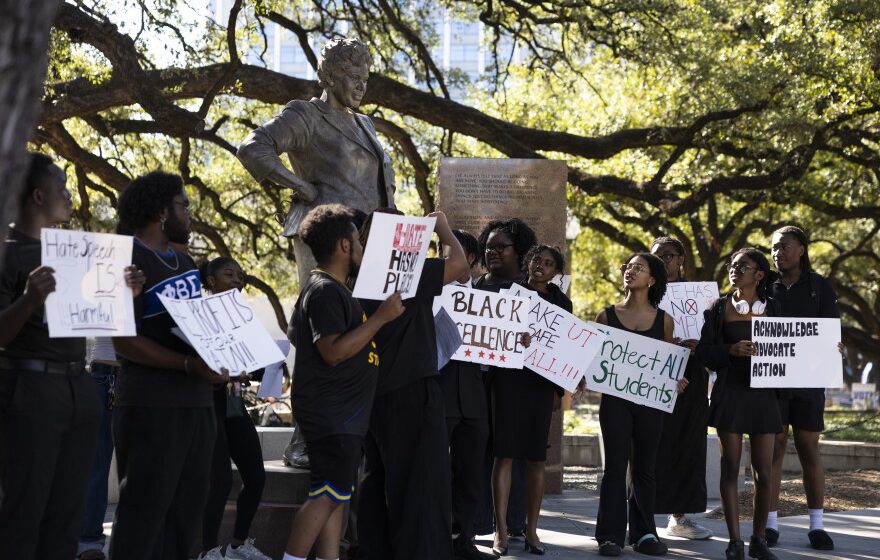
After Davis’ speech, the Black UT student coalition Not Our Texas held a protest outside Hogg Memorial Auditorium. Students said they were disappointed that, although free speech is legal, UT officials have failed to protect all of the university’s students. They said they wish Davis would have acknowledged the problems they face.
“By not recognizing that this is a problem on campus, you’re allowing this to continue. And it’s not addressing direct racism,” said Nealah Ferris, a physics and space science major. “It ignores the everyday facts that this is something they allowed on campus. And they let this turn into a big deal. And they’re not doing anything about it.”
Ferris wondered how UT research benefits minority students. She said Black, South Asian and Hispanic students were left to fend for themselves after the university dismantled resources specifically for them in compliance with SB17, which banned diversity, equity and inclusion programs at public universities.
“I think all of this has trickled down to student vulnerability, and we should never have to walk around a campus not knowing who is going to protect us,” Ferris said.
To comply with new state laws, since 2024, UT has disbanded faculty advisory bodies, limited “controversial topics” in the classroom, and made it easier for presidents to eliminate programs and eliminate positions within those programs without faculty input.
Faculty and students from consolidated departments and majors have also held 15-minute protests in front of the UT Tower every day for the past month. They march in silence with signs reading “We Mourn the Loss of American Studies” and “Join Us and March Against Censorship.”
Editor’s Note: KUT journalists are employees of the University of Texas. Editorial decisions are made independently by the KUT editorial staff. University leaders do not review or approve media coverage of KUT.
Gn headline