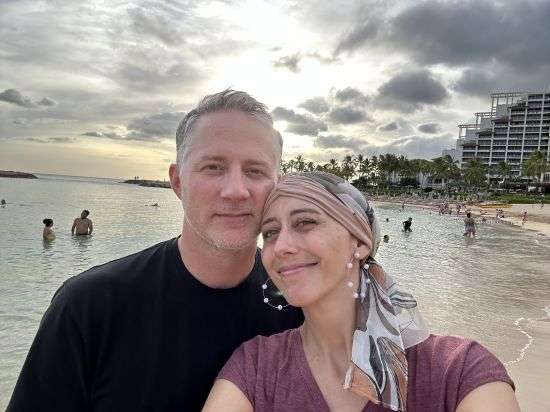

SALT LAKE CITY — Dani Kurtz was a few weeks away from her scheduled mammogram when she noticed something.
“I discovered a lump in my right armpit,” she said of the January 2025 discovery. Her mammogram came back normal, but the lump still worried her.
“Women who have dense tissue are often told that a mammogram may not detect tumors there,” she said.
Dense breast tissue can make cancer harder to detect on a mammogram, because dense tissue and tumors appear white on the scan.
Kurtz’s mother had also recently been diagnosed with breast cancer. Additional tests, including an ultrasound and MRI, revealed seven tumors in both breasts.
A biopsy confirmed the diagnosis.
“That’s the day I heard those words: ‘You have cancer,’” Kurtz said.

Kurtz, a former labor and delivery nurse at Intermountain Healthcare’s Utah Valley Hospital who now works in human resources for the health system, found herself on the other side of patient care. She underwent a bilateral mastectomy, followed by 16 cycles of chemotherapy and radiotherapy, completing treatment in late 2025.
“It came to an end – there was a day where I didn’t think it would happen, but it did,” she said.
Today, she encourages other women to take time for their own health.
“As women, mothers and wives, we often focus our energy on taking care of everyone else. And sometimes we neglect ourselves,” she said. “In addition to getting mammograms and other exams, it’s just important to know our bodies.”
For Kurtz, that means speaking up when something seems different.
“Talk with your doctor, and they will ask more questions and decide if anything needs to be looked at,” she said.
“Mammography saves lives. We see it every day,” said Dr. Jonathan Shakespear, medical director of Intermountain Medical Center’s Breast Care Center.

He said busy schedules can often prevent women from getting tested.
About 63.8 percent of Utah women age 40 or older have had a mammogram in the past two years, according to the Utah Department of Health and Human Services.
The state aims to increase breast cancer screening to 81% by 2030.
“We can’t predict who it’s going to happen to. We can’t predict when it’s going to happen. All we can do is hope to find out when it’s early and easy to treat,” Shakespear said. “Some women feel a little sheepish if it’s been a few years before they have a mammogram. It’s better to have mammograms infrequently than not to have mammograms at all.”
Intermountain Health has introduced an online scheduling tool that allows women to compare available appointments for screening mammograms at nearby facilities and book online.
Shakespear said the tool could help women find an appointment sooner by looking beyond their usual location.
“We want to make getting a mammogram as convenient as possible,” he said. “There might be a two-week wait at one location, and they might turn to another location and be able to arrive the next day.”
Women can access the scheduling portal through the mammography section of the Intermountain website.

For Kurtz, life after treatment opens up from a different perspective.
“We have a saying in our family that we can become bitter or better because of what we go through,” she said. “And in this new normal, I just want to make sure that I’m getting better and appreciating what we have, and looking at life with a new lens of gratitude, not for what isn’t, but for what is.”
The key takeaways from this article were generated with the help of large language models and reviewed by our editorial team. The article itself is solely written by humans.
Gn Health