
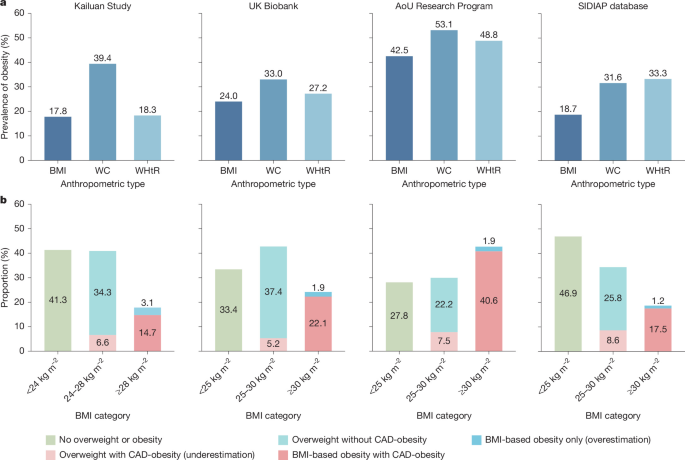
To our knowledge, this is the first large-scale multinational study comprehensively assessing the Lancet Commission diagnostic framework1 against the widely used classification based on BMI. Previous studies have examined individual components of the framework, such as expanded anthropometric criteria or estimates of clinical obesity prevalence, but have lacked integrated assessment or longitudinal follow-up.12,13,14,15,16. This study evaluated several interrelated elements of the new diagnostic framework: the implications of using combined anthropometric criteria to confirm obesity; their effects on prevalence and risk stratification compared to BMI alone; the importance of selecting appropriate anthropometric thresholds; and the prognostic implications of distinguishing clinical from preclinical obesity.
Regarding anthropometric classification, our results show that BMI alone both identifies obesity and does not reliably distinguish individuals at increased mortality risk. These findings support the Commission framework’s use of complementary anthropometric measures alongside BMI to improve obesity classification and risk stratification. Although WC and WHtR are, like BMI, indirect measures of adiposity, increased values for these measures are (for anatomical and physiological reasons) more likely to reflect an expansion of fat mass, whereas a higher BMI could also reflect greater lean mass. Their correlation with direct measurements of body composition10 supports their use as a pragmatic means of detecting excess adiposity where direct measurement is not practical. Future studies should determine whether direct fat measurement adds significant accuracy and could ultimately replace combined anthropometry if reliable bedside technologies become widely available.
We observed substantial discordance between BMI-based classification and coronary obesity, with BMI overestimating obesity in 1.2–3.1% and underestimating it in 5.2–8.6% of participants across all cohorts. Compared to 2025 national obesity estimates World Atlas of Obesity17These proportions suggest that BMI misclassification affects tens of millions of individuals in countries with large populations, highlighting the potential public health implications of seemingly modest differences in classification.
However, the effects of using a combined anthropometric definition of obesity depend critically on how the Commission’s recommendations are implemented. Contrary to our results, previous studies on American cohorts have shown that application of the method Lancet The Commission’s framework has significantly increased the overall prevalence of obesity12,13,14,15,16. These discrepancies mainly reflect methodological differences, including the choice of anthropometric thresholds and incomplete adherence to the framework’s recommendations. In a study14the higher prevalence estimates were driven by the use of a single low WHtR threshold of 0.50 across all populations, potentially classifying individuals with milder increases in adiposity and associated risk as having obesity. Another study16 reported an overall obesity prevalence of 60% in the AoU cohort, compared to 48.1% in our analysis. In addition to using a single WHtR threshold of 0.50, the study applied the threshold across the entire BMI range, including individuals with normal BMI. This approach departs from the Commission’s recommendation that anthropometric confirmation should be used primarily in individuals with BMI values below but close to the BMI obesity threshold.1. Applying anthropometric criteria outside of this context risks classifying individuals with normal body weight and localized abdominal adiposity – such as those with lipodystrophy or related conditions, which are biologically and clinically distinct – as suffering from obesity. It is for this reason that the Commission selected the BMI as the initial selection tool.1and we limited the assessment of obesity to participants within the conventional ranges of overweight and obesity defined by BMI.
In closer compliance with the Commission’s guidance, we applied ethnicity-specific obesity thresholds for WC and WHtR. In our data, the conventional WHtR threshold of 0.50 corresponded approximately to the BMI-defined overweight threshold, whereas WHtR values corresponding to the BMI-defined obesity threshold and increasing mortality risk were generally observed around or above 0.55. This convergence between anthropometric and mortality analyzes supports the use of higher WHtR thresholds for obesity classification and is consistent with the previously proposed threshold of 0.55 to 0.59 (ref. 10). Further prospective evaluation will be necessary to refine population-specific thresholds.
Applying obesity cutoffs for WC and WHtR further illustrates the limitations of BMI-based classification. Although these measures remain proxy indicators of body fat, the reclassified groups had distinct mortality profiles, showing that conventional BMI categories encompass individuals at heterogeneous risk and that additional measures provide clinically relevant stratification beyond BMI alone. This is particularly significant for the overweight category. THE Lancet The Commission’s framework intentionally does not retain overweight as a distinct category of intermediate risk; instead, it expands the definition of obesity to people with a BMI classified as overweight who meet additional anthropometric criteria indicating obesity-level adiposity. Our data support this approach: individuals with a BMI in the overweight range who met the criteria for CAD-obesity had a comparable mortality risk to individuals with a BMI in the obese range who also met the criteria for CAD-obesity. In contrast, people with a BMI classified as overweight and not meeting criteria for coronary obesity had no excess risk and, in several analyses, had a lower risk than people with a normal BMI. The coronary obesity criteria therefore identify an adiposity-related risk that would otherwise remain obscured within the conventional overweight range.
The implications are considerable. An estimated 1.5 billion adults worldwide are classified as overweight based on BMI.17yet our results indicate that not all individuals in this population should be considered at increased risk. Our data suggest that combining BMI with WC and properly calibrated WHtR thresholds, such as those assessed here, can identify individuals at higher risk without significantly increasing the overall prevalence of obesity. This selective reclassification provides a clinically meaningful basis to inform individual care, health policy, and resource allocation.
Anthropometric confirmation improves the identification of mortality risk associated with excess adiposity. However, because clinical obesity denotes an active pathological state, its diagnosis requires an additional step: establishing the presence of organ dysfunction that can likely be attributed to this adiposity. This requirement reflects a fundamental principle of disease definition: because similar alterations in organ function can result from different pathological processes, causality cannot be inferred from coexistence alone. For example, not all joint inflammation is caused by rheumatoid arthritis, nor is all heart failure attributable to the same underlying heart disease. In clinical practice, differential diagnosis responds to this uncertainty by considering other causes and, if possible, excluding them; it is therefore essential to the specificity of the diagnosis. For this reason, organ dysfunction coexisting with obesity cannot automatically be considered obesity-related; this could overattribute dysfunction to obesity and significantly inflate estimates of the prevalence and incidence of clinical obesity. Most previous applications of the framework classified all coexisting organ dysfunctions as obesity-related, without considering alternative causes.13,14,15,16and may therefore have overestimated the prevalence of clinical obesity.
To alleviate this problem, we applied the population-level FA method to estimate the proportion of organ dysfunction statistically attributable to coronary obesity, and adjusted the prevalence and incidence estimates accordingly. Although this adjustment cannot establish causality in individual participants, it mitigates the risk of attributing organ dysfunction to obesity when other causes might be responsible, thereby reducing systematic overattribution and improving population-level estimates of the prevalence and incidence of clinical obesity. Notably, a previous American study12 using a different adjustment approach, the prevalence of clinical obesity was estimated at 9.7%, close to the 10.9% observed in the AoU cohort after adjustment for FA. This concordance across studies using different population-level methods to account for plausible attribution provides some assurance about the robustness of our estimates.
Our longitudinal and mortality analyzes provide evidence supporting the distinction between clinical and preclinical obesity. Despite variations between cohorts, 70 to 90% of people with preclinical obesity did not progress to clinical obesity over 10 years. Clinical obesity was also associated with significantly higher all-cause and obesity-related mortality, whereas preclinical obesity had only modest excess mortality risk. The observed patterns of progression and differences in mortality risk demonstrate that these health states differ not only in their defining clinical characteristics, but also in their prognostic implications. The distinct clinical and prognostic profiles of clinical and preclinical obesity provide the basis for personalized and proportionate care. Preclinical obesity warrants a primarily preventive approach aimed at reducing future risks, with the nature and intensity of intervention guided by the individual’s risk of progression and the presence of relevant comorbidities. On the other hand, an established and higher functional impairment…
Gn Health