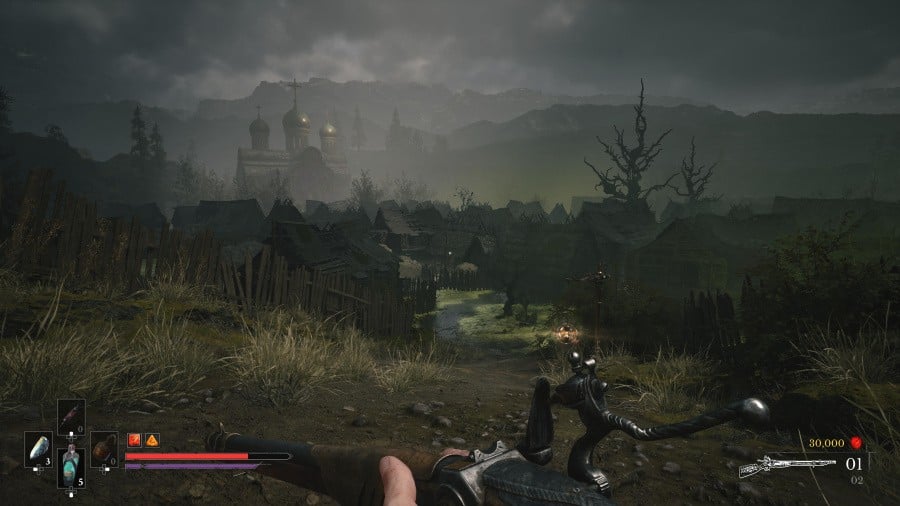


Valor Mortis is an extremely fresh take on the tired Soulslike genre. Its engaging first-person combat, dark Napoleonic setting, and impeccable level design make it a must-play for enthusiasts in an already busy gaming season, even if it stumbles in places.
Developed by One More Level, the Polish studio behind the frenetic first-person action games Ghostrunner and Ghostrunner 2, you can expect plenty of explosive combat and vaguely terrifying platforming sections, as well as the expected multi-phase boss fights.
Valor Mortis is the dark odyssey of William, a British soldier who, inspired by the ideals of Napoleon, enlisted in the Grande Armée and marched across Europe to fight against the Russian Tsar, the only European monarch still standing in the way of Bonaparte.
Instead of being a crushing defeat for the nascent French Empire and the end of Bonaparte’s imperial ambitions, in the alternate history of Valor Mortis, Napoleon actually wins the Battle of Waterloo and goes on to conquer Europe (again).

For the self-confessed history buff, this is immediately compelling and intoxicating stuff, full of fascinating historical tidbits.
After a major battle, William wakes up in a pile of corpses, with amnesia, to discover that a mysterious plague has wiped out the French and Russian forces.
Some have been resurrected, husks of the undead, while others have become twisted biological warfare weapons that wouldn’t be out of place in Resident Evil.
With the disembodied voice of Napoleon himself whispering in William’s ear, urging him on to ever greater horrors, and a satisfying, BioShock-esque combat system to delve into, Valor Mortis could hardly be more my particular cup of tea if it tried.

Combat is the main verb of the game and you will spend the majority of your time there.
A Soulslike through and through, the lowliest enemy poses a threat to the unwary, and you’ll fight tooth and claw to reach the next bonfire (which takes the form of a lantern in Valor Mortis).
Resting respawns defeated enemies and replenishes healing charges, and death will result in the loss of accumulated catalysts, which are used both as currency and to improve William’s stats and shape the player’s build – very familiar attributes.
There’s a parry system to master, several melee weapons offering different playstyles, and a small selection of guns to use.

Additionally, transmutations provide limited magical utility, allowing additional flexibility and tactical options.
The combat has a satisfying weight to it, and there are a bunch of really cool finishing animations that are unique to William’s current gear.
I loved discovering that Transmutations and certain guns are wieldable with William’s various swords, giving the whole system a sort of modern BioShock feel.
You can slash and parry with one hand and shoot flames from the other while dodging; It’s really good material.
Each weapon seems interesting and useful, featuring a unique upgrade tree; Special thanks to the basic gun and saber combination, which remained rock-solid and extremely rewarding throughout my playthrough.

I would have liked maybe one or two more weapons to play with, but considering how long Valor Mortis is, the setting is just about perfect.
For context, I got credits after about 18 hours, after completing most of the side quests in the game, and will probably spawn the Platinum around 10 hours (very accessible if you want it).
The enemies are mostly awesome, with inventive designs, mechanics, and weak points. The variety is quite nice, and the various Napoleonic musketeers, cuirassiers, and grenadiers are given a monstrous twist (the “dogs” you encounter are particularly gruesome).
As a veteran of these types of games, I will say that it’s nice to see Valor Mortis employing basic late-game enemies, used in new and interesting mixes, as opposed to the mind-numbing onslaught of elites that many Soulslikes evolve into.

Character progression is fairly straightforward, but there is room for differentiation. Each higher level allows you to place points in different nodes, increasing maximum health, stamina, etc.
Some nodes offer more exotic options, like slowing down time while aiming in the air or increasing the status effect buildup from a transmutation.
Along with combat, I think the environments you play in are some of Valor Mortis’ greatest strengths. Each requires increasing mastery of traversal mechanics and is filled with secret areas, shortcuts, hidden loot, and side quest content.
I also liked the fact that much of the game takes place outdoors, in forests, valleys and villages. Yes, there are the obligatory sewers and mines, but there’s a feeling of open space everywhere that I appreciated.

As you progress through the game, in unexpected Metroidvania fashion, new abilities will allow access to previously inaccessible areas, and there’s a real incentive to return to earlier levels.
I think things aren’t up to par in the visual and audio departments, but considering the game’s discounted price, that can be forgiven.
Valor Mortis is one of those double-A games that punches well above its weight, which in my opinion is always preferable to a triple-A title that underproduces.
Textures can sometimes fall flat or look muddy, with some characters looking rather undercooked. The music is largely serviceable, if unremarkable, which is a bit of a shame. Mostly moody background stuff, with occasional heavy metal departures in some boss fights.

Speaking of boss fights, Valor Mortis doesn’t really stand out here either. Encounters against named enemies are pretty good.
It’s not Elden Ring; you don’t really need to memorize complex attack patterns or optimize your build to come out on top (probably because of the first-person aspect), but they still provide a suitable test of skill.
There are a few boss encounters that mix in some platforming elements, which is a cool idea that I found executed in a somewhat frustrating manner.
Having to start again because of just one missed jump in a sequence of five during the second phase of an already difficult fight made me angry.
Anyway, and no spoilers here, but I would like to have some polite words with whoever designed the final section of the game.

The entire build-up to the final boss is made extremely frustrating by the baffling decision to let William have extremely low health with no ability to heal, as well as inconsistent checkpoints.
It’s like ten minutes of non-standard gameplay, it’s not really a deal breaker, but it follows an unnecessary stealth section late in the game, and combined it makes for a strangely frustrating ending to what is otherwise a solid campaign.
Gn tech