
Follow us
Add us as a favorite source on Google
Researchers believe they could have identified exactly the night sky we see depicted in Vincent van Gogh’s iconic painting “The Starry Night.”
Perhaps one of the most famous paintings in modern history, Van Gogh’s “Starry Night” carries a legacy that continues to inspire and mystify generation after generation. But even though you can see in its swirls of color and bright points of starlight a night sky derived purely from imagination, some scientists think it represents a real view – one that includes a waning crescent moon, Venus and the Hyades cluster. And they may know exactly when this sky appeared.
In a new study, researchers suggest that “Starry Night” depicts the pre-dawn sky seen around July 22, 1889, from Saint-Rémy-de-Provence, where Van Gogh painted it. But even though this sky perfectly matches the one depicted in the work, art historians have long believed that Van Gogh painted this work in June. Could these discoveries shift the date of this legendary work?
Find a painted sky
This investigation began decades ago with art historian Albert Boime and astronomer George Abell at UCLA in 1984 and continued in subsequent years with astronomer Charles Whitney at Harvard University. However, these earlier analyzes did not agree with each other and there was no real consensus on exactly when the sky fit the picture.
The question therefore remained on the minds of those who shared a common love for art and space. And a team led by Elijah Jeong-hyun Kim, CEO of South Korean robotic telescope company SLLAB and a Ph.D. candidate at the School of Space Research at Kyung Hee University, took up the research.
“When they see a fragment of the starry sky, observational astronomers like me and amateur astronomers will want to solve the riddle. I’m just someone who has pursued this process a little more actively,” Kim said. Espace.com.
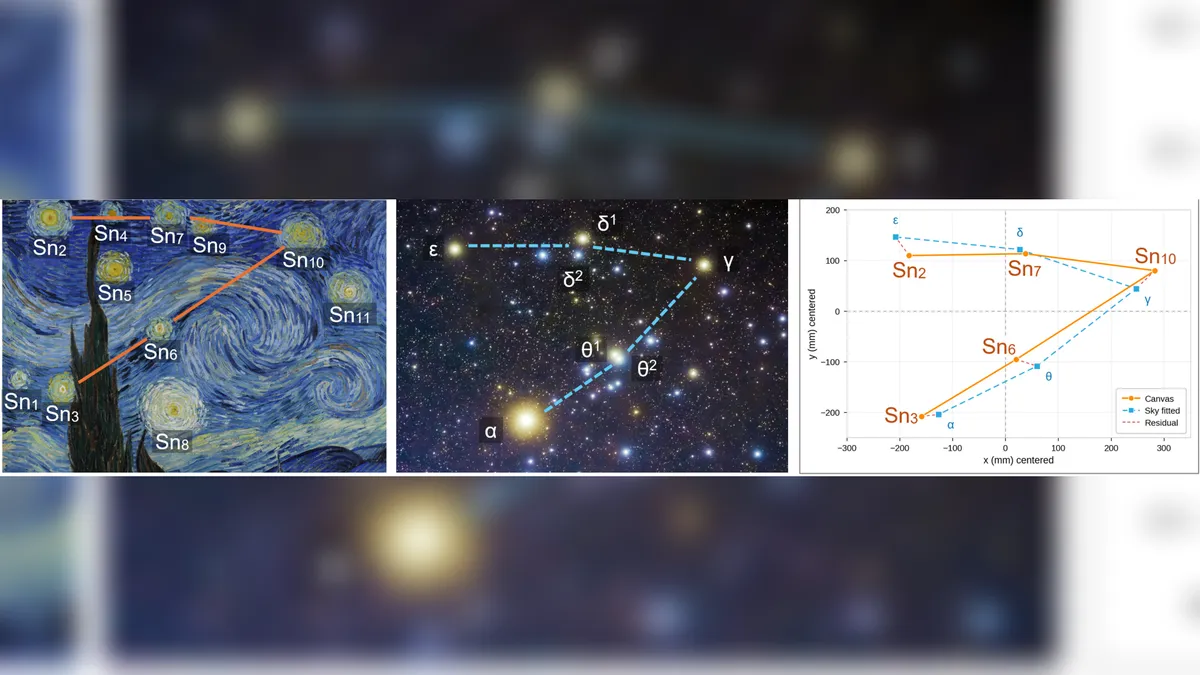
But how did Kim’s team reach this conclusion, when others have failed to nail down a date over the decades? In short, “we analyzed the painting astronomically, analyzed the records of its situation in July 1889, and then conducted ecological and meteorological surveys,” Kim said.
To begin, the team analyzed the sky from the exact location in Saint-Rémy where Van Gogh is said to have painted “Starry Night.” They then used observational geometry to map the historic night sky.
“Modern telescopes are equipped with a feature called astrometry, which compares an image of the night sky with celestial coordinates stored in a computer and automatically extracts the coordinates from the image,” Kim explained. “We used Procrustes analysis, a method that compares only the ‘shape’ of two sets of points. After matching their position, size and rotation, it measures the similarity of the two shapes from the differences that remain (the residuals).”
“As a star cluster on the canvas can be larger or smaller than in reality and slightly tilted, this method was the right solution. It allowed us to explain, in quantitative terms, what previous studies had described only qualitatively as ‘looking like a certain constellation,'” Kim added.
But that quantitative analysis wasn’t enough to say with certainty that this was the ideal sky, because different constellations could fit to a similar degree, Kim said. To get closer to their answer, the team combined their analysis with a deep dive into history.
“We also checked whether the stars were actually in that part of the pre-dawn sky on that date, whether they fell within the painter’s field of view, and whether the appearance of the Moon and Venus matched the painting. It was the Hyades that met all of these conditions,” Kim said.
Explore the history of astro-art
As mentioned, the date of this corresponding sky falls in late July, a month after art historians believe Van Gogh painted “The Starry Night.” But the researchers suggest their findings could provide evidence to support the idea that the work was actually painted in July.
Letters written by Van Gogh as early as 1888 describe his desire to paint a sky filled with stars. A letter dated April 12, 1888 says: “A starry sky, for example, well, that’s something I would like to try to do, just as, in the daytime, I would try to paint a green meadow dotted with dandelions. »
Kim followed these letters over the months to try to find more information that might narrow the discrepancy between the corresponding skies and the actual month the painting was created. Kim pointed to a letter from late May to early June 1889 that said: “This morning I saw the countryside from my window long before sunrise with nothing but the morning star, which seemed very large. »
Kim used “his personal imagination” to find connections between Van Gogh’s observations of the sky during those months and what they might mean for the painting’s timeline, Kim explained, so it doesn’t definitively change the view of the painting’s history. However, Kim suggested that these recordings could indicate that Van Gogh repeatedly looked up and observed the sky before dawn, which could have led him to see exactly this sky on July 22.
The painting itself even causes uncertainty among art historians. As the researchers cite in their new paper, prominent art historians view “Starry Night” as stylistically different from Van Gogh’s other June works, raising further questions about the date painted.
“What our study shows is that the sky in the painting matches, both in terms of observation and shape, the actual sky before dawn around July 22. So we propose the possibility that Vincent conceived the idea in June and completed the painting after July 22,” Kim said.
However, “I think further research in art history and conservation science could shed more light on this issue,” Kim added.
This work was described in a study published on October 22 in the journal Scientific Reports.
Gn entert