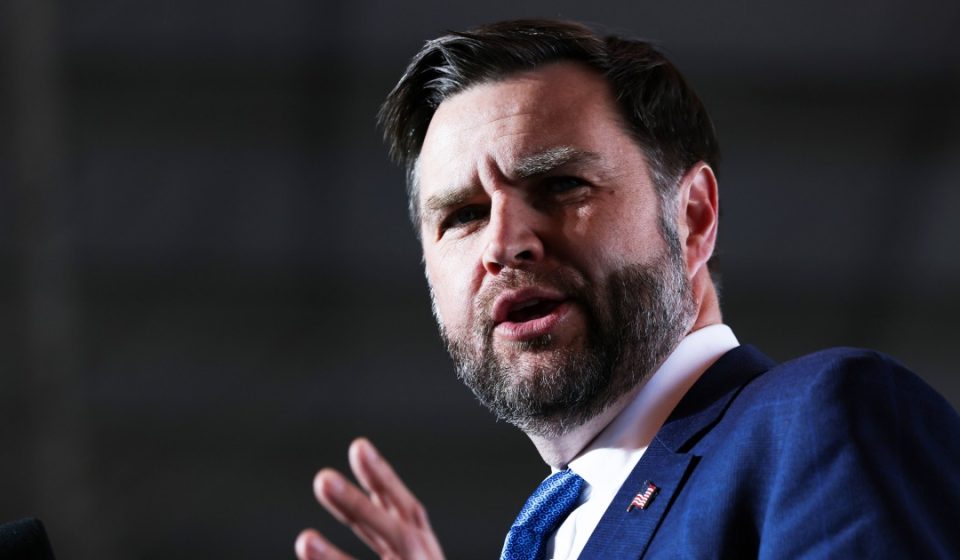
JD Vance said Monday that he and President Donald Trump are fully aligned on the war in Iran after the vice president this month blamed Republicans’ electoral defeat in the midterm elections on voter frustration with the conflict.
“There is no daylight, Laura,” Vance told Fox News host Laura Ingraham in her first television interview since the midterms. “And I think there is no daylight between the president or any other high-ranking member of the administration. Now, politically, yes, and I think the president himself has absolutely said this as well, there has been a political cost: the higher the gas prices, the higher the energy prices.”
Vance, a potential 2028 presidential candidate, also argued that other factors have also contributed to rising fuel prices, including what he described as a lack of investment in U.S. energy infrastructure in recent decades.
It was part of a broader theme that he echoed throughout the interview, doubling down on what he called “economic nationalism” and calling for factories to be relocated in response to the election results.
“Now we’ve been bombarded, of course, and I think we need to take messages from that,” Vance said. “But the message we have to take from this is that the American people want prosperity, they want freedom, they want sovereignty within their own country, and they want us to do more of the good things that we have been doing, and they also want us to recognize that there are economic difficulties in the United States of America.”
“But the way to deal with this economic pain is not by opening the border, it’s not by giving up American sovereignty, and it’s certainly not by shipping more American factories and more American jobs overseas,” he continued. “It strengthens economic nationalism and brings prosperity to the homeland.”
Immediately after Democrats routed Republicans in the midterm elections – the party’s best electoral performance since just after the Watergate scandal – Vance wrote to X: “The reason we lost was the war,” adding that Trump himself had made similar remarks.
“If you want to argue that it was worth it, that losing the Senate for the next 6 years was worth it, then do it,” he wrote on X, apparently aimed at Republicans who supported the war more forcefully. “Say it was worth paying for. Agree or disagree, that’s at least honest. But everyone knows why we lost. And any honest conversation about where we go from here has to start there.”
Trump later told reporters that he thought Vance’s analysis was correct, but added that his vice president “should have made another statement… If you had to do it again, would you do it again? The answer is yes.”
The remarks preceded the president’s announcement last week that he was withdrawing Vance from peace negotiations with Iran, asking him to increase attention to allegations of government benefits fraud.
In his Fox News interview, Vance confidently assured that the administration “will not allow” the war to become “even a two-year commitment.” Trump and senior administration officials said at the start of the conflict, which began Feb. 28, that it would be resolved within weeks.
“But my prediction, Laura, is that whatever the president ultimately decides to do, there will be people who will demand more, who want the war to continue indefinitely, and what I am pretty sure about the President of the United States, and again, there is no daylight here, is that whatever he ultimately decides to do, however he ultimately decides to end the conflict, he will not let this become a war eternal,” Vance said. “And those who want this to become a forever war can attack me all they want because we signed on not to do this, we told the American people we would not fight any more forever wars.”
“Yes, the president felt he had to destroy the nuclear program, and yes, Iran’s nuclear program poses a threat to the United States of America,” Vance continued. “But we’re not going to allow this to become a 10- or 15-year commitment, or frankly, even a two-year commitment.”
The vice president said he had not yet decided whether to run for president in 2028, but that a decision would be made “sometime next year.”
“When I make a decision, Laura, I will be fully involved in whatever that decision is,” he said.
Regarding the scandal that engulfed former Nvidia CEO Jensen Huang, Vance said the main issue at stake was not whether he had a relationship with an alleged Chinese intelligence operative — which Vance said the administration was unsure of — but that it was about reindustrializing the United States, in this case, so that the supply chain for advanced chips needed to power the AI boom would be more fully contained at the level national.
“The main issue is that we need to reindustrialize the country and protect our technology and critical infrastructure,” he said. “And the only way to do that is to build more of them in the United States of America and keep them out of the wrong hands.” »
Responding to a question about Sen.-elect Abdul El-Sayed, D-Mich., with whom Vance frequently clashed on the campaign trail, the vice president expressed hope that the two men and other newly elected Democrats could work together.
“So I hope the Democrats actually try to govern based on what they ran on. Because if you look at what they ran on, what are they talking about? Reindustrializing America, lowering energy costs for Americans,” he said. “They touched on a lot of the same issues Donald Trump is talking about in 2024. Let’s work together.”
Ingraham pressed Friday on the Federal Aviation Administration’s nationwide ground shutdown that stranded hundreds of thousands of passengers after a router glitch derailed air traffic control communications as well as a series of other technology outages in recent days. Vance echoed other administration officials in asking Congress for new funds to modernize the air traffic control system, while seeking to assure viewers that those problems were not escalating into a bigger crisis.
“Yes, many of my friends contacted me and asked, ‘Should we prepare to build a bunker or stock up on food and water?’ And my answer is no,” Vance said after Ingraham pointed out that European governments have recently been pushing citizens to step up their emergency preparedness. “We’re not planning a crisis, but you have to be prepared for anything. And what we want to do is make sure we avoid the worst consequences, but we’re also prepared for the worst consequences.”
Gn usa