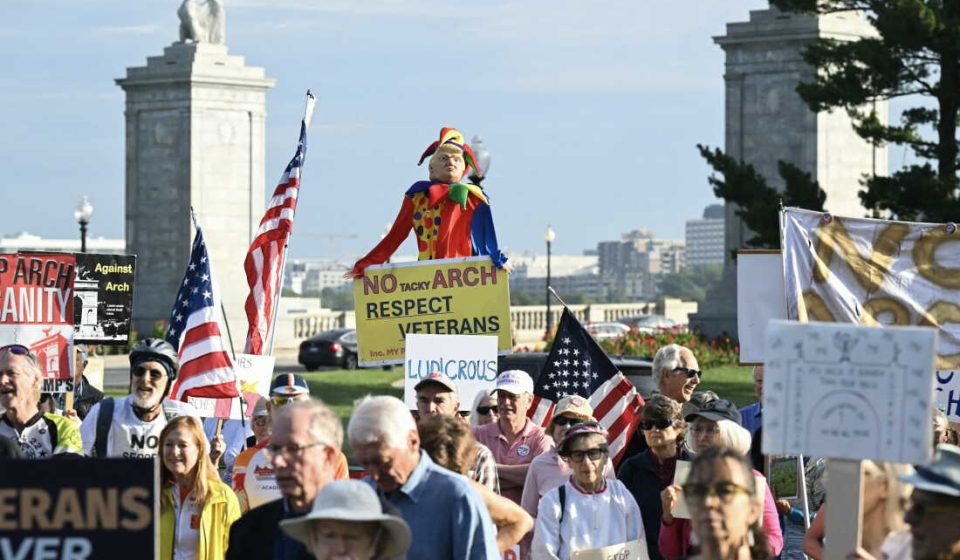


Demonstrators gathered Thursday morning to protest Trump’s proposed arch, which would stand in a traffic circle on the bridge connecting the National Mall to Arlington National Cemetery.
Saul Loeb/AFP
hide caption
Saul Loeb/AFP
WASHINGTON, DC — Dozens of activists gathered at Memorial Circle in Washington, D.C., during rush hour Thursday to protest the 250-foot-tall arch that President Trump wants to build there.
Veterans, retirees and lawmakers spoke out — against its scale, its cost, its lack of congressional approval, its garishness, its intrusion into nearby Arlington National Cemetery, and more — next to a model made of tarpaulin. The real arch, they said, would be 32 times higher.
“It’s the wrong monument, in the wrong place, at the wrong time, to the wrong man,” said Jon Gundersen, a retired Army veteran and former foreign service officer who is among the Vietnam War veterans suing the Trump administration over the arch.
Gundersen came from South Carolina to speak at Thursday’s protest, which was billed as “Veterans Against Vanity.” It was organized in part by Public Citizen, the group leading the lawsuit. He told NPR it was “encouraging” to see so much support for their cause.
“Everyone I talk to, whether Republican or Democrat, says it’s a waste of money and that’s not the way to honor veterans,” he said.

Many speakers were particularly concerned about the impact of an arch dominating nearby Arlington National Cemetery and criticized the lack of input from veterans and Gold Star families in the process.
“I am angry that the five-time cowardly coward of a commander in chief sitting there in the White House would dare to dishonor the men and women of this country who donned his collars, sacrificed and served and now lie in the hallowed grounds of Arlington National Cemetery,” said Sen. Tammy Duckworth, Democrat of Illinois, who said she and her husband would one day join them.
The White House told NPR that the arch would “enhance the visitor experience” at the cemetery and serve as “a visual reminder of the noble sacrifices borne by so many American heroes.” But Duckworth and others say a better way to honor veterans would be to spend money on improving services for them, not on a triumphal arch with a viewing platform.

Protesters are standing Thursday at Memorial Circle, near a model of Trump’s arch, which they say would be 32 times taller.
Saul Loeb/AFP via Getty Images
hide caption
Saul Loeb/AFP via Getty Images
“Imagine the tourists coming up to that arch and watching the funeral on the 24th through the 27th in Arlington,” Gundersen said. “This is not only wrong and inappropriate, it is also obscene and should never be done.”
During the half-hour of rapid-fire speeches, the crowd erupted into loud applause and sporadically chanted “no arch!” » and, at some point, a coordinated interpretation of We will overcome. Cyclists and commuters passing by offered waves and honked horns of support.
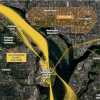
Planes flew over the airport every few minutes, a constant reminder that the arch would stand as it approached one of the busiest airport runways in the country. Several speakers discussed aviation security concerns raised by the arch and by Trump’s recent announcement that the structure will house drones and military snipers.
“Who will the snipers shoot at: the families near the graves or the tourists at the Lincoln Memorial?” » Rep. Don Beyer, D-Va., said from the podium. “The real explanation is that Trump thinks he’s going to lose in court, and maybe if he cries about national security, the Supreme Court will care.”
The White House, Interior Department and Federal Aviation Administration did not respond to NPR’s questions about the military complex. The Trump administration has not publicly explained what the structure’s name change might mean for the ongoing federal approval process, despite growing confusion.
But he dropped hints during a meeting earlier this week.
Administration officials told historic preservation groups on a Zoom call Tuesday that they were not aware of any new submissions and planned to move forward with the original arch proposal, according to a transcript and recording later shared with NPR.
And — despite public pushback, an ongoing lawsuit and many unanswered questions — this proposal is headed toward final federal approval.
Scissors and Votes: How Critics Fight the Ark
The arch is expected to be presented to the National Capital Planning Commission at its next meeting in early November.
As part of the required federal review process, the National Park Service had held discussions with outside groups to negotiate how to build the arch while causing the least damage to dozens of protected monuments nearby. The park service had previously rejected experts’ suggestions to build the arch elsewhere.
Then, in the last week of September — just days after Trump’s announcement of the military complex — the Historic Preservation Advisory Board shut down the review process altogether. This was announced in an email to historic preservation groups, reviewed by NPR.
Charles Birnbaum, who participated in the process as director of the Cultural Landscape Foundation, said he was dismayed that the board halted the review after just two meetings. He remembers this only happening twice in the 15 years he spent working for the National Park Service.
“Projects come before the advisory board when there’s an impasse that people have tried to negotiate with state preservation officers, with stakeholders, and there’s an authenticity to that process,” Birnbaum said.
Instead, the advisory board now says it will deliver its recommendations directly to Interior Secretary Doug Burgum by October 7.
“They’re going to impose this on the process and they’re going to override outside voices. And what that symbolizes is the direction the administration is going with the nation,” Birnbaum said, referring to the same council’s efforts to roll back protections for historic sites nationwide. Additionally, a bipartisan licensing reform bill gaining traction in Congress would also weaken these protections.

Sen. Jeff Merkley, D-Ore., addresses protesters at Thursday’s event. His efforts to block federal funding for the ark were rejected by a Republican senator earlier in the week.
Allison Robbert/AP
hide caption
Allison Robbert/AP
Protesters on Thursday vowed not to let the arch continue — but prepared for the possibility that it might.
“We need to continue to appeal to our senators, to our congressmen, and let them say no to this arc,” said Arlington County Board Member Julius D. “JD” Spain Sr.. “And if it gets built, if it somehow gets built, I’ll have my chisel and I’ll be out there with everyone else to tear it down.”
This sparked some of the loudest applause of the morning. Beyer, whose district includes Arlington, later told NPR that there were “a large number of people ready to protest as soon as they see a shovel.”
“I don’t know how this is going to happen, whether we’ll end up with tents or hunger strikes, but I know the American people are ready to protest in any way they can,” he said.
There’s another possibility, at least in theory: Congress could stop the ark by blocking federal funding from going to the project. Earlier this week, a single Republican senator blocked Democrats’ attempts to stop construction of the arch as well as the demolition of the Kennedy Center.
“We could stop this today if the Republican majority stood up and became a backbone and stood up to Trump,” Duckworth told NPR in a phone interview Wednesday.
Next month’s midterm elections could shift the balance of power in Congress, and if Democrats win, that could be bad news for the party starting in January.
Gn headline