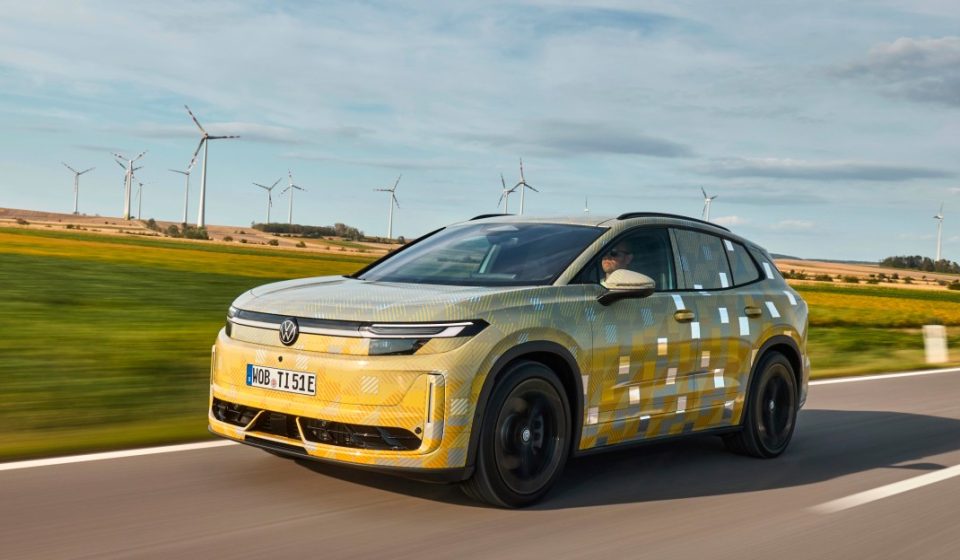

In a widely anticipated move, Volkswagen announced Monday that it will replace the recently retired ID.4 crossover with the upcoming ID.Tiguan. The move is an acknowledgment by the German automaker that its more recognizable nameplates like Tiguan are likely an easier sell to consumers, particularly when it comes to electric vehicles.
When it lands in Europe in early 2027, the ID. Tiguan will join the ID.Polo and ID.Cross to complete Volkswagen’s new and improved electric range. VW also confirmed that the ID.Tiguan would come to the United States, where the ID.4 was previously manufactured, “at a later date.” Design details remain under wraps, as the ID.Tiguan is kept under camouflage for now.
First introduced in 2020, the ID.4 was intended to mark VW’s push into the mass electric vehicle market. But rather than take on big sellers like Tesla’s Model Y, the automaker wanted to compete with high-volume gas-powered vehicles like the Toyota RAV4 and Honda CR-V. Although it has never completely dethroned these rivals, the ID.4 has enjoyed some success, selling 950,000 units since 2021. VW says it ranks “among Volkswagen AG’s most successful battery electric vehicle model series.” VW ended production of the ID.4 at its Chattanooga plant in April 2026.
The electric Tiguan will retain much of what worked about the ID.4, while fixing some of its shortcomings, like its frustrating lack of physical controls. VW plans to give the ID.Tiguan the same interior look as its ID.3 NEO and ID.Polo, the latter a surprise sales success in the EU. This means we can expect buttons for all four windows, rather than just two, as well as physical controls for the volume and climate settings. VW’s Android Automotive-based operating system will also be featured, meaning we’ll likely see a Gemini-powered voice assistant.
Gn bussni