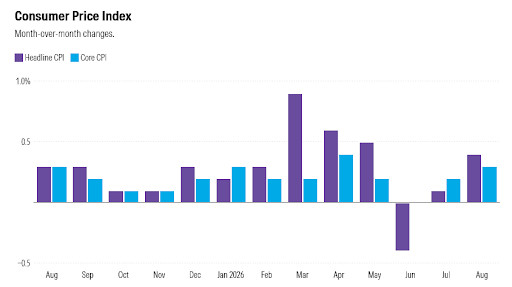

The U.S. Consumer Price Index (CPI) report is expected to be released on Wednesday, with economists predict that key inflation indicators continued to moderate in September despite high oil prices, giving the Fed room to slow the rise in interest rates. For September, economists expect headline inflation growth to be 0.5% month-on-month and 3.6% to 3.7% year-on-year, compared to 0.4% month-on-month and 3.4% year-on-year in August. At the same time, the core CPI, which excludes volatile energy and food prices, is expected to rise 0.2% in September from 0.3% in August, with the annual core inflation rate expected to remain at 2.4%. Additionally, the likelihood of an interest rate hike from the Federal Reserve at the upcoming meeting on October 27-28 fell at around 19 to 20%, down significantly from over 70% at the end of September.
“You’ve seen supply shocks create a tricky situation“Jeffrey Schulze, chief investment strategist at the Franklin Templeton Institute, told Morningstar, referring to AI-related oil supply disruptions, tariff shocks and consumer goods price spikes.”But as we approach 2027, some of these risks will begin to ease. This moderation may already be underway. I think you are seeing a generalized softening (in September).”

Source: Morningstar
While headline inflation is already revealing the impact of rising crude prices, economists note that broader categories of underlying inflation have remained isolated, showing little or no evidence of price pass-through. Airfares have absorbed the bulk of the ongoing energy shocks, with price increases exceeding 2% month-on-month in July and August and 25% year-on-year thanks to high jet fuel costs. Fuel accounts for about 17% to 21% of an airline’s total operating expenses, making ticket prices particularly sensitive to oil price spikes. In contrast, pass-through effects for most retail and manufacturing sectors may take several months or even quarters to manifest. “I think this might appear towards the end of the year, rather than the September release.“, says Schulze.
Related: OPEC sees oil demand growth reaching 2.6 million bpd in 2027
U.S. oil and fuel prices have fallen from recent highs but remain high. Brent crude for December delivery fell 2.0% to trade at $104.60 per barrel as of 7:00 a.m. ET Tuesday, while WTI crude for November delivery fell by a similar margin to change hands at $91.89/barrel. Meanwhile, the average U.S. gasoline price Tuesday stood at $4.3413 per gallon, down from $4.8133 per gallon a month ago but much higher than about $2.98 per gallon before the war broke out in late February. Unfortunately, diesel prices have barely budged, currently averaging $6.2787/gal compared to $6.3151 a week ago.
Last week, US President Donald Trump made an agreement with Russian President Vladimir Putin to supply Russian diesel to U.S. and global markets in an effort to curb soaring fuel prices. Russia has committed to immediately releasing more than 300,000 tons (about 2.25 million barrels) of diesel fuel, with an additional 500,000 tons expected to be delivered in November 2026. Russia will then release 1 million tons after the November allocation, with a potential 3 million tons also expected depending on the state of Russian oil refineries.
As part of the agreement, the US Treasury Department issued a blanket license suspending sanctions on Russian diesel exports until April 7, 2027, although other assets such as those held in US banks remain frozen. Unsurprisingly, the deal sparked bipartisan opposition in Congress, with a group of Republican and Democratic senators pointing out that the move violates a 2022 law banning Russian energy imports. European leaders also critical temporary exclusion, arguing that pressure on Moscow should be increased rather than eased.
However, the deal’s biggest critics have been energy experts, who rightly noted that the deliveries would likely have only a minimal impact on fuel prices. Indeed, the initial delivery of approximately 2.25 million barrels is barely enough to meet U.S. consumption for a single day, estimated at ~4.1 million barrels. These volumes seem even more minimal in a global market for middle distillates which remains highly compressed. Ukrainian drone and missile strikes have decimated Russia’s energy infrastructure, reducing Russian diesel production by nearly 30% and forcing Moscow to restrict or ban some of its own fuel exports earlier in the year in an effort to protect domestic supplies. Before the attacks, Russian diesel exports averaged more than 3 million tons per month (about 1,000,000 barrels per day).
By Alex Kimani for Oilprice.com
More important reading on Oilprice.com
Gn bussni