Skip to content
-
Subscribe to our newsletter & never miss our best posts. Subscribe Now!
Today's News. Tomorrow's Perspective. Today's News. Tomorrow's Perspective.

Deliver fast, factual, and easy-to-understand news covering global events, technology, business, science, AI, health, entertainment, and lifestyle.

Today's News. Tomorrow's Perspective. Today's News. Tomorrow's Perspective.

Deliver fast, factual, and easy-to-understand news covering global events, technology, business, science, AI, health, entertainment, and lifestyle.

  • Home
  • Breaking News
  • Business
  • Sports
  • Health
  • Politics
  • Technology & AI
  • World
  • Home
  • Breaking News
  • Business
  • Sports
  • Health
  • Politics
  • Technology & AI
  • World
Close

Search

  • https://www.facebook.com/
  • https://twitter.com/
  • https://t.me/
  • https://www.instagram.com/
  • https://youtube.com/
Subscribe
Wall Street's AI party on edge as surging yields raise risks
Business

Wall Street’s AI party on edge as surging yields raise risks

By adminvoxa
October 5, 2026 5 Min Read
Comments Off on Wall Street’s AI party on edge as surging yields raise risks

(Bloomberg) — Wall Street’s obsession with artificial intelligence is so strong that it overshadows all risks, including soaring interest rates, as investors continue to pour money into the market’s biggest tech stocks and push stock indexes to record highs.

Most read on Bloomberg

But for all the euphoria, the risks on the horizon are becoming acute, especially as yields on long-term Treasury bonds trade near their highest levels in decades.

“With these higher rates, we’re all on edge,” said Ken Mahoney, president and CEO of Mahoney Asset Management.

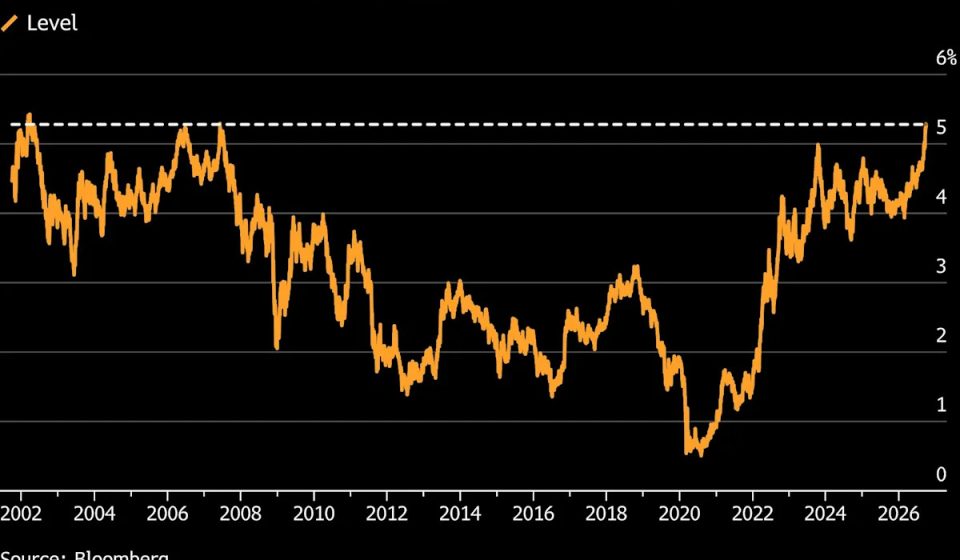
Just last week, the yield on long bonds reached 5.69% and the 10-year rate exceeded 5.3%, which has not been the case since 2002. But technology stocks still managed to hold on to their gains. The Nasdaq 100 index hit a new record high on Friday and is up 22% this year, while the S&P 500 index is less than 1% from the all-time high reached in August. The biggest contributors to gains in the tech-heavy S&P 500 and Nasdaq 100 over the past three months are AI giants Microsoft Corp., Nvidia Corp. and Apple Inc.

“I would have said 5% was the limit, but you know, that’s already kind of in the rearview mirror,” said Matt Stucky, chief portfolio manager at Northwestern Mutual.

Investor confidence in the sustainability of this recovery is largely based on sky-high expectations for future profits from tech giants, which have generated the lion’s share of growth in recent years.

The sector’s earnings per share are expected to jump more than 65% in the third quarter, giving the group the second-fastest growth after energy, which would help fuel the more than 24% EPS rise expected for S&P 500 companies, according to Bloomberg Intelligence. If this happens, it will be the third consecutive quarter where the index’s EPS increases by more than 20%.

“It’s hard to even put this into perspective,” said Rob Conzo, chief executive officer of Wealth Alliance. “It’s historic.”

AI has been the main driver of gains in the stock market — and tech stocks in particular — over the past three years, as companies spend hundreds of billions of dollars to build the infrastructure needed to power the nascent technology. This capital spending has created a virtuous cycle for investors in which the spending giants are growing because they are making progress in AI, and the beneficiaries of all that money, from chipmakers to data center construction companies, are also growing as their revenues take off.

Greed and fear

Still, sentiment around AI has vacillated between enthusiasm and concern repeatedly in recent months, as Wall Street pros wonder when and if they’ll see a return on all that money spent, and whether it will even matter given the risks the technology could pose to humanity. At the same time, the market is grappling with the war in Iran, persistent inflation driven by soaring oil prices and the likelihood of another interest rate hike by the Federal Reserve this year.

This back-and-forth led to rotations from software to hardware and then to tech giants Magnificent Seven, which lagged in the first half but has outperformed the broader market since late July.

This all adds up to a complicated business environment. We can’t ignore the incredible momentum pushing AI names higher, but the threat of a stock market selloff is real, especially with stratospheric interest rates and AI spenders having to borrow increasing amounts of capital to fund their ambitions.

“Interest rate-sensitive stocks are feeling it at this level,” Mahoney said. “I think every stock would feel it if it continued to climb.”

The market appears to have accepted that rates will remain high for longer than expected, at least for now. But it’s unclear how long that might last or at what level the challenges would start to weigh on tech stocks, given their strong earnings.

“Historically, it takes about a hundred basis points over a 10-year period to impact valuations and earnings,” said Northwestern Mutual’s Stuckey. “So I guess it’s just higher, period.”

With benchmark 10-year Treasuries at around 5.3%, there isn’t much room to maneuver. “If 10-year yields hit 6%, we’ll have a different conversation,” said Chris Galipeau, chief market strategist at the Franklin Templeton Institute.

The last time the 10-year rate hit 5% was briefly in 2023. The S&P 500 rose 24% that year, kicking off a three-year run of double-digit percentage gains. At the time, the theory was that rising yields had failed to halt the rise because the gains were led by the Magnificent Seven, who had huge cash reserves on their balance sheets and low levels of debt, allowing them to sustain higher borrowing costs.

“Force a turn”

That changed this year, as massive spending on AI infrastructure prompted them to sell stocks and issue bonds to raise the funds they need. Top AI spenders Alphabet Inc., Amazon.com Inc. and Meta Platforms Inc. all saw their free cash flow turn negative on an annual basis.

“These companies initially entered this phase of AI development with maximum flexibility, holding impeccable AA and AAA credit profiles, what we call the Mount Rushmore of corporate credit,” said Robert Schiffman, an analyst at Bloomberg Intelligence. “Today, however, hyperscalers like Meta, Amazon, Alphabet, Microsoft and Oracle have liquidity needs that far exceed internal liquidity sources, forcing them to turn to debt markets, leading to increased leverage over the next two years.”

But even in this difficult environment, corporate credit ratings have not yet been affected, he added.

“This unique stability persists as expected strong EBITDA growth continues to successfully offset increased leverage,” Schiffman said.

Of course, rising yields have affected other parts of the market, leading to multiple compression in the S&P 500. The index now trades at less than 19 times forward earnings, down from more than 21 in May.

“Paddle like crazy”

“The S&P at the index level is like a duck on the surface of water,” Galipeau said. “It looks good, but beneath the surface the feet are paddling like crazy.”

Given the way tech stocks have generated gains over the past few years, investors’ biggest concern is that if they start to run out of steam, will it jeopardize the strength of the entire market? “If the technology loses the technology and fixes it, then a lot more chips could fall,” Mahoney said.

For now, the strength continues because investors expect the end of the U.S.-Iran war to quickly depress oil prices, loosening inflation’s grip on the economy, Mahoney said. If that happens, strong earnings should propel shares of big tech companies higher.

However, this is hardly a guarantee. Meanwhile, the war drags on and experts wonder whether oil prices will immediately fall if it ends. Between that, stubborn inflation and high interest rates, there are plenty of risks that could just as easily derail this adventure.

“Growth remains strong and sustained and elevated by technology-related activity,” said Magdalena Ocampo, market strategist at Principal Asset Management. “What’s changing now is this growing perception that there are potentially more upside risks to inflation and a bit more downside risks to growth. And that may be what the markets are telling us beneath the surface.”

Most read from Bloomberg Businessweek

©2026 Bloomberg LP

Gn bussni

Post Views: 3
Author

adminvoxa

Follow Me
Other Articles
Florida GOP candidate Byron Donalds courts skeptical black voters
Previous

Florida GOP candidate Byron Donalds courts skeptical black voters

Trade: How India became dangerously dependent on Chinese imports
Next

Trade: How India became dangerously dependent on Chinese imports

Deliver fast, factual, and easy-to-understand news covering global events, technology, business, science, AI, health, entertainment, and lifestyle.
  • About Us
  • Accessibility Statement
  • Advertise With Us
  • AI Usage & Transparency Policy
  • Contact us
  • Cookie Policy
  • Corrections Policy
  • Meet Our Team
  • Privacy Policy
    • Disclaimer
    • DMCA & Copyright Policy
    • Editorial Policy
    • Ethics Policy
    • Fact-Checking Policy
  • Terms and Conditions
Copyright 2026 — Today's News. Tomorrow's Perspective.. All rights reserved.