
Freight is transferred between train and truck at BNSF Intermodal September 17, 2026 in Cicero, Illinois.
Scott Olson | Getty Images News | Getty Images
The Trump administration has pushed European countries to urgently release some of their diesel reserves, saying American farmers, truckers and businesses should not bear the burden of global supply disruptions.
The message comes as US President Donald Trump continues to weigh whether to ban diesel exports in an attempt to rein in high energy prices.
Average U.S. diesel prices hit a record high of $6.50 per gallon late last month, according to AAA, up sharply from last year amid supply disruptions fueled by the war in Iran and Russia’s full-scale invasion of Ukraine.
In a social media post, U.S. Treasury Secretary Scott Bessent said Thursday that the United States’ European partners “should accelerate compliance with their existing commitments and immediately make additional supplies available to address the ongoing disruptions.”
He added: “America is doing its part. We are counting on our allies to translate their commitments into action.”
The US government is currently facing increasing political pressure to combat soaring fuel prices in the run-up to the November midterm elections.

Trump told reporters in Texas on Thursday that he “might” ask European countries to release their diesel reserves. The US president, who previously said he was considering a ban on diesel exports “very seriously”, appeared hesitant about the idea this week, following a resumption of crude exports via the strategically vital Strait of Hormuz.
Trump said Wednesday he was still “considering” whether to ban diesel exports, but acknowledged it could have a “negative impact” on gasoline.
EU crisis talks
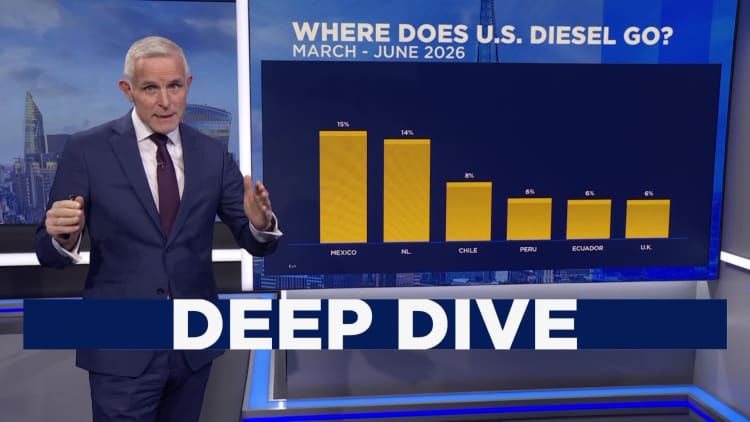
The prospect of the world’s largest diesel exporter implementing an outright ban on diesel exports has sparked strong resistance from the US energy industry and raised alarms across the Atlantic. The United States supplied about half of the European Union’s diesel imports in August, according to the International Energy Agency, underscoring the 27-nation bloc’s exposure to a possible U.S. export ban.
EU member states are expected to hold crisis talks on Friday, seeking to develop a coordinated response to soaring diesel prices.
Oil prices fell sharply on Friday morning after Reuters reported that European Union member states were discussing a French proposal to release additional diesel reserves following pressure from the Trump administration.
The report, which cites a single anonymous source familiar with the details of the discussion, said France proposed that EU countries release 50 million barrels of diesel and that members of the International Energy Agency release 50 million barrels of crude oil.
CNBC could not independently verify the report. A spokesperson for the French government and the IEA were not immediately available for comment.
Cars form long queues to refuel at a Rosneft gas station in St. Petersburg, Russia, September 15, 2026.
Anadolu | Anadolu | Getty Images
Speaking to reporters in Milwaukee at the G20 trade ministers’ meeting, EU trade chief Maros Sefcovic said he had discussed diesel supplies and soaring prices with his American counterpart, US Trade Representative Jamieson Greer.
“We have every interest in working together to lower prices, whether for diesel or other oil and gas products,” Sefcovic said, according to Reuters.
He added that any US move to restrict diesel exports would be unexpected and would have a negative impact on Europe’s economic outlook.
“A global energy problem”
Macquarie Group energy strategists said on Thursday it was understandable that the US stance on the global diesel crisis had taken on a seemingly global dimension.
“The biggest problem facing the United States is not a diesel problem. It’s not a refined products problem either. It may not even be an oil problem. It’s a global energy problem,” Macquarie Group’s Walt Chancellor said in a research note.
“So what’s the solution then? In short, more oil through the Strait of Hormuz and out of the Middle East. Anything beyond that is really just a mix of deck chairs,” he added.
The Strait of Hormuz is a major route for the global oil trade, with maritime traffic stifled after the attack on Iran by the United States and Israel in late February. But this week, daily exports returned to pre-war levels.
— CNBC’s Kevin Breuninger contributed to this report.
Gn bussni