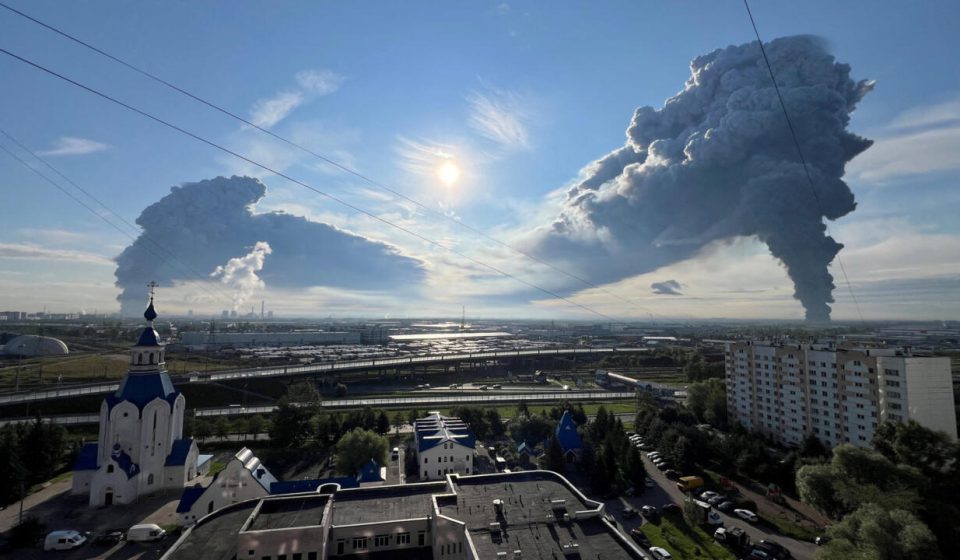
For the past week, Ukrainian bombings on Russian territory have primarily targeted sites that may seem to have no obvious connection with the war: the warehouses of Wildberries, the Russian equivalent of Amazon.
In Moscow, Saint Petersburg, Simferopol (Crimea) and even Krasnodar and Voronezh, Ukrainian drones and missiles have struck nine installations of the Russian e-commerce giant since July 18. Over the same period, Ukraine targeted only five oil installations, according to Meduza, an independent Russian news site.
After oil, e-commerce
These drone strikes have already cost Wildberries between $3 and $4.4 billion in property damage and inventory destruction, the Wall Street Journal points out, citing estimates from Data Insight, a Moscow research firm.
Ukrainian bombing of the warehouses also cost the lives of at least nine people who worked at the sites, according to Russian authorities.
“This is clearly a continuation of the strategy initiated with the strikes against oil infrastructure,” assures Stephen Hall, a Russia specialist at the University of Bath. These bombings for several months have led to gasoline shortages with long queues to access gas stations that still have reserves.
An extension in your browser appears to be blocking the loading of the video player. To be able to watch this content, you must disable or uninstall it.

Cover image: © France 24
“As with the attacks on oil refineries, the strikes on Wildberries warehouses have an immediate impact on the civilian population, reminding them that war is on their doorstep,” says Jenny Mathers, a Russia specialist at Aberystwyth University.
Indeed, “as the largest e-commerce site in Russia, Wildberries is extremely useful for the daily lives of millions of Russians, both in the city and in the countryside where Wildberries’ delivery network compensates for the absence of certain businesses,” underlines Jeff Hawn, Russia specialist at the London School of Economics.
In total, more than 80 million Internet users use Wildberries every month, according to official company figures, or more than one in two Russians.
The platform is not only important for buyers. “It also works a bit like eBay or Amazon Marketplace by offering individuals or small businesses the opportunity to sell their products there,” explains Stephen Hall.
Push the Russians to the limit?
Ukrainian drone strikes risk being very costly for thousands of small Russian entrepreneurs. “It’s not just the warehouse that’s going up in smoke. It’s also all the time, money and hope invested in my business that’s disappearing,” laments Tatyana Mikhailova on Instagram. This Russian woman lost more than 4,000 fur coats that she hoped to sell on Wildberries before winter.
Same observation for Viktoria Terekhova, who manufactures and sells children’s clothing. On Instagram, she explains, in tears, having lost around 160,000 dollars (140,000 euros) worth of goods which were stored in warehouses destroyed by Ukrainian drones.
The Ukrainian authorities are aware of the impact of these strikes. In an interview with the Russian-language version of the Lithuanian online media Delfi, Mykhaïlo Podoliak, advisor to Ukrainian President Volodymyr Zelensky, says that if small Russian businesses have nothing left to lose and are on the verge of bankruptcy, they will perhaps revolt against Russian power and its war of invasion in Ukraine.
Also readBombing of Moscow: when Ukraine wants to deprive Russia of its black gold
“This is a risky strategy because it could also push the Russian population to turn against Ukraine rather than against the Kremlin,” underlines Stephen Hall. Pro-Putin propagandists were quick to denounce these drone strikes, describing them on Telegram as “acts of barbarism”, even “war crimes”.
These attacks on warehouses are the closest thing to Ukrainian strikes against civilian infrastructure since the start of the war, recognizes Jenny Mathers. Meduza, a media outlet opposed to Vladimir Putin and deeply hostile to the war in Ukraine, looked at length at the thorny question of the legality of these bombings and whether they could be qualified as war crimes.
Does Wildberries sell military equipment?
Volodymyr Zelensky denies this, asserting that Wildberries is actively participating in the Russian war effort. How ? The platform sells military equipment usable by the Russian army, such as infrared glasses and bulletproof vests, as well as components useful for designing drones, the Ukrainian president said.
“We often talk about the Ukrainian army’s D system for obtaining equipment, but Russian forces also face supply problems. There are parallel channels, often involving the families of soldiers on the front who buy equipment on Wildberries to ensure that their loved ones engaged in combat have the best possible equipment to survive,” explains Jenny Mathers.
As such, “even if 90% of the goods sold on Wildberries are for purely civilian purposes, the bombing of warehouses will still have an effect on the war effort,” says Jeff Hawn.
With an annual profit of 175 billion rubles (around 2 billion euros) in 2025, Wildberries represents one of the largest taxpayers in Russia. “The money paid to the state is clearly used to finance the war,” underlines Jeff Hawn.
Wildberries CEO and Russia’s richest woman Tatyana Bakalchuk has also been on Ukraine’s sanctions lists since 2021, before the full-scale invasion war. kyiv already criticized him at the time for selling military equipment that pro-Russian militias in Donbass could use.
However, voices even within the Russian opposition in exile wonder whether Ukraine has not gone too far with these strikes against the Russian e-commerce empire. They maintain in particular that the Russian bombings against Nova Poshta, a major fast delivery service which can be seen as a Ukrainian equivalent of Wildberries, had led to the opening of a war crimes investigation in Ukraine.
For Jeff Hawn, Ukraine will probably “continue to diversify the sites targeted by its drones” to both undermine the Kremlin’s war effort and prove that this conflict has a cost for ordinary Russians. The campaign against oil refineries demonstrated the effectiveness of this approach. But over time, Moscow was able to adapt its anti-aircraft defenses to protect its sites. It becomes more complicated if Ukraine also targets other types of facilities like Wildberries warehouses. And a few months before the Russian legislative elections in September 2026, the extension of the range of strikes into Russian territory may increase the feeling that Russian power is incapable of protecting the interests of its citizens.