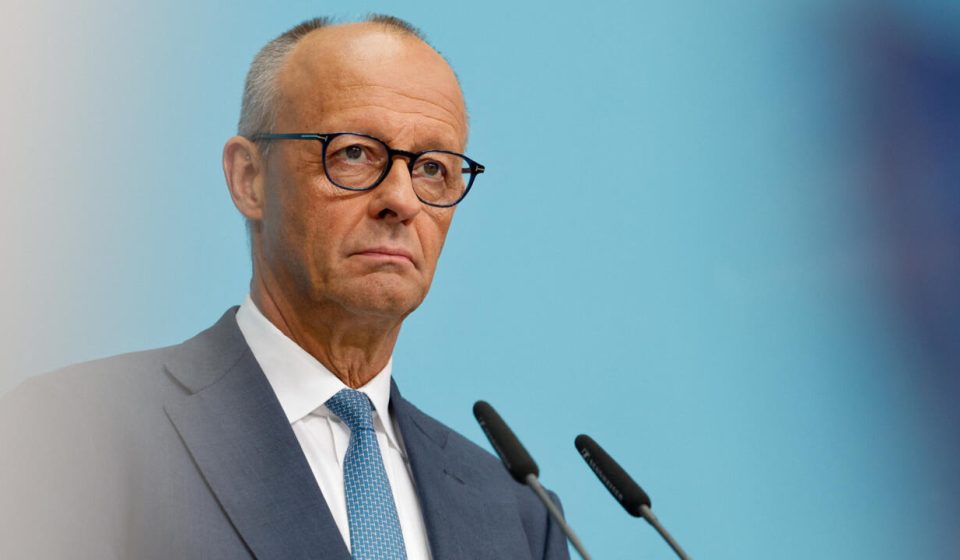
“We need to better explain the reforms”: faced with the far right, Merz wants to stay the course


“Giving up is not an option.” German Chancellor Friedrich Merz said he was “deeply shocked”, Monday September 7, by the historic victory of the far right during a regional election in the state of Saxony-Anhalt the day before, while promising to maintain the course of his reforms but by “explaining them better”.
“My determination is to continue the course of reforms, without disruption, but I know that (…) we must explain them better,” he said after a meeting of the leadership of his conservative party, the CDU.
Also readFollow our live broadcast dedicated to the victory of the far right in the regional elections in Saxony-Anhalt
Very unpopular, weighed down by the disputes within his coalition with the social democrats on the reforms to be carried out, and after several blunders, he admitted to having a responsibility in this defeat, while insisting on his “determination” to govern Germany.
“Giving up is not an option”
“Nothing more or less depends on the future of our country,” he said, before recalling that he had been “elected for four years” since 2025, thus seeming to rule out any resignation. “Giving up is not an option.”
As for the victory of the far-right Alternative for Germany (AfD) party in Saxony-Anhalt, in the east of the country, he judged that it had to be accepted “in a democracy”, but promised to defend “the fundamental law”, while the AfD is regularly accused of authoritarian temptations, of racism, and that its links with the neo-Nazi movement are proven.
Also readAfD’s clear victory in Saxony-Anhalt threatens “the German political system”
“We know that Germany, because of its (Nazi) history, has a special responsibility. We will always preserve our political order and our solid footing in Europe,” he said.
Two other regional elections planned
Friedrich Merz recognized that the electoral rise of the AfD was a game-changer “across Germany”.
The chancellor also recalled that on September 20, two other regional elections were planned, in Mecklenburg-Western Pomerania (north), where the AfD is in the lead according to the polls, and in Berlin, where CDU, far left and far right are neck and neck.
See alsoAfD victory in Saxony-Anhalt: “Germany at a turning point”
As for Saxony-Anhalt, its conservative leader beaten on Sunday, Sven Schulze, recognized that the Alternative for Germany has a “mandate to govern”, even if it is three elected officials short of reaching an absolute majority.
With AFP