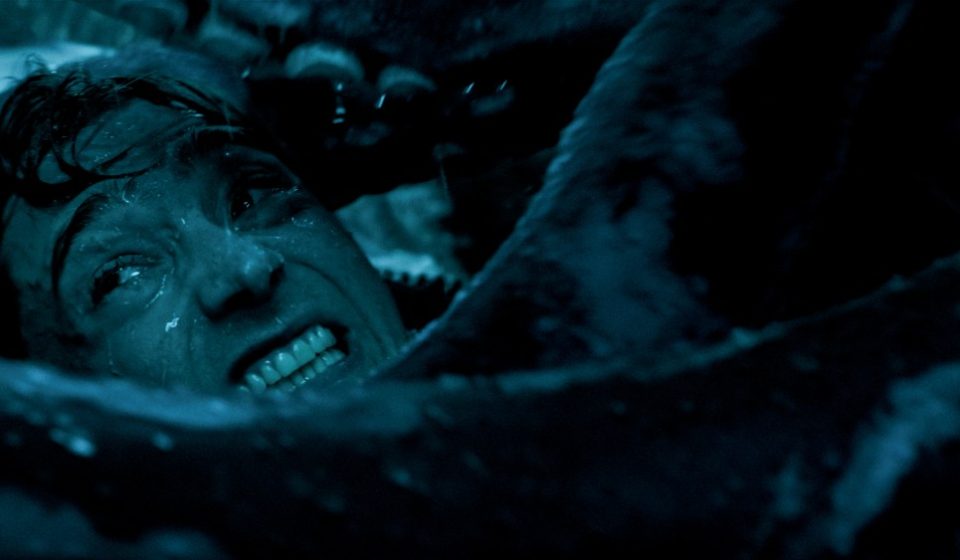

“Whalefall” is an underwater thriller that would like to do for whales what “Jaws” did for sharks. But it doesn’t happen like that. The movie is closer to what “Howard the Duck” did for farmyard superheroes for whales: it makes you never want to see one again. Whales, of course, are beautiful creatures, and the one in “Whalefall” is a sperm whale with the square shape of a submarine, long and angular, a slippery and elegant beast that rules the ocean. Yet for most of the film we are inside this whale. Literally inside. The central character, Jay Gardiner (Austin Abrams), goes scuba diving off Abbey Beach, near Monterey, California, in search of the body of his father, a gruff sailor who committed suicide. (He suffered from mesothelioma, a form of cancer that prevented him from diving; for him, this meant that life was no longer worth living.)
After submerging, Jay finds himself entangled in the tentacles of a giant squid, and that’s when the whale, which feeds on the squid, pulls Jay and the squid into its oversized gaping mouth. Moments later, Jay is trapped inside, surrounded by gooey protrusions of rippling flesh. For the rest of the film, he will attempt to survive inside this whale, which means preventing himself from being sucked out of the creature’s digestive antechamber (which glows phosphorescent blue) and into its internal stomach cavity (which glows hellish red), where stomach acid will begin to dissolve it.
For a moment, I thought Jay might meet his father, a la Jonah or Geppetto. But no, he’s alone, doing everything he can to escape this embrace of whale flesh. Is it disgusting? At times. Claustrophobic? A little. Scary? Not even a little. Jay’s place looks like a colonoscopy designed by HR Giger. The visual effects are…ok. Sometimes it’s like we’re stuck in a pop-up theme park called Full Cavity Search. At one point, Jay uses a jellyfish that the whale ate to light his way, and that’s when he is close to finding a mate. “Whalefall” is a fearless story about human perseverance and the stomach lining of mammals. It should have been called “Project Hail Fish Guts”.
While watching “Whalefall”, I kept thinking: “Why would anyone want to see this movie?” But the answer is obvious. “Whalefall” is an adaptation of Daniel Kraus’ 2023 novel, which in addition to being a bestseller has been received with great success. But something got lost in translation. The literal-minded film that director Brian Duffield made of it is a kitsch thriller, full of unintentional laughs. With a hero who spends the heart of the film sucking his oxygen nozzle, without speaking but rather uttering frantic grunts of fear, “Whalefall” cuts us off from the most fundamental interest. Of course we want to see Jay get through it, but only because the whole ordeal is so mind-numbing and unpleasant.
It says something that this is the second movie in a month where Austin Abrams has to fight his way out of the grip of fleshy tentacles, and only one such movie isn’t it definitely absurd, and it’s “Resident Evil.” Abrams had runaway indie-hipster appeal in Zach Cregger’s horror hit, but in “Whalefall” he’s half too wimpy, a simpering student who never proves to the audience that he’s got what it takes. The film, like the book, stems from the troubled relationship between Jay and his father, Mitt, played by Josh Brolin with a mean look and body tattoos, in one of those abruptly overrated performances as an abusive macho father – a not-so-great Santini who thinks the best way to prepare his son for what a tough world is to make the kid hate him and respect him, in that order. As Brolin plays him, Mitt is like Robert Shaw’s Quint in “Jaws,” only turned up the boozy psycho-masochism several notches.
The film keeps going back to flashbacks of Jay and Mitt at different points in their relationship, which is essentially one long downhill slide. However, during the second half, Jay begins to realize that Mitt has actually taught him everything he needs to know to free himself from his predicament. The message? The young man who bonds with the ghost of his asshole father while trapped in a slimy cushion of whale intestines stay with the ghost of his asshole father. “Whalefall” even has an “ecological” side: the title refers to what happens when the carcass of a whale sinks to the bottom of the ocean, an event that can give rise to a rich marine ecosystem. But “Whalefall,” the film, is the shell of a thriller that never emerges.
Gn entert