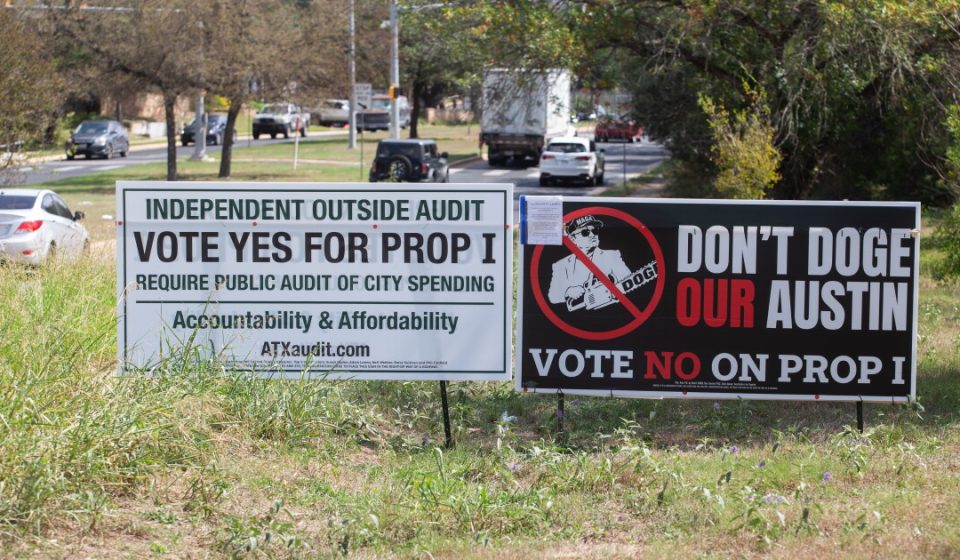

There are eight propositions on the Nov. 3 ballot that would amend Austin’s city charter.
The city charter is like its constitution. It defines the structure, responsibilities and powers of local government, limiting what it can and cannot do.
Although you will find propositions A through J toward the bottom of your ballot, proposition I has gotten the most attention.
How will Prop I appear on the ballot
Should the City Charter be amended to require an independent initiative on affordability and efficiency on a regular basis and prior to any election to increase the tax rate and require the independent contractor to identify annual and multi-year savings that exceed the cost of the contractor’s service?
What does this mean?
The campaign to bring Proposition I to voters was led by Save Austin Now, a political action committee co-founded by Matt Mackowiak, the former chairman of the Travis County Republican Party. More than 21,000 registered voters in Austin signed a petition to put the measure on the ballot.
The plan would require the city to undergo an independent audit every five years. The company chosen to carry out the audit must find savings measures that exceed the contract price.
The City of Austin, by ordinance, already has an external company called Public Works which audits city services to find cost-saving measures.
If passed, the language of Prop I would be locked into the city charter. Any changes would have to go to voters again.
This is a higher standard than a city ordinance, and can be adjusted more easily by city council members. An order may also be waived entirely by future councils.
If Proposition I passes, Bill Aleshire, an Austin attorney and former Travis County judge who wrote the proposal, said it would replace the audit already done by the city. The wording of the proposal does not automatically require the repeal of the current audit.
Mackowiak questioned the reputation of the company currently auditing the city.
“How impressive is it that an accounting firm would lose the ability to do business legally in Texas, the second-largest state in the country? » he said at a press conference on October 7.
Jenny LaCoste-Caputo, assistant communications director for the city of Austin, said Public Works previously let its Texas registration expire because at the time the company was not doing business in the state. LaCoste-Caputo said the company reinstated its license before it began working with the city.
Opponents of the proposal argue that the auditor would cost too much and undermine social programs to meet its contractual obligations.
City Council member Vanessa Fuentes spoke at an Oct. 7 press conference against the proposal. According to her, it would cost the city dearly.
“They know this service will be written into the city charter,” Fuentes said. “The city will have no choice but to hire them, and then it will be up to them to set the price, not the city. … Article I states that consultants must identify enough discounts to pay their own fees. That is an inherent conflict of interest.”
Also present at the press conference were City Council Members Mike Siegel, Zo Qadri, Ryan Alter, José Velásquez and Chito Vela, as well as U.S. Rep. Greg Casar, Austin Assemblyman. Mayor Kirk Watson was not at the event but has previously called the proposal a political attack.
“When you hire for-profit consultants who have no idea what’s going on in our city to try to make cuts,” Casar said at the news conference, “and they make more profit from the cuts they offer, then what ends up happening is it costs us more to fix the things they broke.”
Here are some of the other proposals you’ll find on the ballot.
Proposition A and Proposition B
Proposals A and B are not proposals to amend the city charter, but they will appear first on the list of proposals on your ballot. Voters will decide on a $295 million bond package to improve the city’s parks and libraries.
On your ballot are Proposition A, which is comprised of a $260 million parks bond, and Proposition B, which would set aside $35 million for libraries.
You can learn more about Prop A and Prop B from KUT Town Hall reporter Luz Moreno-Lozano.
Proposition C
How Proposition C will appear on the ballot
Should the City Charter be amended to clarify that the Independent Citizens Redistricting Commission (ICRC) is independent of the control of the City Council, allow the ICRC to review city districts after city boundary changes, create voter registration and length of residency exceptions for student members, provide an effective date for the redistricting plan adopted by the ICRC, increase the number of people in the pool of potential appointees to the ICRC, clarify the method and timing of filling ICRC vacancies and permit city staff to communicate with the ICRC outside of a meeting, provided that such communication complies with the Texas Open Meetings Law?
What does this mean?
The city’s independent Citizens’ Redistricting Commission handles the redistricting and mapping of each district for City Council seats.
Proposition C emphasizes the commission’s independence from City Council control and changes some of the commission’s procedures.
The proposal would allow the commission to review city council district boundaries when city boundaries change and set guidelines for when district maps take effect. It would also expand the number of people who can apply to serve on the commission and determine the process for selecting and filling vacancies.
Finally, it would also allow city staff to speak to commissioners outside of a meeting, as long as it does not conflict with the Texas Open Meetings Act.
Proposition D
How the proposition will appear on the ballot
Should the City Charter be amended to remove language stating that the City Council will meet at least once a week?
What does this mean?
Currently, the municipal council meets once a week. Proposal D would remove this requirement. Council members can still meet weekly if they wish, but this would no longer be necessary and would give the council more flexibility in deciding its meeting schedule.
Proposition E
How the proposition will appear on the ballot
Should the City Charter be amended to remove language requiring the City Council to determine its rules and agenda by ordinance?
What does this mean?
The city currently adopts rules and an agenda by ordinance, which establishes meeting procedures. By removing this requirement, the city can “determine its own rules and agenda.”
This gives the city more flexibility to change things like public comment times and meeting agendas.
Proposition F
How the proposition will appear on the ballot
Should the City Charter be amended to clarify the meaning of the term “election” and provide that campaign contribution and spending limits will be changed each year before January 1 rather than with the adoption of the budget?
What does this mean?
This proposal would allow the city to set campaign contribution and spending limits on Jan. 1, rather than when the city adopts its budget, which typically occurs in August. The proposal would also clarify what type of elections the contribution and spending limits apply to.
Proposition G
How the proposition will appear on the ballot
Should the City Charter be amended to provide that requested initiative elections and charter amendment elections must be held on the next available election date in November that occurs in an even year and allows sufficient time to comply with other requirements of the law?
What does this mean?
Currently, citizen proposals are voted on during each November election. Prop G would require these proposals to be voted on in even-numbered years, which would coincide with the midterm and presidential elections. Elections in odd years may result in lower voter turnout.
If Prop G passes, it would mean some proposals will have to wait longer before voters can decide whether to accept it.
Proposition H
How the proposition will appear on the ballot
Should the City Charter be amended to provide that the City Council appoints and removes the City Attorney?
What does this mean?
This proposal would allow the City Council to appoint or remove the city attorney. Currently, this power rests with the city manager, who is responsible for the day-to-day operations of the city. Councilmember Fuentes proposed the amendment at a 2024 council meeting.
“This really ensures that we align our structure with other major cities in Texas, while also ensuring that we have more responsibilities in place for our community,” Fuentes said.
In 2012, a similar proposal failed by a margin of 51% to 49%.
Proposition J
How the proposition will appear on the ballot
Should the City Charter be amended to make non-substantive corrections to typographical errors, punctuation, and sentence structure, and to modify or delete terms that are moot or unenforceable because they have been superseded by state law or final court order?
What does this mean?
Prop J is a cleanup of the city charter. This would remove grammatical issues and typos, as well as supersede orders by state law or court orders.
Gn headline