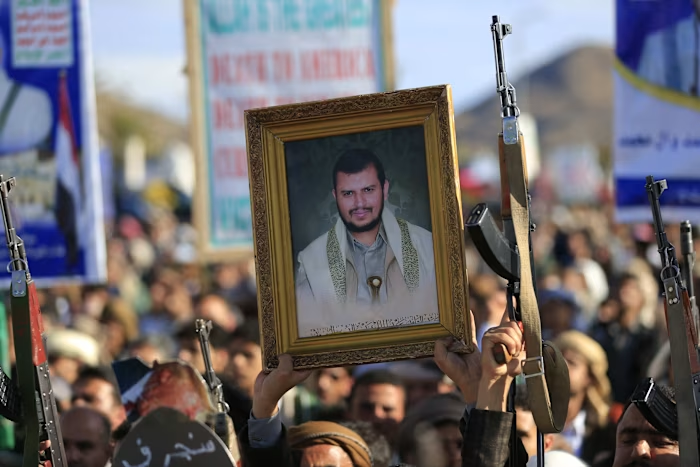

Last month, as Yemen’s Houthis seized territory along the Red Sea, bombed Saudi energy facilities and attacked Riyadh itself, the rebel group’s enigmatic leader outlined his demands from a hideout in the mountains.
The Houthis, who control part of northern Yemen, wanted access to the country’s oil and gas revenues, Abdulmalik al-Houthi said, as they demand compensation for damage suffered during years of conflict with the Yemeni government and its Saudi backers. Saudi Arabia and Yemen must also allow free movement through Houthi-controlled ports and airports, he added.
But al-Houthi went further, saying Riyadh’s ties to Washington – and by extension Israel – made it an unworthy guardian of Mecca, suggesting Yemenis would be better suited to guard Islam’s holiest city.
“We are also the most devoted to Mecca and the Kaaba, and those who have the most right to support and defend them, rather than the perfidious and proxy Saudi regime,” he said.
Al-Houthi’s speech captured the Islamist movement’s wide range of ambitions, which range from financial gain and military victory over rivals to aspirations – rooted in its fundamentalist worldview – to expand its power and influence in the region.

While the Houthis’ campaign aims on the one hand to “blackmail” Saudi Arabia financially, said Farea al-Muslimi, a Yemen and Gulf researcher at Chatham House, “in the long term, I think they want to rule the entire Arabian Peninsula. But for now, inside Yemen.”
Nothing suggests that his grandest goals will ever be more than fantasies. But the group’s spectacular progress since the resumption of conflict with Saudi Arabia in July nonetheless poses the greatest threat to the kingdom in decades.
This month alone, they have repeatedly struck Riyadh airport, killing 18 people, injuring hundreds and forcing it to close for several days. A wave of international events in the kingdom have been canceled or postponed, threatening Crown Prince Mohammed bin Salman’s ambition to make Saudi Arabia an economic hub. And they even struck the headquarters of Saudi Aramco this week.

There is no indication that the Houthis have been held back by a recent Saudi-backed counteroffensive, which aimed to recapture territory captured by the militants. Instead, they moved toward a new target, encircling the densely populated government-held city of Taiz. The UN warns that supplies of life-saving aid to 800,000 people in the city have been interrupted.
Concentrated in northern Yemen, the Houthis follow a radical branch of the Zaydi branch of Shiite Islam, tracing their origins to the imams who ruled Yemen for centuries. The group would then launch an armed struggle against dictator Ali Abdullah Saleh, before taking advantage of the chaos that followed his ouster to invade the port city of Hodeidah and the capital Sanaa in 2014.
More than a decade of civil war followed, during which Saudi Arabia led a military coalition – including the United Arab Emirates – into Yemen in 2015 to restore the internationally recognized government. But the costly conflict turned into a quagmire for Saudi Arabia, and the Houthis retaliated by targeting Saudi infrastructure with missiles and drones until a 2022 truce, which lasted until July.
Throughout this period, the Houthis have deepened ties with Iran, which has long provided arms and training to the group in order to build an ally alongside regional rival Saudi Arabia. The rebels’ recent gains have cemented their status as the Islamic republic’s most powerful regional proxy force.
The Houthis “have become much more sophisticated, have developed new and more advanced technologies with the Iranians, with the support of the Chinese and the Russians,” said Sanam Vakil, director of the Middle East and North Africa program at Chatham House.
Analysts, however, debate the extent of Iranian control over the Houthis, saying the group is the most independent member of Tehran’s so-called “resistance axis.”
But the increased pressure on Riyadh nonetheless aligns with Iran’s own goals of driving up global energy prices and opening a new front in its confrontation with the United States and Israel, experts say.
“I don’t think the Houthis need to be ordered around by the Iranians at this point,” said Yasmeen Al-Eryani, executive director of knowledge production at the Sana’a Center think tank. “Now we are at a stage where we can say that Sanaa and Tehran are the same fighting arena.”

“As Iran feels the economic pinch, it just needs to shift some of that pressure to Saudi Arabia,” said Ambassador Barbara Leaf, who served as US assistant secretary of state for Near Eastern affairs in the US Biden administration.
However, Leaf said the Houthis’ “appetite and ambitions were stimulated by the war in Gaza,” when the rebels began firing missiles and drones into Israel and sailing into the Red Sea following the October 7, 2023 Hamas attack and the Israeli offensive into the Palestinian territory.
“They do not see themselves as a junior partner of Iran, much less a proxy,” Leaf added. “They see themselves as a power in their own right. They are determined to demonstrate it.”
One of the immediate triggers for the breakdown of the ceasefire came after Riyadh bombed an airstrip at Sanaa airport in July, saying it was trying to prevent the landing of an Iranian plane while it was carrying Houthi members from a trip to Tehran.
In response, the Houthis declared a blockade of Saudi ports and outlined their financial demands, which included payment of salaries in Houthi-controlled areas as well as access to Yemen’s oil revenues and compensation for war damages.
The Saudis have resisted and airstrikes in support of pro-government Yemeni forces have thwarted the Houthis’ ambitions to conquer the whole country, where they are despised by many.
Analysts say the repeated attacks on Saudi Arabia are aimed in part at forcing Riyadh to back down militarily, raising the cost of supporting the Yemeni government and leaving rebels better positioned to confront the country’s fractured anti-Houthi resistance.

“They will want the Saudis not to support the Yemeni government,” said Sascha Bruchmann, a researcher at the International Institute for Strategic Studies think tank, even as “the Saudis are leading a concerted effort to try to stiffen the backbone of the anti-Houthi forces.”
Experts have divergent views on what it will take for the Houthis to halt the latest wave of escalation. Some see the intense strikes against Saudi Arabia as a harbinger of negotiations. “Usually with the Houthis there is maximum escalation before any type of negotiation,” said Fatima Abo Alasrar, an expert at consultancy Red Sea Futures.
But others say that as long as they remain in an ascendant position militarily, the rebels have little incentive to retreat. “Nothing will bring the Houthis to the negotiating table as long as they have the upper hand,” Al-Eryani said.
Cartography by Cleve Jones
Gn world