What is optogenetics? Nobel Prize winner Karl Deisseroth explains how light could help treat brain disorders

The 2026 Nobel Prize in Physiology or Medicine was jointly awarded Monday to Karl Deisseroth, Peter Hegemann and Georg Nagel for their work in optogenetics, a field of neuroscience that studies the activity of individual neurons to link them to specific behaviors.
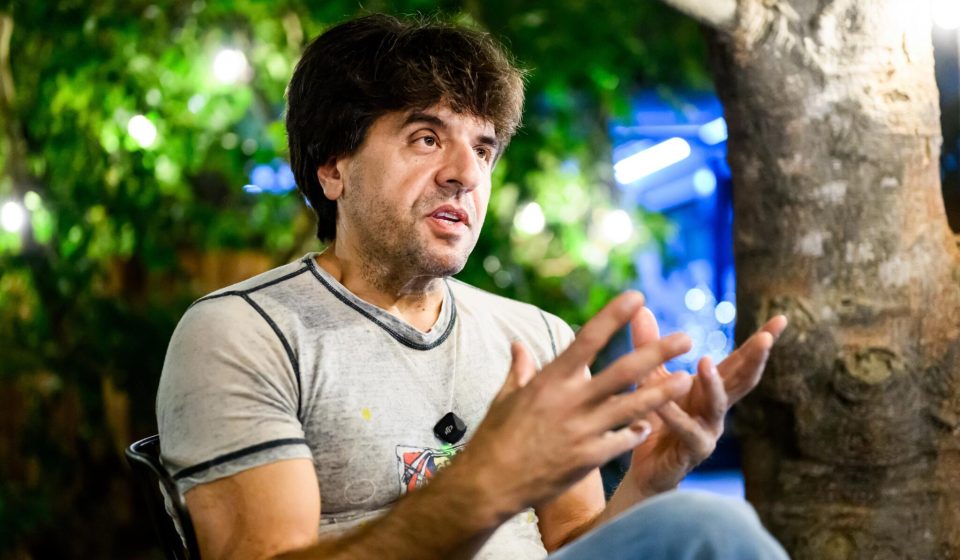
Here and now Host Robin Young spoke with Deisseroth, one of three Nobel Prize winners and a professor of bioengineering, psychiatry and behavioral sciences at Stanford University, shortly after learning he had won the prestigious prize.
“It was very disorienting, unexpected,” Deisseroth, a Boston native, told Young. “I was a bit of a night owl, but I was working late, I had just gone to bed, and I was in the interface between sleeping and waking up. And then the call came, and so I didn’t know if it was a dream or not. I’ll tell you that.”
4 questions to Karl Deisseroth
What is optogenetics?
“What we discovered is how to use light to control brain cells.
“And so, it’s different from how you normally think of light as an imaging tool to look at things. In this case, it’s totally different. We’re using light to make things happen, to turn cells on or off, but deep down in a functioning brain in an animal or even a person that moves and behaves and lives.
“And it’s so powerful because what we can do is make cells sensitive to light by introducing a gene from algae. From single-celled algae that gives rise to a light-sensitive ionic current, a flow of charged particles, which is electricity. So basically, long story short, we can use light to create electricity in exactly the cells that we give the gene to.”
And maybe change the way the brain reacts to something?
“Yes, for example. So normally we take for granted the choices we make and the priorities we think. Of course, survival drives like hunger and thirst will do what it takes to fulfill them. If we need to feed our young or if we need to be aggressive or defensive, we will do what we need to do.
“In reality, all of these actions and priorities are set by cells, and cells are competing with each other and deciding what to do based on the connectivity of neural circuits. And what optogenetics has allowed us to do is to pick that apart and say, ‘OK, here’s why this action is taken, here’s why this priority rises to the top, and here’s how to change it.’
“So it’s interesting to get to this level of understanding why we do what we do.”
You are also a psychiatrist and we read that your work made you very frustrated because you could not explain to patients why they were suffering. Is that part of it?
“Yes, that’s absolutely true. So psychiatry is probably the area of medicine that most needs such explanatory power. Why does something happen? What is the biological basis for it? And part of that is not because of a lack of effort or trying, but because the brain is very complicated. It’s very difficult to study, very fragile and complex.
“And what optogenetics does is it gives us the tools to break through that complexity. Optogenetics is fast. Optogenetics is precise, just like the brain. So we can follow the brain and make things happen.
“As a psychiatrist, it’s so exciting to look at this and think, ‘Oh, this is a way for us to come to a deeper understanding of ourselves.’
How can this discovery be used to treat people?
“This has already been tested in blind humans, and it’s a disease called retinitis pigmentosa, which is characterized by cell loss due to neurodegeneration.
“And optogenetics has been used to give these people sensitivity to light and allow them to see things they couldn’t see before. And that’s just one example of many.
“But once you understand the cells that matter, which is what we’ve been missing for so long in psychiatry. Once you understand the cells that matter, you can design any kind of treatment. You can design a drug that targets those anchored cells for the first time and knowing what matters. And that’s the real power of optogenetics because it tells you what matters.”
This has been edited for clarity.
Hafsa Quraishi produced and edited this interview for broadcast with Michael Scotto. Scotto adapted it for the web.
This segment aired on October 5, 2026.
Gn headline