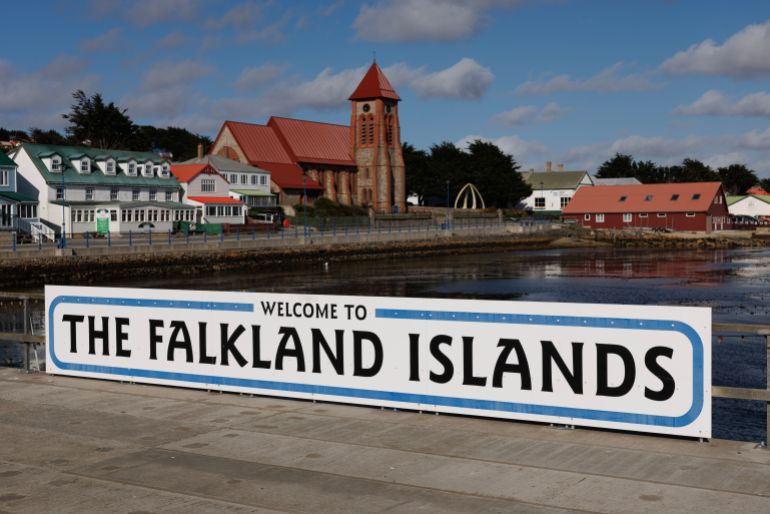
What is the Falklands oil project at the heart of the latest row between the UK and Argentina? | Oil and gas news

The UK has vowed to defend its interests in the Sea Lion project to develop an oil field near the Falkland Islands, as Argentina filed a court case over offshore oil exploration, citing environmental concerns.
Attorney General Ellie Reeves, representing the UK government at the International Tribunal for the Law of the Sea (ITLOS), said billions of pounds vital to the future of the Falkland Islands would be lost if Argentina succeeded in blocking the project.
The Hamburg-based court sits for two days as Argentina seeks an interim ruling to suspend oil drilling.
Reeves also said Argentina’s objection to the project was rooted in its territorial claims. “The hearing is not about the sovereignty of the Falklands,” the British prime minister’s official spokesperson said on Monday, echoing his country’s position that the island’s sovereignty is non-negotiable.
The dispute is the latest in growing tensions between the United Kingdom and Argentina over the British Overseas Territory in the South Atlantic Ocean.
Here’s what we know:
What is it about?
Sea Lion Development is an Anglo-Israeli venture aimed at drilling for oil in waters administered by the Falklands.
British company Rockhopper Exploration and Israeli company Navitas Petroleum, operator of the Sea Lion oil field, located about 220 km (137 miles) from the islands, are expected to start the project in March 2027, with oil production expected to begin in 2028.
According to Rockhopper Exploration, the Sea Lion exploration field contains approximately 1.7 billion barrels of oil in place, of which 500 million barrels are recoverable resources.
However, Argentine President Javier Milei announced measures to block the development in September and said in a message on X that he had instructed the country’s foreign ministry and legal teams to initiate arbitration proceedings against the UK.
“If in two weeks the UK does not end this illegitimate exploitation, we will go to the International Tribunal for the Law of the Sea. THE MALVINAS ARE ARGENTINA’S, and they are defended by facts, not words,” he wrote, using the Argentinian name for the Falkland Islands.
Argentina formally filed a complaint with the court seeking interim measures against the United Kingdom on October 13.
The United Kingdom has administered the Falkland Islands since 1833. However, because the territory lies off the coast of Argentina, Buenos Aires claims sovereignty over what it calls Las Malvinas.
Milei also threatened tougher sanctions against companies involved in the oil exploration project, preventing them from operating in Argentina’s oil and mining sectors.
Milei’s government says the project violates a United Nations resolution calling on both sides to refrain from unilateral action in the islands until their dispute over sovereignty of the territory is resolved.
But Jorge Emilio Nunez, professor of legal philosophy at Manchester Metropolitan University, explained that the question of sovereignty over the Falklands is at the heart of the proceedings.
“The oil project is the current trigger, but it adds to deeper competing claims over title, islander self-determination and control of surrounding maritime spaces and resources,” Nunez told Al Jazeera.
“This is not just a legal dispute. It also involves domestic politics and the prestige of leaders on both sides. When valuable natural resources become commercially viable, the underlying territorial disagreement is reactivated and reframed through legal, environmental and economic arguments. The question of resources does not replace the sovereignty conflict; it intensifies it.”

What was said in court?
On Tuesday, Reeves told the Law of the Sea Tribunal, which makes legally binding rulings on maritime disputes, that Argentina wanted to “take control of these resources for itself.”
“The interim measures requested by Argentina would prevent the people of the Falkland Islands from developing their natural resources as they are entitled to do, in accordance with their fundamental right to self-determination,” she said, according to The Guardian.
“The measures requested would have devastating consequences for the people of the Falklands. They stand to lose billions of pounds, which is essential to the economic development of the islands.”
But Argentine lawyer Mario Oyarzabal argued that action was needed to block the project.
“(Argentina) respects the interests of the islanders and their way of life as enshrined in the Argentine constitution… What these British citizens do not have is the right to decide to which state the islands belong,” he said during the hearing, the Guardian reported.
“These resources belong to the Argentine people. Some 46 million of them, including the 1,247 inhabitants born on the islands, whose interests will be duly taken into account,” he added.
In 2013, residents of the Falkland Islands voted overwhelmingly to remain in the UK, despite demands from Argentina.
What did the British government say?
On Monday, the British Prime Minister’s official spokesperson Andy Burnham told the independent media outlet that the UK was “fully engaged in the UNCLOS (United Nations Convention on the Law of the Sea) process, and we will clearly state our position on Argentina’s request for provisional measures before the Tribunal.”
“We will continue to vigorously defend our interests and those of the people of the Falkland Islands,” the spokesperson added.
Last month, Burnham also discussed the attempt to block the oil project during a call with US President Donald Trump.
“The Prime Minister discussed the economic consequences of Argentina’s coercive measures for the United Kingdom and the United States and reiterated the importance of respecting the right of the islanders to develop their natural resources,” Burnham’s office said.
What are the latest developments?
Strained relations between the UK and Argentina remain tense and heavily focused on the Falkland Islands.
Milei took advantage of Trump’s refusal to say whether Washington would support the UK in a future conflict over the Falklands after the US president criticized London for not doing more to support the US during its attacks on Iran.
In September, Milei said the “winds of change” were blowing in Argentina’s favor regarding its sovereignty claims.
“The United States is considering this change in position because it knows that Argentina has a reliable partner, aligned with Western values, in a strategically important position and who can be a valuable ally in the decades to come,” Milei said.
At the same time, Argentina is preparing for elections next year, where stopping the Sea Lion project could improve Milei’s position in the polls.
For Nunez, the tribunal could have a “modest national impact” in the country.
“A visible legal success would allow the government to claim that it is actively defending national interests and resources, because the issue of the Falklands and Falklands has strong symbolic weight (the slogan “Las Malvinas son Argentinas” is still, intentionally, widely used),” he said.
However, he noted, “a setback could be used by opponents.”
“Overall, although this case will be used for political purposes in Argentina, Argentine voters tend to prioritize economic performance over the evolution of the sovereignty conflict. »
Gn world