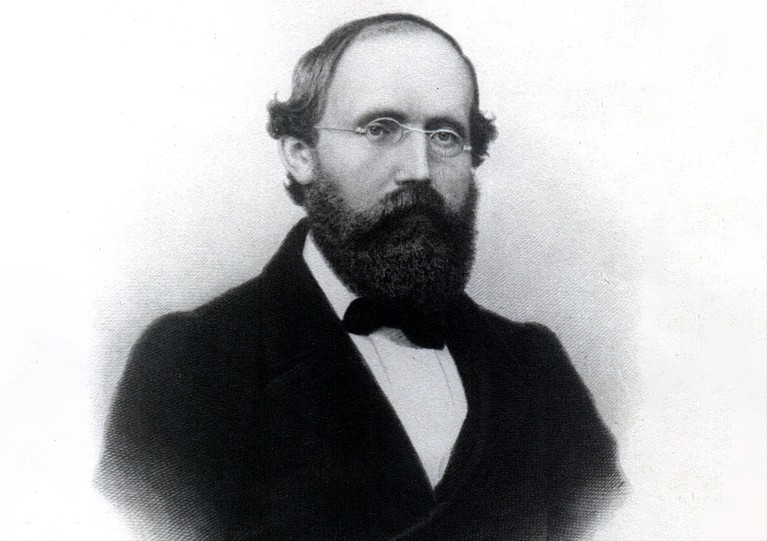

The German mathematician Bernhard Riemann formulated his famous conjecture in 1859.Credit: Smithsonian Libraries and Archives (CC0)
On November 20, mathematicians made two competing announcements about solving the Riemann hypothesis – perhaps the most important open problem in mathematics.
The question had remained unanswered since it was formulated in 1859 by the German mathematician Bernhard Riemann (1826-1866). His statement is at the heart of the theory of prime numbers, whole numbers that cannot be divided equally by any other number except themselves or 1.

AI is “the end of mathematics as we know it” – where does this field go next?
The hypothesis concerns the distribution of prime numbers, and it is important because these numbers are at the heart of all mathematics. “There is nothing more fundamental in mathematics than prime numbers,” says Álvaro Lozano-Robledo, a mathematician at the University of Connecticut in Storrs.
Riemann arrived at his idea by studying prime numbers as waves – in a way that foreshadows the way music recordings are compressed into mp3 files – and his hypothesis is usually described in abstruse-sounding language. But basically the idea boils down to a statistical test familiar to any scientist who has ever analyzed data.
Nature destroys the Riemann hypothesis.
What do prime numbers have to do with statistics?
Mathematicians want to know how predictable prime numbers are. German scientist Carl Friedrich Gauss (1777-1855), considered by many to be the greatest mathematician in history, noticed in the late 1700s (when he was a teenager) that if one chooses an integer, the chances of it being prime depend on the size of the number. Prime numbers slowly become rarer as numbers become larger. Gauss observed that their frequency seems to depend on (or is inversely proportional to) the number of digits. Basically, among the numbers with k numbers, one on each k one of them is first.
By Riemann’s time, half a century after Gauss’s supposition, there was still no rigorous proof of this. In a historical article from 1859, Riemann declared that the late Gauss, who had been one of his mentors at the University of Göttingen, was right.
But Riemann – who was a “bold” thinker, says mathematics historian Rossana Tazzioli of the University of Lille in France – went much further. He proposed that “one on each k“The guess was a good statistical prediction, meaning that the frequency of prime numbers should not deviate too far from it. In other words, Riemann made a guess about the margin of error of Gauss’s prediction.
If true, this “Riemann Hypothesis” would make the behavior of prime numbers similar to that of a random process, such as a series of coin flips. Specifically, he suggested that when counting prime numbers among the prime n whole numbers, the fluctuations would take a form familiar to many scientists: “The idea of the Riemann hypothesis is that the error term looks a lot like √nwhat any random model will give you,” says Andrew Granville, a number theorist at the University of Montreal in Canada.

Mathematicians amazed by AI and human-written proofs of iconic Riemann hypothesis
Such square root terms appear everywhere in data analysis because they control the reduction of a margin of error as the number n of data points increases.
What evidence did Riemann have to support his hypothesis?
In his article, Riemann did much more than guess. He introduced tools that would form the basis of much work in number theory – the branch of mathematics concerned with integers, prime numbers, and divisibility – over the following centuries.
First, developing new analytical techniques – another word for advanced computing – over time, Riemann built the “Riemann ζ function’ (ζ is the Greek letter “zeta”).
Riemann then showed that the function contained a huge amount of information about the prime numbers. First, he proved that the solutions of the equation ζ (z) = 0 — where z is a point on a plane – encodes the statistical distribution of prime numbers along the number line. To do this, Riemann used a type of Fourier analysis, the type of calculation that today allows music to be compressed into compact mp3 files by breaking down sound waves into sinusoidal components.
What is the relationship between prime numbers and sound?
Gn bussni