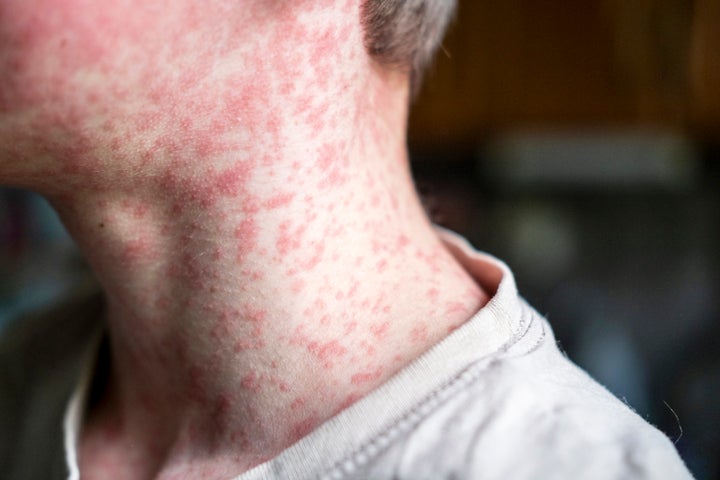

The first rash didn’t seem to worry Mike Z.’s doctor. Mike, then 26, had spent days in a hospital waiting room with a severe sinus infection when he reported a rash he noticed spreading all over his body. The doctor called it an allergic reaction and prescribed penicillin.
The next morning, Mike noticed another rash on his chest, and this one looked nothing like the first. “Because it was so sudden, I went to the emergency room,” Mike, who asked to use his last name when discussing his illness, told HuffPost. That’s when Mike was diagnosed with measles, even though he had received the MMR vaccine as a child.
Mike had a high fever and a deep cough, but the worst part was the rash, which had spread from his center to his entire body.
“My whole body hurt and itched,” he said. “Taking a shower was painful; even washing my hands hurt because the rash became painful when exposed to heat.”
Mike described the rash as so painful and itchy that he couldn’t sleep. “I tried every over-the-counter cream I could find, but nothing worked,” he said. “A lot of them made my life worse because of the extra scratching – my skin had micro-scratches that burned.” The most intense pain lasted two to three weeks, he remembers.
Mike’s case is an exception for MMR vaccines. Two doses are about 97% effective and breakthrough cases are rare. Pennsylvania, for example, recorded a 1,561 confirmed cases of measles at the time of reporting, and less than 1% of them were vaccinated.
This does not mean that the vaccine has failed or does not work. Dr. Paul Offit, director of the Vaccine Education Center at Children’s Hospital of Philadelphia, compared it to wearing a seat belt.
“We wear seat belts, which greatly reduces the risk of dying in a car accident,” he said. “That doesn’t eliminate it.”
For many adults, measles is unfamiliar territory. Mike grew up after the United States declared the elimination of measles in 2000 and never saw anyone get it. Many adults today have never seen what measles looks like; many dismiss it as “just a rash.»
“When we eliminated measles in 2000, we eliminated the memory of measles,” Offit said. “People don’t remember how sick or dead this virus can make you.”
On November 17, the United States officially lost its measles elimination status. Of the cases in Pennsylvania, more than 315 people are hospitalized and eight have died from measles. Most patients are adults.
“We seem to be focused on vaccinating children. … Adults who have never been naturally infected … and who for whatever reason have not been vaccinated are now at high risk. And they are more likely to develop severe disease,” Offit said.
Many younger doctors have also not seen measles, and cases are often missed early on since the rash appears about a week after contracting the disease.
It started like the flu, Wesley D., 32, told HuffPost. Wesley, who asked to remain anonymous to speak about his condition, said he received two doses of MMR as a child, as required by his school. He described a sudden fever, a persistent dry cough, and an inability to digest any food.
“Every morning I woke up and felt a little better, but once I was awake for a few hours in the afternoon, I started feeling worse again,” he said. “Sleep was incredibly unpleasant. I felt like I had never really fallen asleep – I was tossing and turning; my muscles felt this kind of slight pain.”
About a week later, Wesley saw spots on his face and panicked. His doctor diagnosed him with measles, but Wesley’s first blood test came back negative. Her doctor believed it was drawn too early and that early tests could miss an active measles infection, according to the Centers for Disease Control and Prevention.
The doctor also told Wesley that he had probably been contagious the week before when he thought he had just had the flu. The CDC reports that measles spreads to other people four days before the rash appears until four days afterward. If someone has measles, up to 90% of people around them who are not immune will also be infected, the CDC says.
“I’m someone who will shake off a cold, flu or fever and continue to live life normally,” Wesley said. “But the measles was really nasty. It was the sickest illness I’ve ever felt, and when it lasts that long, it really starts to make someone almost angry and frustrated. It goes on and on.”

Natalya Maisheva via Getty Images
Why losing elimination status is so worrying – even if you’re vaccinated
Not all vaccinated people benefit from the same protection. People born after 1989 received two doses, which Offit said provide about 97% to 98% protection. People born between 1968 and 1989 are likely to have received a dose, about 93 to 94 percent. Dr. Gregory Poland, director of research at the Atria Research and Global Health Institute, said adults vaccinated in the 1960s may have received a vaccine that did not protect them.
If you have already received two doses of the MMR vaccine after your first birthday, you are considered protected and do not need another dose, HuffPost previously reported. You can check with your parents or your state’s immunization registry to find out your vaccination history. If you were born before 1957, you are also considered immune.
If you cannot find your vaccination record or if you received the vaccine between 1963 and 1967, it is recommended that you receive a booster shot (unless you are pregnant or have severe immune deficiencies; consult your doctor first). There is no harm in getting another dose of the MMR vaccine if you are already immunized, according to the CDC. You can also take a blood test, called a titer test, to check for measles antibodies – a positive result indicates immunity.
Poland said measles is the most contagious disease known to humans. He compared it to the flu: if you got the flu, you could pass it on to a few people. With measles, you would spread it to 12 to 16 people, and they would spread it to 12 to 16 other people each.
“It’s becoming exponential; I think people don’t realize that,” Poland said. “They don’t realize it’s not just a low-grade fever and a childhood rash. It can be a life-threatening illness, a morbid illness when you look at the complications.”
Vaccinated people who get measles usually have milder illness, but the illness itself can be serious.
“About one in a thousand people will develop encephalitis,” Poland said, referring to brain swelling. “About 10 people in 100,000, so it’s quite rare, will develop SSPE, subacute sclerosing panencephalitis, from which you die. There is no treatment.”
Overall, of people who contract measles, about 20% will end up in hospital and about 80% will develop immune amnesia, Poland said. Immune amnesia occurs when the virus erases a body’s immune memory cells and makes it harder to fight other germs. Mike believes he suffered from immune amnesia after contracting measles in 2024.
“I was constantly sick for a year,” Mike said. “Seasonal flu hits a lot harder now.”
Vaccination is not a force field. How protected you are also depends on the person around you, Offit pointed out. “If you live in a highly unvaccinated community, you are more likely to contract the virus than if you live in a highly vaccinated community.”
The issues go beyond personal preferences. Immunocompromised people cannot receive the vaccine, Poland said, so “they are entirely dependent on the immune status of those around them at school, at work, at church, in the community, whatever it may be.”
“It hasn’t changed my mind about vaccines,” Mike said of his experience. “It made me even more worried about the lack of vaccines. You wish more people had been vaccinated, so I could have been spared.”
Gn Health