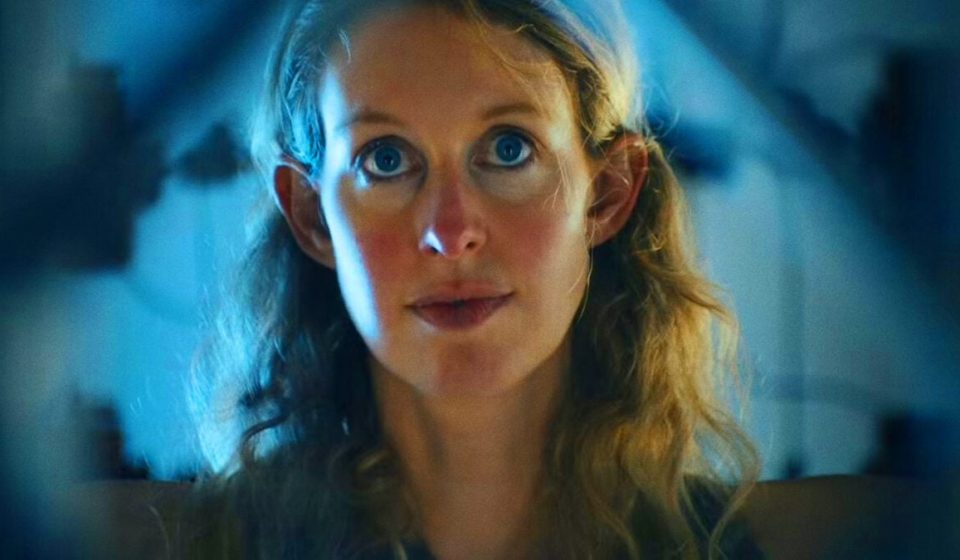
The sublime documentary by Nathan Fielder and Lance Oppenheim, You can see everythingestablished itself as a seismic cultural event. The three-hour film that reprized the speech had a historic opening weekend at the box office, maintained its momentum in its second weekend expansion to 2,655 screens and is already poised to chart uncharted territory at next year’s Oscars. All this with a logline that seems almost cheeky and quaint once you’ve seen it: Fielder camps out with disgraced Theranos CEO Elizabeth Holmes and her family during her final weeks of freedom before the start of her 11-year federal prison sentence.
I entered my YCSE a screening with no expectations of what was going to happen, content to just sit back and let the maestro work. It’s a testament to Fielder’s genius that, even with this blank slate in place, I left the theater not only with my head swimming in questions about Holmes’ work, but also questioning my own.
I will join the chorus of critics and audiences who urge you to go see this generational film – in theaters, and as soon as possible, knowing as little as possible – before its virality turns every new conversation into a potential spoiler minefield. That said, while I will try to thread the needle by discussing certain parts of YCSE without revealing its magic tricks, if you have not yet attended a screening, read ahead at your own risk.
Perhaps because I, too, earned a college degree in business before embarking on a creative career focused on what I could do, I always felt a certain kinship with Fielder. I’ve been proselytizing about his reality-distorting projects since the pilot episode of Nathan for youa show that culminated with that of 2017 Looking for Francesa series finale that was itself a stunning investigation into the malleable space between reality and fiction in which documentarians operate. When it aired, industry luminary Errol Morris hailed Fielder’s documentary debut as “one of the most interesting reality-based works ever made.” We didn’t know what was going to happen. As the scale and scope of Fielder’s projects grew, those of us who had witnessed his career parasocially nodded quietly in approval from the growing herd. More were finally seeing the world through Fielder’s prism, where rules are invented or unspoken, as well as potential instruments of their own circumvention.
But then Nathan pulled a trick that no one saw coming: using the second season of The Rehearsal to affect material change in real life. Old fourth wall breaks like Dumb Starbucks were fun, but fleeting portals to alternate dimensions. Passing a bill through the Senate that impacts the future of air transportation leaves an indelible mark on this world. We suddenly had proof that Fielder’s powers were more than just comedic tools. They could be the vector of essential improvements. What else could he do, given the budget and the freedom?
Whether he likes it or not, YCSE It seems our common existence is also on the verge of extinction, if only as a flicker of disbelief as literacy rates fall off a cliff while the risks of obfuscation of truthfulness multiply. The new document does this by relying on Looking for Frances‘s seminal text with a deeper dive into the blatantly corrupt outcome of a feud over narrative control. Although many facets of the human condition are addressed over the course of these three hours, the central themes explored are the intrinsic unknowability of the interiority of others and the difficulties that opacity presents when attempting to seek and present the truth, whether in a legal, journalistic or artistic framework.
The film audit begins with a quote published in The New York Times it strengthened the case against Holmes, but she disputes ever saying it. It’s the first of many words and actions that Fielder and company scrutinize, all through the prism of a horror film, resulting in a story of an unreliable narrator that ends up feeling more like The thing that Rashomon. However, the film’s brilliance truly blossoms once Fielder expands his field of vision beyond attempts to uncover the truth in a few moments with his hosts and begins to grapple with the existential factors that muddle his own lens.
How can a documentarian hope to establish the authenticity of a simulacrum of “real life” that is artificial and often controlled by its subject? Given enough time devoted to a subject, could even the most honest and well-intentioned effort to present the truth be unconsciously thwarted by the familiarity-based biases that might infiltrate within the documentarian? Even if these pitfalls are overcome or accepted as the cost of doing business, what is the best way to proceed?
Like many great magical acts, YCSEIllusions involve (figurative) mirrors. It was Fielder’s exploration of the above topics and the shock of suddenly seeing my own reflection that gave me one of the most unexpected surprises in a film already full of them: a new pair of eyes to look at my own industry and career. I’ve now seen countless metatextual discussions about the film spread across social media platforms and among my friends like wildfire — still-shocked viewers feverishly unpacking not only every element of this story on and off screen, but also how it fits into our shared reality. It’s clear to me that there’s a certain appetite for some sausage-making secrets in the world of tech journalism. Because what I disclose is essential to understanding how a scandal like Theranos could have happened. It’s also, hopefully, a wake-up call that creates some basic skepticism about how a company is presented to you in the media.
The price of access
Much like the filmmakers of the documentary, I recently received an unexpected invitation to personally observe something I probably wouldn’t have studied organically. Mine came from NordVPN as a press trip offer to take me to the company’s headquarters in Vilnius, Lithuania. Their email pitch stated that I would be part of a “small group of American journalists” who would learn about the dark web at the company’s Cyber City campus before attending a startup show the next day. Frankly, none of these prospects excited me much. However, it is my personal policy to never refuse free trips to unknown destinations. So I responded to Nord with my RSVP and set the wheels in motion.
I’m a freelancer, beholden to the approval of no particular media outlet, and I’m at a point in my career where I’m confident in my ability to unearth a story of intrigue in any foreign ecosystem I parachute into. I would do so during my trip to Lithuania with Nord, as I have done in many other countries as a guest of various entities, including regional tourism boards, a bottled water company, and even a mobile game developer. I made each of these trips with the firm intention of finding a story. In almost every case, I achieved my goal. What I have never done (and I always make it clear that I will not) is offer the travel supplier any assurances about what type of item they can expect from me, if any. Even if some “coverage” were a natural byproduct of my visit, there is no guarantee that the topic, angle, or tone I choose will please my benefactor.
There have only been a handful of blatant quid pro quo offers that I have been forced to flatly refuse over the years. Usually I am simply presented with offers that are fully aware of and consistent with these stipulations. Because why go through the sordid business of attaching conditions to anything when the SOPs of a tacit agreement worked so well to achieve their end goals?
The already obviously strained relationship between journalist and subject became exponentially more thorny once the powerful realized they could stealthily reach the public via a Fourth Estate Trojan horse. By welcoming journalists into spectacle and convivial spaces where products and people are presented in their most flattering and managed light, PR teams promoting something (whether an in-house team or an external outsourced company) accomplish far more with these proactive charm offensives than they would by getting the message across with an ad buy.
With every successful function, activation, event, and trip where journalists like me are wined, dined, and offered the kinds of experiences and products that the customers these companies are trying to reach have to pay their hard-earned money for, the basic objectivity of the work we’re supposed to do is eroded a little further. The line between professional and personal life is blurring. The symbiotic relationship is growing between two factions that, in theory, should be at least somewhat at odds.
My Gizmodo contract is pretty lax when it comes to press trips, allowing them on the condition that I “disclose in the story that the company paid for (my) travel and lodging,” which NordVPN did, excluding the extra day I spent doing touristy things at my own expense.
However, concerns about possible irregularities and the effects of gifts on journalistic integrity (or, at least, the public’s perception of them) led to the establishment of blanket prohibitions on staff accepting trips, samples, etc. in most hardline investigative media. But even these institutions often create or absorb designated sponsored content (“SponCon”) derivative sites (e.g., The New York Times‘s Wirecutter) which allow them to continue to accept gifts, maintain B2B relationships and collect all the advertising and affiliate link revenues that these highly frequented “reviews” generate in a consumerist society like ours. This is a technical separation of church and state, occurring at this very moment…
Gn entert