November 4, 2026, 10:59 a.m. ET
If you own stocks, you may be wondering what the midterm election blue wave means for the stock market and your 401(k).
Is the market thriving after a historic election day? Will traders care if American voters end Republican control of Congress?
Apparently the answer to both questions is yes.
Morningstar looked at 100 years of U.S. stock returns during election months and found that elections tend to boost the market.
This year is no exception. Stocks soared on November 4, following decisive Democratic victories across the country. The Dow Jones opened up 2.1%. The S&P 500 rose 1.8% in early trading. The tech-heavy Nasdaq rose 2.5%.
“The election results have brought an end to uncertainty, which is generally welcomed by markets,” said Dan Lefkovitz, Morningstar index strategist and author of the Oct. 21 report. “Now speculation begins about the political implications and what the election could mean in terms of taxation and spending, regulation and debt.”
Since 1926, Morningstar found, stocks have performed better in November in election years than in non-election years. In an average election year in November, shares rose 2.4%. In an average non-election November, shares rose just 0.9%.
“It seems like there is a post-election pop,” Lefkovitz said.
November is a good month for stocks, period, Lefkovitz said. This is a time of increased consumer spending, as the holidays approach.
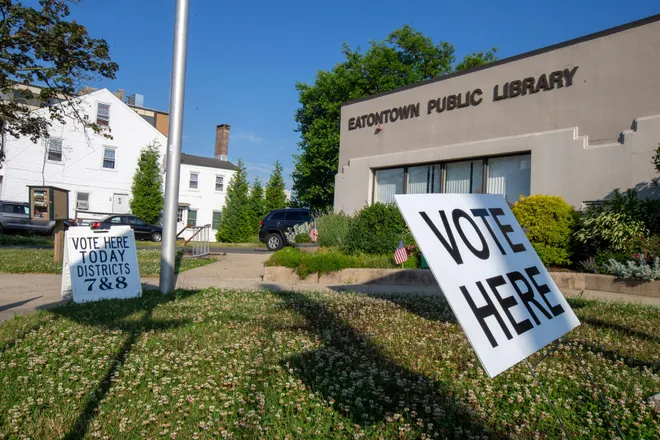
Election day took place peacefully. The market responded
As the 2026 election approaches, media coverage has focused on the possibility of the federal government intervening in the vote or questioning the results.
As it turned out, the midterm elections passed with only minor voting hiccups and no reports of major interference from either party. Many contests weren’t even close. President Donald Trump has indicated he will accept the results. All these things should boost the stock market, investment experts believe.
“It was a very divisive midterm, and now it’s in the rearview mirror,” said Chris Grisanti, chief market strategist at MAI Capital Management.
“The fact that the president went on the air last night” and said he would support the election results “was a big deal,” Grisanti said. “And so, we don’t need to spend weeks debating whether (Democratic Senate candidate James) Talarico really won Texas. That was a big deal, too. The Democratic victory was that big. The saying is ‘too big to fake.’ There’s no debate on the sidelines on this one.”
Chaos could still descend on the 2026 midterm elections. Losing candidates could refuse to concede, question the results, or even claim widespread electoral fraud. New seeds of uncertainty could sink the stock market. It’s already happened.
The best way for an investor to respond to this scenario is to do nothing, said Lou Whiteman, stock analyst at Motley Fool.
“Remain optimistic about the country,” he said. “Remain optimistic, even if it takes a few days, things will be resolved.”

Why do stocks rise during election months?
The data doesn’t tell us why stocks improve in November in election years, but researchers have a theory: Elections put an end to things.
“Markets hate uncertainty,” Lefkovitz said. “So getting past the election ends the uncertainty. It allows markets to move forward.”
The two worst election months for the stock market were in 2000 and 1948, Morningstar found.
In 2000, uncertainty persisted for several days after a presidential election that was too close to call. The 1948 election was close enough to result in the famous headline “Dewey Defeats Truman,” shaking the markets.
If these scenarios provide any indication, Lefkovitz said, it’s that the stock market likes elections with clear winners.
Do stocks do better under unified or divided government?
One of the big questions looming over the 2026 midterm elections was whether the elections would result in a unified or divided federal government. Voters answered this question emphatically, putting the House and Senate under solid Democratic control. Two years of unified Republican government are coming to an end.
Which is better for the stock market, divided or unified government? Morningstar also looked into this question.
The analysis found that stocks have performed better under a unified federal government over the past century, with past gains averaging 1.2% per month, compared to 0.7% per month under divided government.
This conclusion flies in the face of conventional Wall Street wisdom, which suggests that divided government might be better for the stock market. Here’s the surprising reason: a unified government is more likely to pass policies, and policymaking can hinder business activity.
“Markets actually performed better overall under unified government than under divided government,” Lefkovitz said, “but they performed well in both cases.”
This is how the market behaves before and after the election
Several other financial firms contributed by analyzing stock performance before, during and after the federal election.
A report from BlackRock reveals that annual stock returns tend to be lower over the medium term. Over the past century, stocks have risen an average of 7.5% in mid-term years and 12.4% in non-mid-term years, according to the analysis.
If this is the rule, this year could prove to be an exception. The S&P 500 is up about 12% in 2026, as of October 29.
A report from Fidelity reveals that stocks tend to perform well in the 12 months following a mid-term fiscal year. Since 1950, the S&P index has gained only 4.9% in the 12 months before the midterm elections, but 14.5% on average in the 12 months afterward.
Motley Fool reports similar results.
“The biggest thing we see after the election is we move from talking about what could happen to talking about what happened,” Whiteman said. “It’s uncertainty, or not knowing what the future holds, that tends to give traders goosebumps.”
Gn bussni