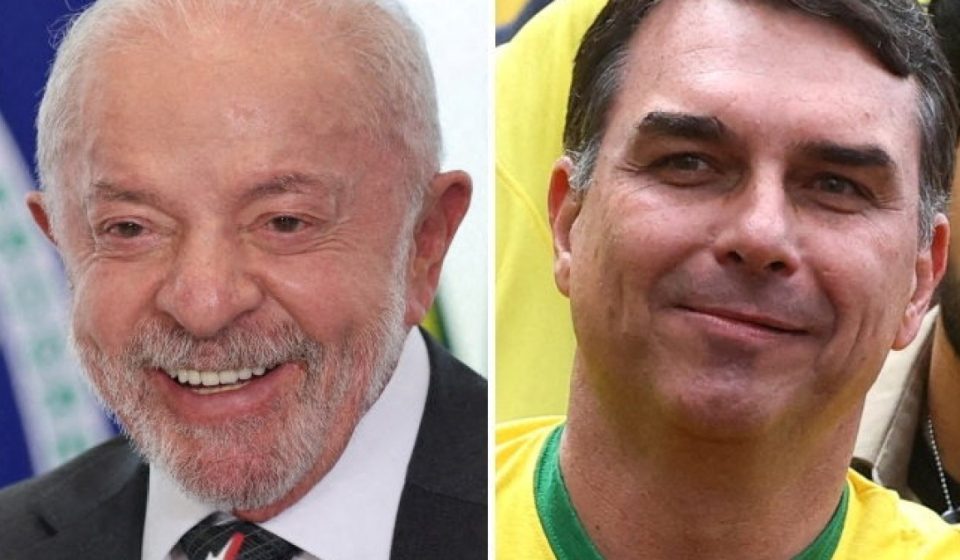

For the second consecutive election, Brazilian voters must choose between left-wing candidate Luiz Inacio Lula da Silva and a right-wing candidate from the Bolsonaro family.
The country’s tough elections are expected to take place amid a wave of winning far-right candidates across Latin America and a sensitive period in Brazil’s modern political history.
Recommended Stories
list of 3 itemsend of list
Former right-wing President Jair Bolsonaro is serving a 27-year prison sentence for his role in a coup plot following his defeat by Lula in 2022. The conviction of Jair Bolsonaro and several military officers has raised questions about the resilience of Brazil’s democracy, revived decades ago after a period of rule by a U.S.-backed military dictatorship.
An explosive corruption scandal has implicated figures and institutions across the political spectrum, and observers have expressed concerns about possible U.S. intervention.
Polls suggest that Lula, the current president who is seeking a fourth nonconsecutive term, and Bolsonaro’s eldest son, Senator Flavio Bolsonaro, are virtually tied in a simulated runoff.
Who are the candidates, what issues have been at the forefront and what could the elections mean for Brazil? Here’s what you need to know about Brazil’s 2026 presidential elections.
When do the elections take place?
The first round of the Brazilian presidential election will take place on October 4 from 8:00 a.m. to 5:00 p.m. Brasilia time (11:00 a.m. to 8:00 p.m. GMT).
If no candidate wins the first round, the top two candidates will proceed to a second round on October 25.
Who is Lula?
Luiz Inacio Lula da Silva, better known simply as Lula, is the country’s current president and the candidate of the Workers’ Party, or PT.
The 80-year-old has been a central figure in Brazilian politics for decades, having served two four-year presidential terms between 2003 and 2011, and his current term, which began in 2023.
His tenure was defined by an effort to combine political democracy, restored after a U.S.-backed military dictatorship that ruled the country for several decades until the 1980s, with material improvement for the country’s poor through a series of social programs intended to combat inequality.
Lula also sought to forge ties between non-Western developing countries on the world stage.
“He became the embodiment of the institutionalization and consolidation of Brazilian democracy since the end of the dictatorship,” Andre Pagliarini, assistant professor of history and international studies at Louisiana State University and author of a book on Lula, told Al Jazeera.
Who is Flavio Bolsonaro?
Flavio Bolsonaro has become the heir to his father’s status as leader of Brazil’s political right and the main challenger to Lula in the 2026 elections. Bolsonaro is running as a candidate for the right-wing Liberal Party.
This 45-year-old man is the eldest son of former President Jair Bolsonaro.
Flavio pledged to take a tough stance on crime and insecurity and to work closely with the administration of US President Donald Trump, who has designated several criminal groups in Brazil as “terrorist organizations”.
He also promised to rein in inflation and public spending, with one adviser saying he would implement a debt cap if elected.
Flavio Bolsonaro has also sought to turn his father’s conviction into a story of political persecution, denouncing his trial as illegitimate and calling for his release from prison.
“I ask God for the opportunity to climb the ramp of the Planalto Palace next year alongside President Jair Messias Bolsonaro, so that he can place the presidential sash on my chest,” he said at a campaign event in September.
“The Bolsonaro family’s narrative is that the institutions that Brazilian democracy has erected since the end of the dictatorship are rotten and unresponsive, and that we must radically move away from this status quo,” Pagliarini said.
“The stakes in this election are incredibly high because the candidates hold very opposing views on what Brazil’s recent history means,” he added.
What issues defined the race?
As in many recent elections in the region, crime, insecurity and cost of living issues dominated Brazil’s elections. Corruption and concerns about U.S. intervention in the country’s internal affairs also dominated the campaign.
A September 7 Quaest survey found that 31 percent of respondents cited violence as their biggest concern, followed by 20 percent who cited corruption, 19 percent who cited the economy and 12 percent who cited health.
While Brazil experienced decent economic growth and low unemployment and inflation during Lula’s third term, this slight progress was accompanied by explosive levels of household debt and concerns about the rising cost of living.
A report from the Center for Economic and Policy Research, a left-wing US think tank focused on economic issues, found that extreme poverty in Brazil fell by about 40% between 2022 and 2024, unemployment fell to historic lows and the country’s economic growth far outpaced that of most of its neighbors. But the analysis also found that households were being strained by a sharp rise in the cost of servicing debt. Overall, analysts say they provide a view of the economy that is neither catastrophic nor particularly satisfactory.
Pagliarini says both candidates attempted to steer the election onto more favorable terrain for their pet issues, with Lula portraying Flavio Bolsonaro as a willing accomplice to U.S. efforts to undermine Brazilian sovereignty, and Flavio Bolsonaro accusing Lula of being corrupt and weak on crime.
What do the polls say?
Analysts say the polls reflect the state of Brazilian politics: deeply polarized but unenthusiastic.
“The general mood is that this is a very pessimistic campaign,” Pagliarini said. “There’s not a lot of enthusiasm anyway, and it’s hard to say at this point who it favors.”
Most surveys show a close race, with Lula holding a marginal advantage over Flavio Bolsonaro, which tightens further in a hypothetical runoff.
A Quaest survey from September shows Lula with 37 percent voting intentions to Flavio Bolsonaro’s 33 percent, while an AtlasIntel survey from the same period shows Lula winning 46 percent to Flavio Bolsonaro’s 43 percent.
A Datafolha poll gives 40 percent to Lula and 36 percent to Flavio Bolsonaro.
Polls also show that Flavio Bolsonaro is preferred to Lula on the issues of inflation, the fight against corruption, crime and drug trafficking, while Lula is seen more favorably on the issues of poverty and inequality, foreign affairs and health.
What challenges did each campaign face?
An explosive corruption scandal, focused on disgraced banker Daniel Vorcaro, has raised questions in both campaigns and implicated members of the country’s political and business elite from across the political spectrum.
Reports emerged that Flavio Bolsonaro had solicited substantial funds from Vorcaro, apparently to finance a documentary – The Dark Horse (or O Azarao) – about his father.
Lula’s former finance minister, Guido Mantega, also said he helped arrange a meeting with Vorcaro, Lula and the head of Brazil’s central bank to discuss banking policy. Lula said he told Vorcaro that there would be no political interference in his bank’s matter, but only a “technical investigation carried out by the central bank.” The Reuters news agency confirmed the meeting.
The scandal has also implicated the country’s Supreme Court, with Alexandre de Moraes, whose central role in the Bolsonaro coup trial making him a subject of anger for the political right, facing questions over his own ties to the banker.
De Moraes in turn accused a judge appointed by Bolsonaro of wrongdoing, with the court considering investigating the conduct of both judges.
What are the concerns about US intervention?
Fears that the Trump administration could intervene or seek to influence the outcome on Bolsonaro’s behalf have also loomed over the election.
The US president has frequently threatened to withhold economic aid to Latin American countries if his preferred candidate fails to win. Trump had also used sanctions to target members of the Brazilian judiciary involved in the case against the elder Bolsonaro, which he called a “witch hunt.” Trump also imposed heavy tariffs on Brazil in an effort to have the case thrown out.
The country’s government has denied visas to two U.S. officials seeking to travel to Brazil, saying they planned to sow doubt about the integrity of Brazil’s elections. Lula’s government has warned the United States against interfering in the country’s internal affairs.
Trump himself has used false claims of widespread fraud to justify his efforts to stay in power despite his 2020 election defeat.
A group of 31 Democratic members of the US Congress recently sent a letter to US Secretary of State Marco Rubio criticizing “an apparent attempt to interfere with, and potentially undermine” Brazil’s elections.
Reuters reported that Brazilian intelligence officials also briefed a French and German delegation in September about the possibility of election interference from outside powers such as the United States and Russia. The officials said U.S. interference ranged “from legal intervention to openly acknowledged interference.”
Gn world