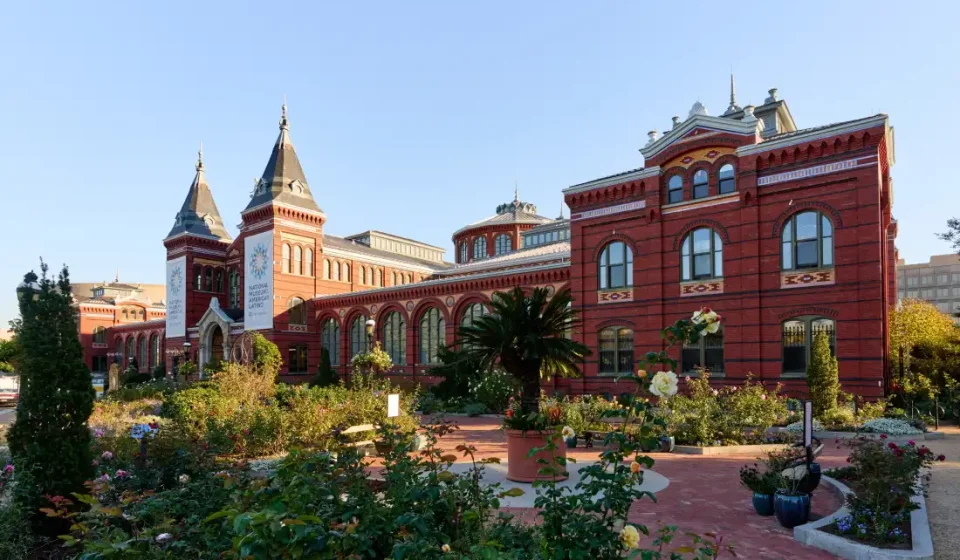

The Smithsonian Arts and Industries Building in Washington, DC is being renovated to house the institution’s newest museum: the National Museum of the American Latino.
Noah Willman/The Smithsonian Institution
hide caption
Noah Willman/The Smithsonian Institution
Before the National Air and Space Museum, before the National Museum of Natural History, the Smithsonian had only one museum: the United States National Museum. It’s now the Arts and Industries building, and it’s been empty for years.
But this fall, the Smithsonian Board of Trustees announced that the oldest of its museum buildings would be renovated to house the institution’s newest museum: the National Museum of the American Latino.
An artifact from the “Red Brick City”
Many of the National Mall’s older museums are neoclassical in style, with symmetrical white facades and prominent columns. Not the Victorian Arts and Industries Building. It is made of red bricks with geometric patterns, towers with pointed roofs and arched windows. Its rusty color makes it almost a sister building to the castle, the Smithsonian’s oldest building, which sits right next door.
These buildings may look like outliers on the Mall, but they originally looked like much of Washington.
“Washington, D.C., was once called the Red Brick City,” said Carly Bond, director of historic preservation at the Smithsonian. “This building is truly one of the last remaining red brick buildings.”

A close-up of the building’s intricate brick work. Brick was an excellent choice for museum buildings because it is fireproof.
James Ward/Smithsonian Institution
hide caption
James Ward/Smithsonian Institution
Brick was an excellent choice for museums; according to the Smithsonian website, the material was “modern, economical, and (above all) fireproof.”
Inside is a cathedral of light. There are intricate designs on the walls, patterned floors with occasional fossils embedded in the marble, colored glass in the windows. The metal roof is surrounded by wrought iron trusses. There are towers, a mezzanine and even a secret tunnel that leads to the castle underground. It is considered one of the finest remaining examples of 19th-century World’s Fair architecture and is listed on the National Register of Historic Places.
New or reinvented
For a time, Latin American museum leaders thought they wanted a new structure designed for them, like the iconic one that houses the National Museum of African American History and Culture, opened in 2016.
Eventually, they realized that the graceful old Arts and Industries building, with its vast expanses of open space and multiple side galleries, would be ample space for exhibitions, research areas and services. Museum management says it plans to preserve the building’s historic details.
The Arts and Industries Building was built in 1881 and has actually been closed since 2014. And there is challenges of converting an older building that has been closed for a while, some major.

The Arts and Industries Building, shown while it was under construction in 1879. The United States Capitol is visible in the upper left corner.
Smithsonian Institution Archives
hide caption
Smithsonian Institution Archives

The Arts and Industries Building, shown while it was under construction in 1879. The United States Capitol is visible in the upper left corner.
Smithsonian Institution Archives
Architect Jennie Gwin, partner and director of historic preservation at the firm Beyer Blinder Belle, who previously studied the building for the Smithsonian, addressed some of these challenges: temperature and humidity controls, ensuring airtightness to preserve the collections, reducing asbestos, updating modern security and technology. And then there are all the review processes required by being a federal building in Washington, DC.
“But the Smithsonian did a really good job taking care of the building. They didn’t just lock the doors and walk away,” Gwin said. “They replaced the roof, replaced the windows and did some structural work, so the building has been very well maintained, even though it hasn’t been used very much.”
It’s also easier, she said, to renovate a building like Arts & Industries, which was previously a museum, rather than renovating a building originally built for a different purpose. Additionally, she added, museums are constantly evolving: even those that are in constant use need to be updated.
A long history
The Arts and Industries Building is the second oldest building in the Smithsonian and the first built as a museum.
The idea was born in 1876, on the occasion of the country’s centennial, when an international exhibition was held in Philadelphia. American exhibits featured everything from a steam locomotive and a demonstration of Alexander Graham Bell’s telephone to root beer and stuffed animals. The exhibit became the foundation of the National Museum of the United States and the seed of the Arts and Industries Building. It was designed to be similar in style to the main Philadelphia Exhibition Hall and to accommodate many of the same exhibits.

Interior of the Arts and Industries building with the Spirit of St. Louis airplane hanging from the ceiling.
John Dillaber/Smithsonian Photo Services, Photo/The Smithsonian Institution
hide caption
John Dillaber/Smithsonian Photo Services, Photo/The Smithsonian Institution
Over the years, as other Smithsonian museums opened, objects in the National Museum’s collection migrated up and down the mall. A row of spiky rockets, once lined up like soldiers in front of the Arts and Industries Building, now sits at the National Air and Space Museum, as does Charles Lindbergh’s plane, The Spirit of St. Louis, which once hung from the ceiling. The mineral and animal exhibits formerly presented at Arts et Industries were transferred to the National Museum of Natural History. The original exhibit on First Ladies’ dresses opened in Arts and Industries in 1914 – a version of it is now at the National Museum of American History.
“It’s really been an incubator,” Bond said.

Exhibition of First Ladies at the Arts and Industries Building, when it was a museum.
John Dillaber/Smithsonian Photographic Services/Smithsonian Institution
hide caption
John Dillaber/Smithsonian Photographic Services/Smithsonian Institution
The last major public exhibition at the Arts and Industries Building was during the country’s bicentennial in 1976. After that, the building was used primarily for personnel purposes, although for a few months last summer there was a folklife exhibit and market in honor of America’s 250th anniversary.
The next chapter
Now, the interior of the building will be reconfigured to accommodate the National Latin American Museum.
The museum was authorized by Congress in 2020. Since then, museum staff have assembled an advisory board, acquired a collection and are traveling to communities across the country to ask people for their stories.
Jorge Zamanillo, founding director of the Latino Museum, said they want people to feel comfortable when they walk in, to know right away that even if they feel like they’ve never been included in a museum before, they are now.

A huge rotunda sits at the heart of the Smithsonian Arts and Industries Building.
Eric Long/The Smithsonian Institution
hide caption
Eric Long/The Smithsonian Institution
“We’re not creating a single narrative for this museum. It’s more about exploring all the different stories that we can capture across the United States. We know that some of us are immigrants, some of us have connections to natives, so how can we do that?” Zamanillo said.
“They tell this powerful story of hundreds of years of Latinos in the United States, creating this identity, forging the American identity.”
When Zamanillo looks around the space, he imagines exhibitions, a research center, a theater. He said he imagines people who felt excluded before seeing their story finding a permanent home.
“And it will be in the heart of the National Mall. You can’t ignore that importance,” Zamanillo said. “People are passing by every day and they will finally be able to open these doors and come in.”
He said they plan to open these gates to the public in 2036.
Meghan Sullivan edited this story for digital and broadcast; LA Johnson retouched the photos. Chloee Weiner mixed the audio.
Gn headline