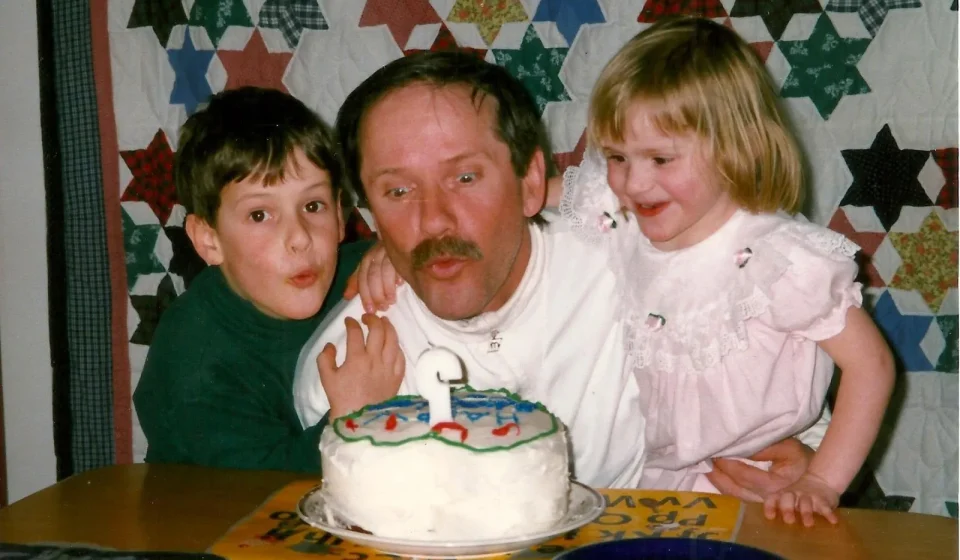
I was holed up in the kitchen cutting vegetables for dinner. I didn’t notice 5-year-old Rosalyn behind me until she blurted out, “Mom, I just went blind.”
My heart skipped a beat.
“What do you mean, you’ve gone blind?” I asked.
“I was watching TV and it was blurry, and I couldn’t see it anymore,” Rosalyn said.
My breath caught in my throat. My daughter ? Blind? Maybe all moms would be worried at this point, wondering if this could be something serious, but I had other reasons to be alarmed. My husband, then 50, was diagnosed with CADASIL, a condition that causes vascular dementia. An early sign of CADASIL is a migraine with auras, and in Rick’s case, his vision became blurry during a migraine.
“Do you even know what it means to go blind? I said trying to clarify the situation. Maybe she was standing too close to the TV. Maybe she was playing with her eyes, focusing and blurring them, testing the limits of her body. Maybe she was making a funny face. All this could cause his vision to become blurry.
“Yeah, that means you can’t see,” she said.

I felt a wave of tingling and anxiety course through me. I fought to keep my mind clear, but one nagging thought didn’t leave me: Was Rosalyn showing signs of this terrible disease?
Four years earlier, Rick’s mother had been diagnosed with CADASIL, an acronym that stands for autosomal dominant cerebral arteriopathy with subcortical infarcts and leukoencephalopathy. Basically, it is a stroke that can cause dementia. And the autosomal dominant part means that anyone carrying the gene has a 50/50 chance of passing the disease on to their children. This meant that Rick and his five siblings were all looking for a chance to have her. The neurologist who identified CADASIL in Rick’s mother was eager to learn more about this rare disease and track its spread in the family. With my encouragement, Rick agreed to get tested right after his mother’s diagnosis. The scientifically minded medical professional in me needed answers. Out of the whole family, I have had the most experience with dementia through my work as an occupational therapist. I had a vision of what that looked like and I didn’t want that for my family. But we were unlucky: Rick’s test came back positive: he had CADASIL.
Devastated and full of fear, I went into clinical mode, searching the medical literature for information that would ease the burden on Rick and his mother. But all I found out was bad news, that CADASIL is an incurable disease and the treatment options were unfounded – these are just the medical establishment’s best guesses. And even worse for our family, because Rick had the CADASIL gene, that meant our children also had a 50/50 chance of having it.
In this early phase, when our children were only 1 and 4 years old, I desperately wanted to know their fate. Unfortunately, for me, genetic ethics were at issue. Because CADASIL is an “adult-onset disease” and has no cure, medical ethics dictate that we wait until children are adults so they can decide for themselves. It’s a concept called “the right to an open future.”

I had to sit with the stranger. Terrified that my children might have the disease, I returned to the medical literature to research early signs and symptoms. Headaches, depression, learning difficulties, attention at school. I remained vigilant to the point of exhaustion, watching every movement, dissecting any unusual behavior, monitoring every bout of illness for a potential sign of CADASIL. Almost exhausted, I fell into a pattern of maladaptive denial, completely ignoring CADASIL, living our lives as if there were no illnesses lurking around the corner. Since Rick didn’t show significant signs of the illness at first, it was easy to fall into this cloud of denial.
Until a situation like that of Rosalyn’s “blindness”. Whiplash brought the same shock and terror as when Rick was first diagnosed. My desire to know his fate grew. Additionally, there were potential treatments that could delay the disease if she tested positive.
We took her to a pediatric neurologist, who was hesitant at first, but agreed to test her because she had this obvious symptom of CADASIL. A blood test and an MRI of his brain were performed. Then an interminable wait for the results – days or weeks perhaps; It seemed like months. Finally, we got the call. Her result was negative: Rosalyn did not have CADASIL. The relief was palpable. A child safe, at least, from this specific disease.
Over time, Rosalyn no longer had symptoms and I was able to let go of that bit of anxiety. I am grateful for this knowledge, but I confess that I still contemplate the and if. We briefly considered the ethical implications of diagnosing a 5-year-old with adult-onset dementia, but the neurologist missed an important step by referring us to a genetics specialist. Our decision after genetic counseling might have been not to do testing, in which case we would be unable to know. The tests had other implications that we didn’t have to face: what if the test had come back positive? Would I have treated Rosalyn differently and made different parenting decisions? Would knowing that it was positive be better than a wait-and-see approach?
I can answer this question because we had two children. And we did not and do not know the fate of our son, Calvin. Unconsciousness continued to haunt me. I still obsess over his every slide into depression, his inattention, his general health. Until now, my 34-year-old son did not want to know his status. He didn’t want a potential positive outcome to impact the choices he made in life. And if he was positive, he didn’t want to live with the burden of knowing his fate. The weight of not knowing became too much for him.
It will be tested soon. I’m relieved. I just want to know.
Mary Anne Moisan is a writer and retired physical and occupational therapist living in Maine. This essay is adapted from his upcoming memoir, An island offrom Vine Leaves Press in December 2026.
All views expressed in this article are those of the author.
Do you have a personal essay you’d like to share with Newsweek? Send your story to MyTurn@newsweek.com.
Gn Health