INDIA – 2025/05/13: In this photo illustration a Meta logo seen displayed on a smartphone with a Google logo in the background.
Sopa Images | Light flare | Getty Images
Google and Facebook have dominated the Internet for the past two decades, turning billions of eyeballs into billions of advertising dollars during that time. But with the ChatGPT era changing the way consumers interact online, businesses are diverging.
In the third quarter, Meta’s advertising business grew more than twice as fast as Google’s search and other units, supporting Mark Zuckerberg’s assertion that his company’s investments in artificial intelligence are leading to better targeting tools for brands to promote goods and services on Facebook and Instagram.
Google’s problem is that chatbots are becoming an alternative to search, leading consumers to click on far fewer blue links and hurting Google’s advertising revenue. Anthropic Chatbot Claude and Meta’s recently launched Muse assistant add to the mix. Meanwhile, users are spending more time scrolling through Instagram, giving Meta more advertising opportunities.
“It’s a double-edged sword, because as AI revolutionizes discovery, people might stumble upon tools they prefer better than Google,” Nate Elliott, AI analyst at Emarketer, told CNBC in an email. “If ChatGPT, Claude or Muse do a better job of helping them find what they’re looking for, people’s search habits could change for the first time in a generation. That could be catastrophic for Google’s advertising business.”
Meta’s advertising revenue rose 26% in the quarter to $63.1 billion, up from $50.1 billion a year earlier, compared with 12% growth for Google’s search division, which brought in $63.4 billion. This 14-point growth gap is the largest in Meta’s favor since 2021, and it puts the two companies neck and neck in terms of size, although Google did get an additional $11 billion in revenue from YouTube in the third quarter.
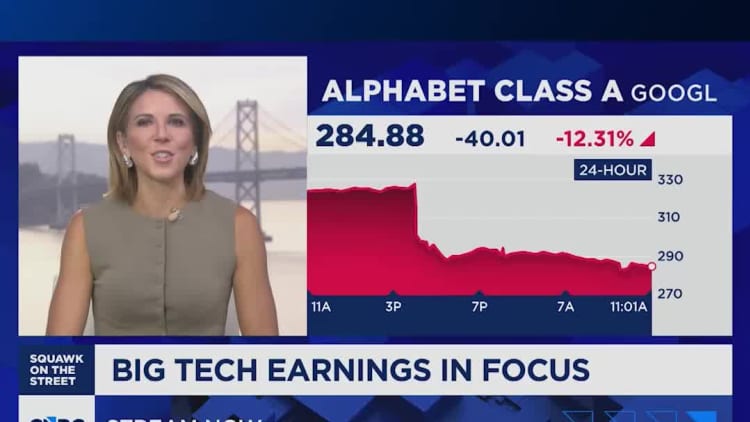
After releasing its disappointing third-quarter results on Wednesday, Alphabet suffered its worst trading day in history, plunging more than 12% and wiping out about $500 billion in market capitalization. Meta isn’t exactly a Wall Street darling at the moment either, as the stock fell 14% in October, its worst month since October 2022. That follows a 27% rise in September, which was its best month since November of that year.
Investor reactions reflect market nervousness surrounding the companies’ AI development, which has pushed both companies into negative free cash flow territory. Questions revolve around whether their historic spending on AI infrastructure will generate enough revenue.
Meanwhile, Meta and Google are aggressively trying to diversify their revenue streams. Meta, which still relies on advertising for almost all of its revenue, is investing money in AI models and agents to build a subscription business. Google already has a large and growing cloud computing division that just posted more than 100% growth to $31 billion in quarterly revenue, driven by demand for its infrastructure and custom AI chips called tensor processing units, or TPUs.
The post-Apple renaissance
The online advertising bonanza and the huge margins that come with it have catapulted both companies into leading positions and pushed their market capitalization into the billions.
Meta needed AI to bring its advertising business to life after Apple The iOS privacy change in 2021 significantly limited the company’s ability to target users on iPhones. The following year, Meta’s revenue fell for the first and only time in the company’s history.
The end of 2022 marked the launch of OpenAI’s ChatGPT and ushered in a new era of generative AI technology. While Meta initially struggled to find a cohesive AI strategy and fell far behind OpenAI and Anthropic in developing pioneering models, the company managed to integrate AI into its advertising products, giving brands advanced tools to reach users more effectively.
A year ago, the company unveiled the Meta AI sales assistant, which advertisers can connect to the Ads Manager system to help create campaigns and improve performance. Susan Li, Meta’s chief financial officer, said on last week’s earnings call that advertisers who adopted the system’s recommendations “drew nearly 5% more conversions” and “increased their ad spend by 9% compared to similar non- adopters.”
Li gave the example of syrup producer Simply Organic Maple and said the company, using the assistant, saw a 57% increase in purchases and a 36% decrease in cost per purchase. She added that in the third quarter, nearly 10 million advertisers used at least one of its AI tools.
Google has a similar opportunity with AI in advertising products on its properties, including YouTube.
Philipp Schindler, Google’s chief business officer, said during the earnings conference call that the company is rolling out its Gemini models “across our entire advertising infrastructure,” adding tools for advertisers and improving ad quality.
However, Google’s search engine competes directly with ChatGPT and Claude by showing more results through AI previews and AI mode, where users primarily get summaries rather than links to other sites. Search queries hit a record high in the quarter, Google said, but revenue growth is slowing.
“This will bring to the forefront fears of search cannibalization, compounded by META’s advertising strength this quarter and the ongoing threat of Muse/Agent,” UBS analysts wrote in a note after Google’s results.
Both companies are so optimistic about the potential of AI that they are pouring hundreds of billions of dollars into the infrastructure needed to create new models and services. Google plans up to $205 billion in capital spending this year, while Meta plans to spend up to $145 billion.
Advertising remains essential, but both are investing in a future that could be very different. Google is much further along in terms of diversification, with advertising now accounting for less than two-thirds of its revenue, while Meta still relies on advertising for 98% of its sales.
Still, Wedbush analysts view Google’s search monetization as critical to the investment thesis.
“GOOGL stock is unlikely to perform until the research narrative changes,” the analysts wrote in a report released Thursday. “And it will likely require new advertising products and evidence that it can monetize in the era of evolving AI, as it has in the past.”
— CNBC’s Jonathan Vanian and MacKenzie Sigalos contributed to this report.
WATCH: Alphabet’s earnings miss reflects the first real sign that AI is taking a bite out of search

Gn bussni