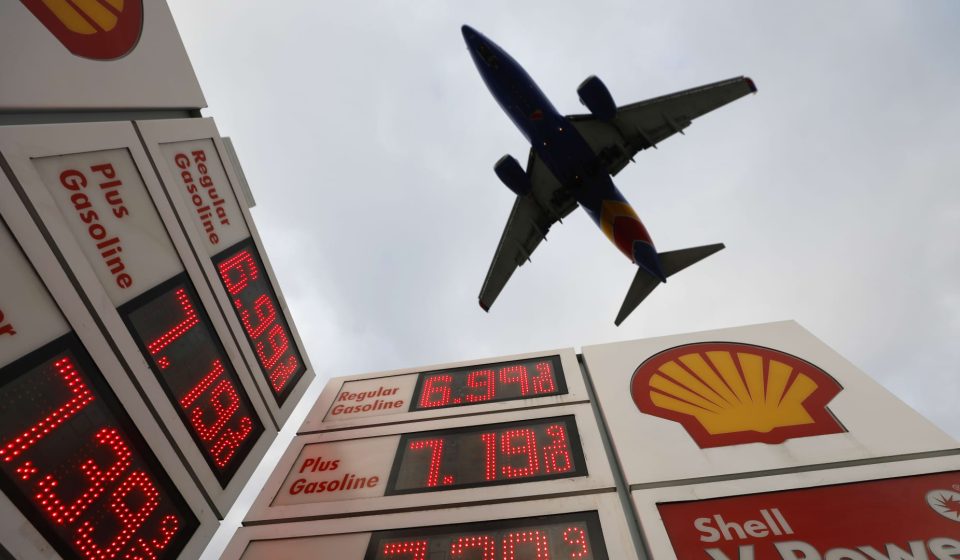

Gasoline prices are displayed at a Shell gas station as a plane approaches San Diego International Airport in California, April 24, 2026.
Kevin Carter | Getty Images
Volatile fuel prices and resilient travel demand threaten to keep airfares high this year. Airline profits will be harder to achieve.
The war in Iran that began in late February has propelled fuel prices to near-record highs, including for diesel, gasoline and jet fuel, airlines’ biggest expense after labor. Strait of Hormuz-related supply disruptions that have lasted most of this year and strong demand have pushed prices of jet fuel and other distillates higher than those of crude oil.
Airline executives do not expect a significant reduction in fuel costs in the near future, nor a drop in travel demand.
“You can’t run a business hoping that the Strait of Hormuz will open at some point,” Vanessa Hudson, CEO of Qantas Airways, told CNBC in an interview late last month. The Australian airline operates some of the longest flights in the world and is planning even longer flights for next year and 2028, starting routes between London and Sydney and New York and Sydney.
“There’s a backdrop of resilient demand in this environment. We’re making sure our capacity metrics are right,” she said.
Airlines are passing on rising fuel costs to consumers by raising fares, adding fuel surcharges or increasing their checked baggage fees. Truce talks between the United States and Iran since the spring have kept fuel prices volatile, but airlines are holding on to those fare gains as customers continue to book.
Carriers have also rushed to add more luxurious seats on board to capitalize on demand for more expensive, roomier offerings, sometimes reducing the number of standard coach seats to do so.
Slightly fewer people are flying this year compared to last year, but demand remains strong overall, even with higher ticket prices. Security screenings at U.S. airports decreased 1% this year through September 20 compared to the same period in 2025, according to a September 23 Bernstein memo.
Yet the latest US inflation figure shows airfares rose 23.4% in August from a year earlier. Holiday travel could increase even more. As of Sept. 24, fare tracking platform Hopper said domestic round-trip tickets cost $402 over Thanksgiving, up 31% from last year. Christmas fares in the United States, meanwhile, are up 23%, to $452 round trip.
These holiday visits are essential for many families, said Hayley Berg, an economist at Hopper, so many travelers might not like the fare but book it anyway. Berg said many customers grounded their flights for Thanksgiving and Christmas earlier than usual.
Although demand for business travel has been strong in recent months and off-peak travel is no longer a secret to savvy travelers, customers’ focus on these key holiday trips this year could mean deals will be struck in the meantime, Berg said.
“To me, that indicates that they’re already thinking about end-of-year trips and not thinking about any of these filler trips, fall trips,” she said.
Airline revenues rise, profit forecasts fall
Carriers are forecasting double-digit revenue growth for the third quarter as customers spend more. That’s even with slightly fewer people flying.
“I’ve never seen in my career, outside of the recovery from maybe the pandemic or 9/11…a revenue environment in terms of year-over-year improvement,” American airlines said CEO Robert Isom at a Morgan Stanley investor conference last month. The carrier has revamped its cabins to add more premium seats and other changes to catch up with competitors.
But despite the rise in fares, Wall Street analysts have lowered their profit estimates for U.S. carriers since another surge in jet fuel over the summer.
American said in July that it expected to lose between 10 and 70 cents per share, on an adjusted basis, for the third quarter and cut its 2026 earnings outlook.
Travelers at San Francisco International Airport in California, May 22, 2026.
David Paul Morris | Bloomberg | Getty Images
Investors and anyone looking to buy a plane ticket in the coming months will get an updated view of what to expect when airline earnings season kicks off Friday with Delta Airlines. The most profitable US carrier, which also benefits from its owned refinery, will report its third quarter results and give new outlook for the end of the year.
Wall Street will focus on the fourth quarter and beyond. Airlines are expected to lower their profit outlook for this quarter, said Savanthi Syth, an airline analyst at Raymond James.
She said carriers probably wouldn’t make as many across-the-board fare increases right now, but if jet fuel stayed in the $4 to $4.50 per gallon range, they would likely cut more flights, which could end up raising fares with fewer seats to choose from.
“You’re going to see a greater rationalization of capacity,” she said.
Eyes on capacity growth
Volatility in fuel prices encourages airlines to remain cautious. Carriers have reduced some of their schedules to eliminate unprofitable or poorly performing routes.
Along with the decline in routes, the collapse of low-cost carrier Spirit Airlines in May removed 1% to 2% of its capacity from the U.S. market, according to Barclays, meaning that low-cost and full-service airlines have enjoyed greater pricing power this year.
But if oil prices fall, investors will be watching to see if airlines significantly increase capacity, which could ultimately drive down fares.
“We expect higher booked fares to translate into similar fourth-quarter unit revenue trends for most airlines, but strong domestic capacity growth at American and United (+10% and +9% in current schedules) will likely be the most closely watched forecast by investors,” Barclays Airlines analyst Brandon Oglenski said in a Sept. 28 note. on planning assumptions for 2027.”
Gn bussni