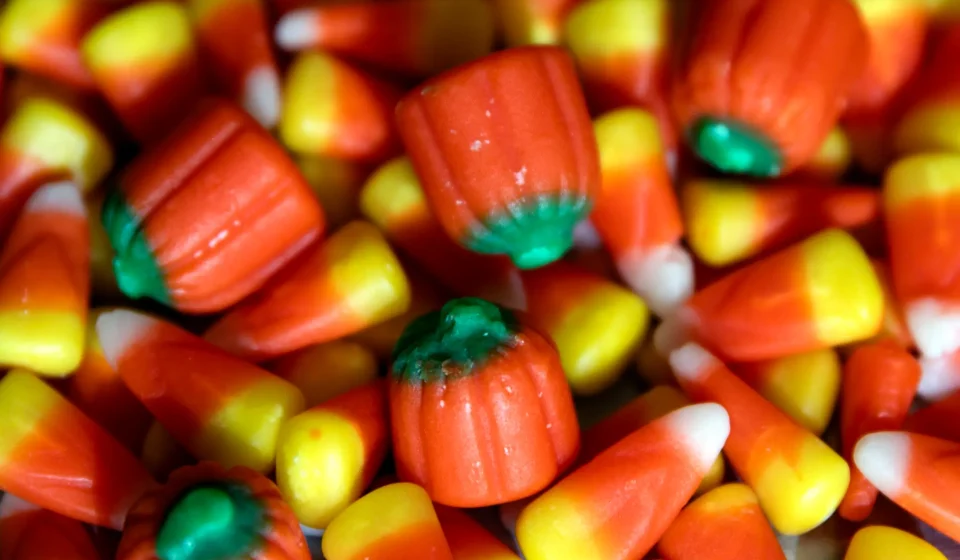
Every October, Americans find themselves divided over a Halloween staple scattered across orange and black tablecloths and mixed in with party favors: candy corn.
The tiny tricolor triangles have been around since the 1880s, known then as chicken feed and marketed to farming communities across the country. Eventually, candy corn became associated with the harvest and thus with fall, surviving more than a century of changing tastes, candy trends, and increasingly heated public criticism.
Some people look forward to their annual report, while others might prefer to eat the plastic spider rings stuck in the frosting of grocery store cupcakes.
Even the experts have chosen sides.
“I hate candy corn. I’m not a fan,” said Caitlin Clark, senior food scientist at the Spur Food Innovation Center at Colorado State University in Denver.
But Clark says there’s real science behind the great candy corn divide. And it turns out the problem may not be the taste of the candy, but the feel in your mouth.

McKenzie Lange/CPR News
It’s not just sugar. It’s the mouth feel.
Candy corn is a combination of sugar, corn syrup, fondant, marshmallow, gelatin, edible wax and artificial flavors molded into the kernels. And while its intense sweetness is enough to scare some people away, Clark suspects it’s not the biggest offense.
“The texture is pretty polarizing,” she said. “It’s like fondant and people either love it or hate it.”
Unlike hard candies, which have a smooth, glassy structure, candy corn contains sugar crystals that give it a crumbly consistency that people often refer to as waxy…and they’re not wrong.
“There is wax in candy corn. It’s a type of food wax called carnauba wax, and that’s what allows it to be shiny on the outside,” Clark said.
Then there’s another unfortunate feature: what Clark calls “teeth crowding.”
It’s the tendency of candy corn to get stuck in your molars.
Some people barely notice it. Others find this feeling impossible to ignore.
“The mouthfeel can be a little like that,” Clark said, comparing an unpleasant texture to the irritation of a splinter. “It’s hard to distract yourself from something that’s bothering you.”

McKenzie Lange/CPR News
But texture is still only part of the equation.
Our experience of flavor is a complex combination of taste, smell, and physical sensation. The tongue detects basic tastes like sweet, while flavor molecules travel to receptors in the nose from the back of the mouth when we chew.
And our brains don’t interpret all of these signals the same way.
“Different people respond differently to the same stimulus,” Clark said.
Some of these differences are physiological, including variations in our sensitivity to certain tastes. But candy corn’s staying power may have less to do with its flavor than with the memories attached to it.
A taste of nostalgia
Think about the foods you associate with the holidays. Maybe it’s your grandmother’s Christmas cookies, Thanksgiving stuffing, or those little marshmallow chicks that only seem to appear when spring approaches.
For some people, candy corn, which technically tastes like honey and vanilla, falls into this category.
Clark says our food preferences aren’t just influenced by what’s on our tongue. They are also influenced by childhood experiences, family traditions and the emotions we associate with certain foods.
“Holiday foods are tied to emotionally charged experiences, right? So it’s the way you grew up. Maybe it’s things you experienced in your relationships,” she said.
This means that someone who grew up eating candy corn every Halloween might associate its sweetness with treats, costumes, and happy childhood memories.

McKenzie Lange/CPR News
Someone else might remember their ex hitting them too hard while watching Friday the 13th, or getting it instead of a chocolate bar and being disappointed.
Yet despite his own strong feelings, Clark doesn’t think the candy deserves as much criticism.
“I don’t think anything deserves this level of vitriol. It’s just candy, right?” she said. “Everyone is going to like something and everyone is going to hate something. That’s why we have options.”
Perhaps the most reasonable version yet of a candy that’s either a Halloween treat or a trick, depending on who you ask.
Gn bussni