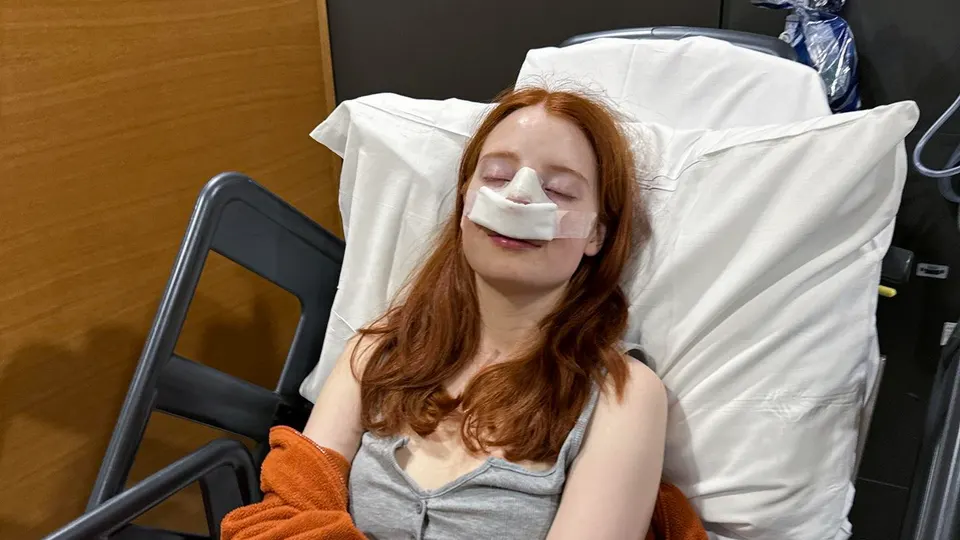


The gene that gives people red hair also appears to affect how their bodies deal with pain.
getty
People with red hair sometimes say that anesthesia doesn’t work as well on them. A common version of the story is that of a dental filling where the numbing injection didn’t really work and the dentist had to give a second one. It’s easy to dismiss this as a coincidence. But researchers have taken this idea seriously for more than two decades and found a plausible biological reason why it might be true.
That reason is a gene called MC1R, short for melanocortin-1 receptor. Almost all people with natural red hair carry variants of this gene that prevent it from functioning normally. Red hair is rare in the world, found in approximately 1 to 2% of people. It is much more common in parts of northern and western Europe, including Scotland and Ireland.
What the “redhead gene” normally does
MC1R is best known for its work in pigment cells. When the receptor is working as it should, it signals these cells to produce eumelanin, the dark pigment behind brown and black hair and behind tans.
When the receptor is weakened or deactivated, cells produce a different pigment. This, called pheomelanin, is reddish yellow and is what gives red hair its color. This also explains why many redheads have fair skin that burns rather than tans. In most cases, a person must inherit the variant from both parents to end up with red hair.
If that were the whole story, MC1R would be an appearance-related gene and nothing more. What researchers have learned is that it is linked to a much larger hormonal system in the body.
How the “red pigment” gene connects to pain
MC1R responds to hormones produced by the body from a common starting molecule called proopiomelanocortin, or POMC. This molecule is broken up into several smaller hormones. One of them tells the pigment cells what to do. Another is beta-endorphin, a natural pain reliever that the body produces itself.
Some of these hormones make the pain stronger, while beta-endorphin makes it weaker. Normally, the two remain in balance. When the MC1R doesn’t work as intended, this balance can change, and the change isn’t limited to the skin.
Animal studies provide the clearest picture so far. A 2021 study published in Scientific advances looked at red-haired mice carrying the same type of MC1R variant found in humans and showed that these mice could tolerate more pain than black-haired mice. The difference did not come from the red pigment. This came from changes in hormonal signals, which seemed to favor the body’s relief of pain.
What this could mean for anesthesia and redheads
In humans, a 2004 study published in Anesthesiology suggested that redheads needed a little more of certain inhaled anesthetics to be completely submissive. A 2005 study, also published in Anesthesiologyfound that local anesthetics, the type used to numb a small area, were less effective in people with red hair. Researchers also noticed that redheads tend to report being more anxious about going to the dentist. This makes sense if they’ve had more experiences with numbing that didn’t fully work.
But the relationship does not always go in the same direction. A 2005 study published in the Journal of Medical Genetics found that people with non-functional copies of the MC1R gene got a stronger effect from a morphine painkiller. If their natural pain relief system is already configured differently, a stronger response to opioids would suit this.
I want to be careful here, because the research doesn’t all agree. A 2024 review published in the Personalized Medicine Journal found that results vary considerably between studies. Some suggest that women with red hair may be more sensitive to certain types of pain. Others suggest that people with two copies of the variant have a higher pain tolerance.
The results of anesthesia are also mixed. Early studies reporting a difference were limited. A 2015 study published in the Canadian Journal of Anesthesia was much bigger. The study compared hundreds of self-identified redheads with similar patients during real surgeries and found no significant differences in the amount of anesthesia they needed.
One likely reason for this disagreement is that hair color is an imperfect way to sort people. Two people with similar red hair can carry different versions of the gene, and some people carry the variants without having obviously red hair. Different types of pain also travel along different nerve pathways, so a finding about one type of pain may not apply to another.
For patients, the stakes are lower than they seem. Anesthesiologists don’t give a fixed dose and walk away. They monitor each patient closely and adjust as they go, which is how differences between people are already handled. If you have red hair and the numbness has worn off early or isn’t settling in, it’s always worth talking to your doctor or dentist before a procedure.
Why This Matters Beyond Redheads
What I find most interesting is how much this has changed the way scientists think about MC1R. For a long time, it was treated as a pigment gene and nothing else. It now appears to be part of a hormonal network that affects several parts of the body, including how pain is felt.
The question of why red hair became common among certain populations remains open. A widely debated idea is that lighter skin helped people in cloudy northern regions produce enough vitamin D through limited sunlight, and that red hair took it with it. If this is true, the anesthetic effect was never the issue. This is a side effect of a trait shaped by sunlight long before modern medicine existed.
Surprised that a hair color gene could potentially shape the way redheads experience pain? See how much you really know about what’s going on in your own body with this scientific test: Human Anatomy IQ Test
Gn Health