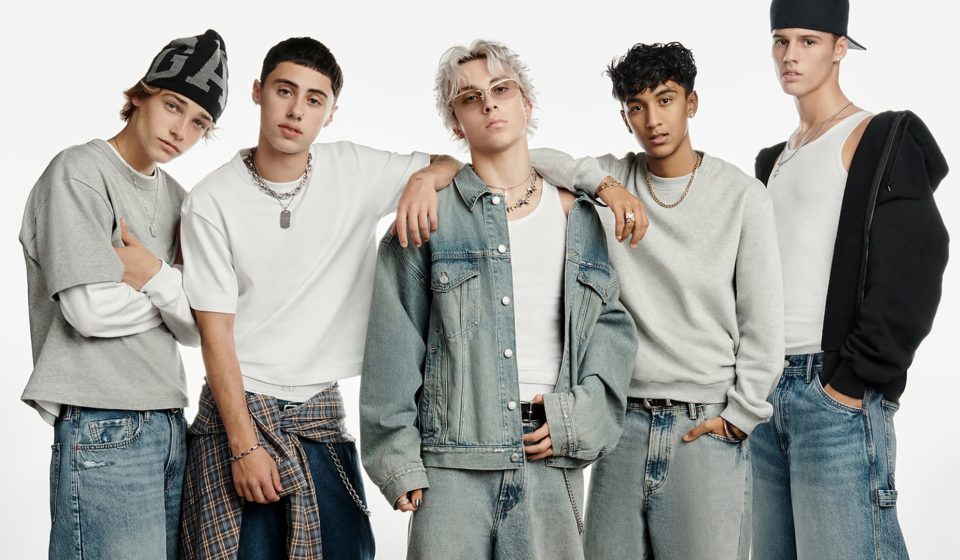
Gap Inc. has launched its first “fashiontainment” partnership, with emerging boy band Just Your Type.
Source: The Gap
Historical retailer Gap inc. made an unconventional hire earlier this year: an entertainment director.
This was a newly created role as the company called on former Primordial director Pam Kaufman to lead its entertainment, content and licensing platform. Since then, Gap has launched major campaigns, partnering with the likes of Just Your Type and building on the success of last year’s ads with girl group Katseye.
“Beloved brands have value beyond the products they sell. Consumers identify with them, trust them and want to be part of their world,” Kaufman told CNBC in a statement. “The key is authenticity: each extension must reflect what the brand stands for and offer its fans a new, meaningful way to experience it.”
She said it’s part of a broader goal to emphasize what Gap calls “fashiontainment,” a strategy to blend retail and entertainment to better align with consumers. Gap is part of a growing cohort of retailers investing in entertainment and experiences both in-store and through exclusive online content to drive engagement.
“Brands are stories, and we are the storytellers,” CEO Richard Dickson said at Goldman Sachs’ Global Consumer and Retail conference in September. “I think you’ll be able to see that come to life when you look at some of the work we’ve done, putting our brands at the center of culture and the cultural conversation.”
In another mix of retail and media, Mattel made waves a few years ago with its “Barbie” movie, leveraging the intellectual property of a decades-old fan favorite and achieving huge box office success. At the time, Dickson was president and COO of the company, witnessing the intersection of industries before leaving for Gap.
“I think post-Covid consumer attitudes toward shopping have certainly evolved a lot,” said Bryan Eshelman, who leads the retail practice at consultancy AlixPartners. “Shopping has evolved from being a task of accomplishment to shopping, in many cases, more as a form of entertainment.”
Between physical store experiences and media campaigns featuring exclusive content, Eshelman said, retailers are getting more creative in how they drive engagement and marketing.
“At the end of the day, community is one of the biggest ways to build customer loyalty, so I think retailers of all types are trying to tap into a certain sense of community, a certain lifestyle, a certain sense of belonging that goes beyond the product that they offer,” he said.
Branded entertainment has been around for a long time. Procter & Gamble made headlines in the 1930s for helping coin the term “soap opera,” and companies for decades created media campaigns to attract customers.
But with the rise of social media, content creation and short-form offerings, experts say audiences are hungry for something new and original more than ever.
Valuable gains in intellectual property
The intersection of retail and entertainment is occurring at a time when intellectual property is becoming more valuable than ever, experts say.
As consumers face marketing more than ever, the companies that will win the battle for attention are those that can “stand out from all the noise,” said Alex Michael, senior managing director at investment firm LionTree.
“The hardest thing to find and get is viewership these days,” Michael told CNBC. “Intellectual property, in this sense, is the most valuable thing there is, and it only becomes more valuable because it is tied to the public.”
At the same time, he said, the way intellectual property is distributed is expanding to include video, audio, short-form, long-form and live event content. Consumers are also redefining their loyalty to brands, meaning companies need to “play much earlier in the consumer journey” than in the past to earn their trust, he said.
This trend is also likely driven by executives who have worked in both retail and entertainment: Gap’s Kaufman came from Paramount, for example, and Ynon Kreiz, co-CEO of Dickson and Skydance, held senior positions at Mattel.
“The gray areas have never been more pronounced when it comes to what is classically defined as retail, media, entertainment or live events,” Michael said. “People with cross-industry expertise are increasingly valuable because they can’t be defined by a single vertical, especially since things are changing so quickly. »
Bridging the gap
Still, there’s room for new players, especially with the rapidly changing studio landscape, said Sean Akaks, CEO of SonderCo, an agency that matches brands with celebrities and entertainment properties.
“I think it’s a really interesting time for non-traditional players creating content because we’re seeing a massive consolidation of these traditional entertainment companies,” he said. “I think there are just more open avenues for independent creators, as well as brands and anyone outside of the traditional studio system, to create content.”
This is where retailers could tap creators, Akaks said, because they can use their platforms to reach consumers directly.
“I think there’s a world where we’re going to see creators and brands co-creating intellectual property that maybe they own together,” he said.
Once these companies draw consumers into the store, they also move toward experiential retail, making shopping a more immersive experience than it otherwise would be, as Dick’s Sporting Goods offering interactive activities and simulators in its stores.
According to data from AlixPartners, companies investing in experiential commerce like Coach And Ralph Lauren saw a nearly 10% year-over-year increase in the average consumer basket size.
“The idea that retailers would potentially invest in distributed electronic content to help drive traffic, and then once there, it’s experiential — that really fits into the type of flywheels that entertainment companies are also trying to build and grow,” said Jeff Goldstein, co-leader of the media and entertainment practice at AlixPartners.
Yet the entertainment developed by retail brands is just one piece of a larger puzzle aimed at retaining customers and attracting new ones. Translating this into tangible sales growth isn’t necessarily a no-brainer.
“The basics of having a great product in stock at a transparent price that looks like value are not swept away by animatronics,” said Eshelman of AlixPartners. “The fundamentals are still there, and if you want to have a good retail proposition, you have to have that balance. You can’t mask a bad product at a bad price without inventory with glitz and glamour.”
Gn bussni