Why South Korea issued an air raid alert after Russian planes flew over its airspace | Explanatory news

South Korea deployed warplanes and issued brief air raid warnings to residents of an island after Russian military planes approached its airspace over the waters between the Korean Peninsula and Japan.
Russian planes on Tuesday briefly entered South Korea’s air defense identification zone (ADIZ), an air buffer zone between the countries, the South Korean military said, adding that “several” Russian planes were “about to” enter the country’s airspace over Ulleung Island.
Recommended Stories
list of 3 elementsend of list
“An airspace intrusion was planned. Therefore, to protect the safety of our people, we issued a warning preemptively,” said Jang Do-young, a spokesperson for the Joint Chiefs of Staff.
Authorities previously issued an alert that a North Korean plane had made an incursion, which would have been a significant escalation in tensions between the two Koreas, which remain technically at war after the 1950-53 Korean War ended with an armistice rather than a peace treaty. South Korea later issued a correction saying no North Korean planes were involved.
Here’s everything we know about the incident:
Why did South Korea ask its residents to take shelter?
According to the Joint Chiefs of Staff, approximately five Russian military aircraft entered South Korea’s ADIZ on Tuesday morning. There was ultimately no intrusion of South Korean airspace by the Russian plane, the South Korean military said.
Jang said the plane came “very close” to the airspace over Ulleung Island, which is home to 9,000 people and is 120 km (75 miles) off South Korea’s northeast coast. South Korean warplanes conducted “tactical maneuvers” to avoid any incidents, the Joint Chiefs of Staff said.
But confusion ensued around the alert and who was responsible for the intrusion.
The government of North Gyeongsang province, which includes Ulleung, sent out an alert saying the planes were suspected of being North Korean, which it later corrected.
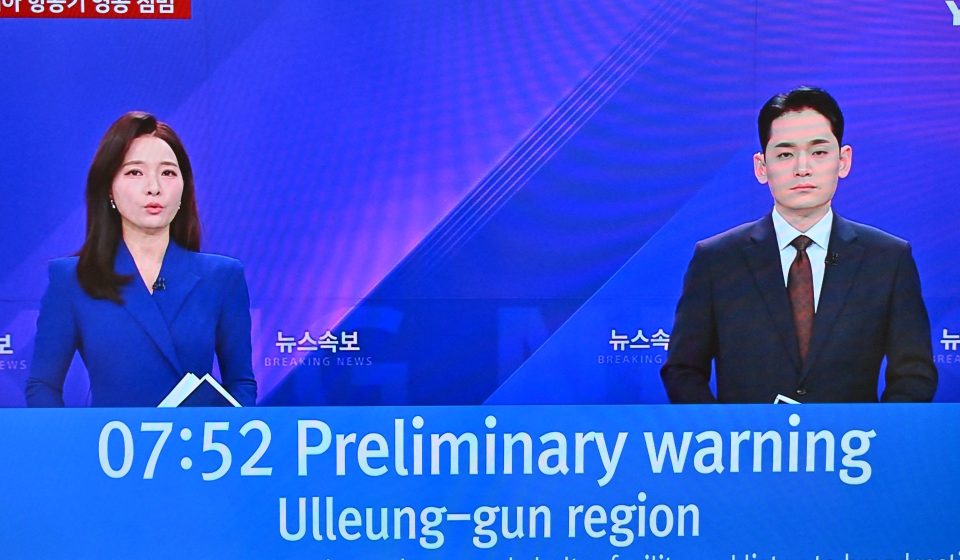
The Ministry of Interior and Security nevertheless issued a shelter alert at 7:52 a.m. (2252 GMT Monday) and lifted the alert three minutes later after the plane left the area.
The last time the East Sea island, also known as the Sea of Japan, was plunged into panic was in 2022, after North Korea fired more than 20 missiles into the sea during a period of heightened inter-Korean tensions. After a missile headed toward Ulleung, it triggered air raid sirens and led residents to evacuate.
What did South Korea say about Russia?
South Korea’s Foreign Ministry said it expressed regret over the incident to Russia and called for measures to prevent it from happening again, South Korea’s Yonhap news agency reported.
The ministry also sent the message to the Russian embassy in Seoul, but did not summon the Russian ambassador, diplomatic sources told the agency.
The Ministry of National Defense nevertheless called on the Russian military attaché, Nikolai Marchenko, to file an official complaint.
Russian military aircraft have entered South Korea’s ADIZ five times this year.
Last week, South Korea announced that Russian military aircraft had temporarily entered the ADIZ.
The same day, Japan protested to Moscow after it also said two suspected Russian planes had entered its airspace off its southwest coast.
In 2019, South Korean warplanes fired warning shots after a Russian A-50 early warning plane, flying alongside Russian and Chinese bombers as part of a joint patrol, entered its territorial airspace near Dokdo Island.
At the time, Moscow denied violating South Korean airspace.
What did Russia say about this incident?
Moscow has not yet made any comments.
Russia does not recognize South Korea’s authority over its ADIZ and says it has no basis in international law.
What is the state of Russian-Korean relations?
The two countries maintain rather tense relations.
Moscow has close relations with North Korea and Pyongyang has deployed troops to help Russian soldiers during its war in Ukraine. Meanwhile, Seoul has joined Western sanctions against Russia over its invasion of Ukraine.
However, recently, leaders of both countries have expressed interest in reestablishing ties.
Last week, South Korean President Lee Jae Myung and Russian President Vladimir Putin held a 10-minute meeting on the sidelines of the Asia-Pacific Economic Cooperation summit and agreed to continue cooperation wherever possible while also working to ease tensions on the Korean Peninsula, an official in Seoul told reporters on condition of anonymity, Yonhap reported.
Gn world