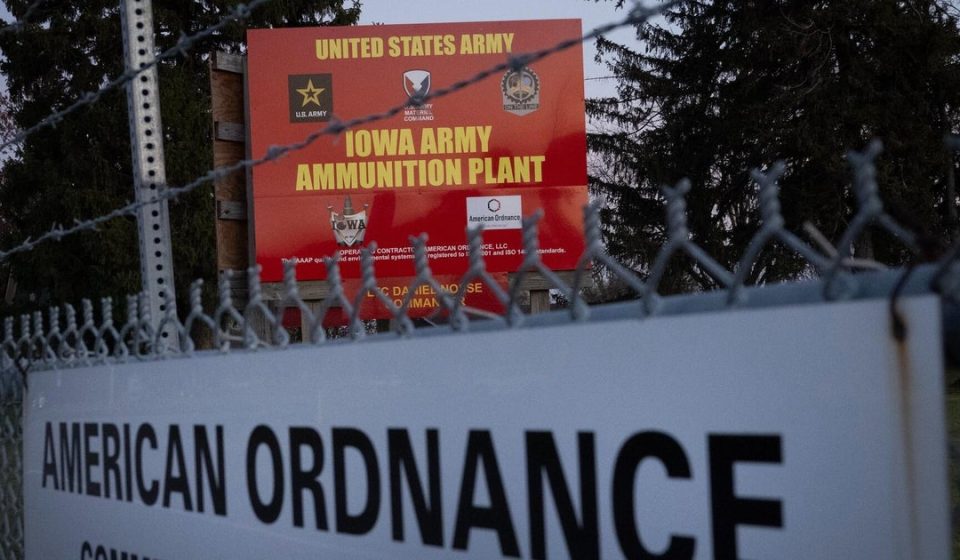
Why the military says it must detonate lead-filled unstable explosives in Iowa and what the risks are

A federal court Friday suspended US Army projects explode several tons unstable explosives at an Iowa munitions plant after community outcry over the risk of toxic lead particles spreading in a dust plume in parts of Iowa and Illinois.
An emergency motion was granted by the 8th U.S. Circuit Court of Appeals to halt the lead azide demolition after environmental groups filed a lawsuit.
Two controlled explosions were initially planned for midday Friday in Middletown, Iowa, a rural community of 360 residents about four hours from Chicago. The army then delayed it until Monday before the court intervened.
The military released a statement saying it was working closely with the Department of Health and Human Services and the Environmental Protection Agency to ensure the controlled explosion would take place as safely as possible.
“Officials have meticulously planned for this event since March, and all agencies involved are prepared to take the most extreme mitigation measures available to ensure there is no risk to the public and any disruption is minimized,” the statement said.
But why exactly does the military have to detonate these chemicals and what are the risks to the public?
Why does the military have to detonate lead azide in Iowa?
In March this year, the military said it had discovered that 68 drums of lead azide at the site had begun to “re-crystallize.” The lead was stored in bunkers at the Iowa Army Ammunition Plant, a munitions factory built in 1941 that produces quality medium- and large-caliber ammunition.
Lead azide is a very sensitive primary initiation explosive. Due to its extreme sensitivity, even minor external triggers, such as sparks, open flames, friction or pinpricks, can cause it to explode.
Recrystallization of lead azide can pose a high risk of spontaneous explosion, which the EPA says creates a very unstable and dangerous situation.
In addition, the cold would further destabilize explosive materials. Justine Barati, public affairs specialist at Army Sustainment Command, said CBS News Chicago that the risk of accidental detonation increases in cold weather.
Military officials said it was not safe to move the explosive materials.
The Army said it modeled four different methods to try to neutralize the chemicals and concluded that a controlled detonation was the best method available.
“It was determined that a controlled detonation was the option that posed the lowest risk to the public in the immediate and surrounding area,” Acting Secretary of the Army Adam Telle said in a statement.
Army officials said they have contacted stakeholders and the public in and around Middletown about the approved plan. Critics, however, say they were informed of the plan to detonate lead azide only days before the planned controlled explosion.
Local politicians said the decisions were made at the federal level and that poor communication contributed to the outcry and confusion among residents concerned about the toxic chemicals.
“The safety of Iowans, now and in the future, should be the government’s primary concern. An unacceptable lack of communication and clarity has left Iowans rightly concerned and angry about this situation,” said Iowa Governor-elect Rob Sand.
What are the risks for residents?
One of the main concerns is that lead particles would be dispersed in the dust plume created by the explosion. Lead, whatever the quantity, is dangerous for humans, and especially for young children.
“Lead is a very problematic contaminant,” said David Cwiertny, a professor at the University of Iowa and director of its environmental policy research program.
He explained that there are basically two ways lead is released: by moving freely through the air or by accumulating on the ground.
“We expect this air to dissipate quite quickly as it moves with the wind,” Cwiertny said.
Lead can enter the body through contaminated food, water, or through dust or fumes, according to the U.S. National Institutes of Health, causing health problems in adults and children. This can hinder growth, contribute to learning disabilities, and damage the brain and nervous system. Children under age 6 are most susceptible to lead poisoning, according to the CDC, because their bodies and brains are still developing.
Residents were asked to evacuate the immediate area ahead of the expected explosion. But some fear that lead will then contaminate the environment and seep into their groundwater, making their communities unsafe.
Middletown resident Sean Byers, whose house is across the street from the munitions plant, pointed down the street and said, “There’s a playground there where kids in the community play all the time.”
Byers, who has three young children, said he was worried about the contamination.
“It’s probably going to last for decades,” he said. “It’s going to affect everyone.”
Are there measures to reduce the risk?
The military said it planned to take a number of steps to reduce the risk of a controlled detonation.
The lead azide drums would explode inside earth-covered concrete magazines surrounded by sand-filled Hesco barriers, about two stories high. Before and during the detonation, explosives experts saturated the ground with water. Water misters would also be sprayed, the army said.
Residents will be asked to leave the area at that time because the controlled detonation “will cause temporary noise, ground vibrations and a plume of lead-containing dust,” the military said in a statement.
Byers said he found out about the planned explosion through his neighbor a few days before the planned explosions — not from the U.S. military. He said he planned to evacuate with his family to Branson, Missouri, where they would stay for three or four days.
He said the army told them they would be able to return home safely after six hours, but he “strongly doubts that.”
Notices were sent out by the military stating that residents’ windows could potentially break and if they did, they would be replaced by the munitions factory.
Byers said he received the notice, but he said, “The damage at this point has already been done, because it’s going to let all that lead into the house.” And the question is: are they going to come and decontaminate this? Are they going to, you know, are they going to do this? Probably not.
The Army said that because of its mitigation efforts, although there will be lead particles in the air after the detonation, the levels will be far below the level at which the EPA requires protective measures.
Gn headline