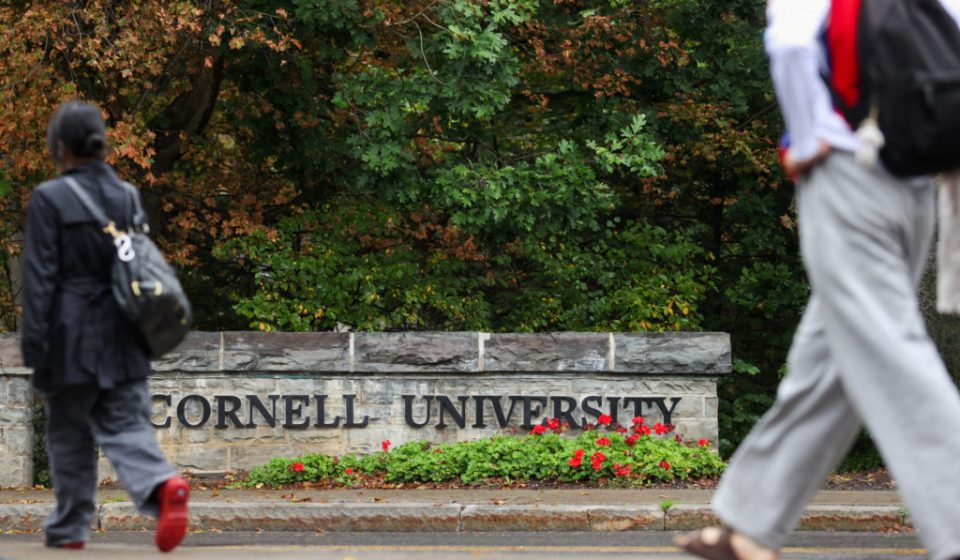
Woman who accused Cornell students of rape says university president’s response made her feel ‘unsupported’

A woman who accused seven Cornell University students of raping her at a fraternity house said the university president questioned why she waited to report the alleged assault, leaving her “unsupported and in disbelief.”
LEARN MORE: Polymarket blocks users from betting on possible criminal charges against Cornell students accused of rape
His second-hand account of the president’s remark, which Cornell disputes, comes as faculty prepare for a possible vote of no confidence in the Ivy League school’s leadership. She sent a letter to faculty leaders last week, which The Associated Press obtained Tuesday.
Allegations of sexual assault by the former student, referred to as Jane Doe in court documents, sparked campus protests, renewed scrutiny of the university’s disciplinary system and a state investigation into the alleged October 2024 assault.
In the letter, Jane Doe said the president of her sorority told her that Cornell President Michael Kotlikoff wondered why she waited until the following month to report that she had been assaulted. The sorority leader, who spoke with Kotlikoff in November 2024, interpreted his remark as casting doubt on his story.
“President Kotlikoff’s initial response was along the lines of, ‘Why did she wait so long to report this?'” Jane Doe wrote in the letter. She said the conversation made her less confident in the administration’s ability to handle what happened with the sensitivity and fairness she expected.
Cornell’s dean of faculty, however, offered a different account of the conversation. In an email to faculty senators Tuesday and verified by the AP, professor Chris Schaffer said another official present at the conversation remembered Kotlikoff asking why bystanders hadn’t reported the alleged assault sooner through the school’s anonymous tip line, especially since the allegations were already circulating on social media.
Schaffer said he waited to share Jane Doe’s letter with faculty senators until he could get another account of the conversation. He said he forwarded the letter to university lawyers, who forwarded it to an independent team investigating Cornell’s response.
Schaffer said at a meeting last week that he was against the proposed censure resolution, saying it did not identify any specific failures or solutions, but he recognized faculty frustration. “Our community’s anger is justified and I share it.”
Kotlikoff did not respond Tuesday to an email inquiry about Jane Doe’s letter. A statement from a university spokesperson also disputed her version of the conversation, saying Kotlikoff was asking about the actions of bystanders rather than Jane Doe.
Her letter, sent through her attorney and first reported by The New York Times, comes as Cornell faculty consider a resolution declaring their distrust in the university administration’s ability to address what some faculty members have described as an “ongoing crisis” of sexual assault on campus.
Faculty members began debating the resolution at a meeting last Wednesday, during which Kotlikoff faced pointed questions about the school’s response to sexual assault allegations and its oversight of fraternities. The Faculty Senate is expected to resume its debates on October 28 before proceeding to an electronic vote.
In her letter, Jane Doe said she wanted faculty members to have information that might be relevant to their deliberations. She emphasized that she wasn’t trying to tell them how to vote.
“My intention is not to prescribe how the Senate should interpret this narrative, but rather to provide information that its members may wish to consider or further explore,” she wrote.
Messages seeking comment were left with Jane Doe’s attorneys, Thomas Giuffra and W. Whitney Seals.
A free press is the cornerstone of a healthy democracy.
Support trusted journalism and civil dialogue.
Gn headline