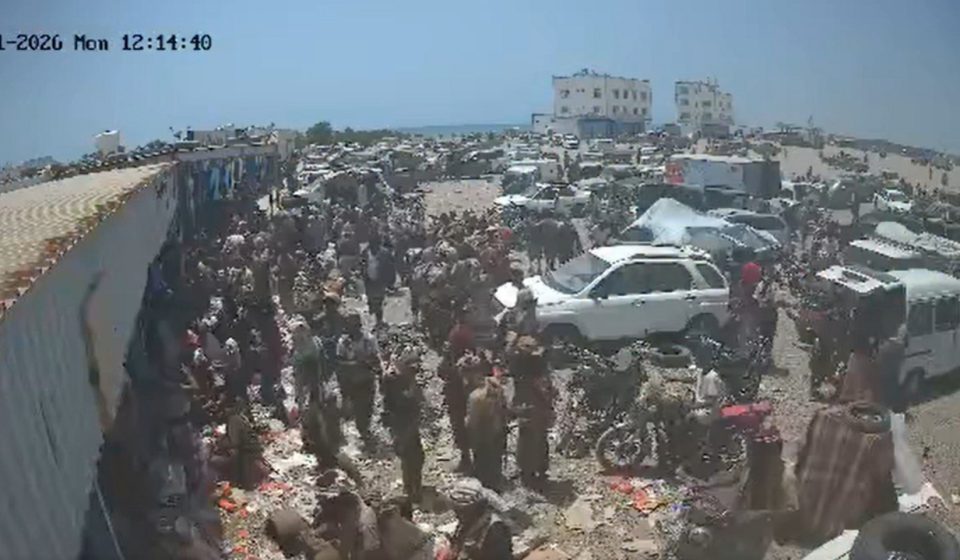
While the fighting between Houthi rebels, supported by Iran, and pro-government forces, supported by Saudi Arabia, have intensified since August, two strikes took place on a roadside gas station in al-Hajaf on September 21. This area of Yemen was under the control of pro-government forces, supported by Saudi Arabia.
This rest area is, however, located not far from the front lines, notably Bab el-Mandeb, under Houthi control, about twenty kilometers further north, on the west coast.
The Houthis, allies of Iran, denounced via their press agency Sabaa an attack by Saudi aircraft on a “popular market in Dhubab district, Taiz governorate.” But in this press release, we note that the Houthis mention an area which is not the one where the strikes were located, in this case al-Hajaf, but a town which is under their control, around fifty kilometers further north.
Mutual accusations
The Houthi press release was then repeated by several media favorable. The Lebanese channel al-Manarheld by Hezbollah, support of the Houthis and ally of Iran, relayed this same accusation by accompanying it with video surveillance images of the attack. Several Houthi activists also relayed the images on X in turn accusing the Saudi air force.
For its part, the Ministry of Human Rights, from the internationally recognized government, blamed these strikes on the Houthi rebels. Her press release states that they occurred in “a popular market” located “in the Al-Hajf region”, and affirms that the attack left several civilians injured, without specifying the number.
Video surveillance images show a projectile falling into the rest area where a crowd was gathered, causing a foul ball. The video surveillance screen shows 12:14 p.m. when the strike occurs. © X / @fathibnlazrq
The geolocation of the attack (12°42’07.4″N 43°45’13.1″E), provided by Mohammed al-Basha, a analyst Yemeni-American at risk, confirms that the attack took place in a rest area in al-Hajaf – which is in line with the government press release. This area is located in the governorate of Lahij, in the hands of pro-government forces, of which Saudi Arabia is an ally.
Mohammed al-Basha also obtained the CCTV footage showing the second strike. The images are filmed from a different angle but show the same location, about an hour after the first strike, according to the time indicated on the screen, 1:17 p.m. In these images, we can clearly see a projectile falling into the now sparse market, hitting a vehicle near which were two men on foot and a man on a motorcycle.
This extract from surveillance video, obtained by Mohammed al-Basha, shows a projectile falling near a vehicle next to which three men were standing. X / @BashaReport
A missile or rocket, not a bomb dropped from an airplane
We showed these images to two ballistics experts.
For Frederik Coghe, expert in weapons systems and ballistics at the Royal Military Academy in Brussels, they are not consistent with an air strike coming from the Saudi air force:
Images and video of the first strike appear to show the impact of a missile/rocket, not a bomb from an aircraft. Images and video of the second strike also appear to show the impact of a missile/rocket. It seems to me that the two missiles arrived from the north. This direction does not exclude either party as responsible.
“In the event of aerial fire, there is a crater which must be significant, this is not the case here”
A second ballistics expert, who requires anonymity, agrees:
Both rounds are very thin, with fins that are more prominent at the rear.

Screenshot from surveillance video showing the first strike. We can see fins at the back. © The Observers
By comparing the length of the projectile with the average human height in Yemen, approximately one meter and sixty, we can estimate the length of the missile, I would say approximately 5.9 meters.

Screenshot from CCTV showing the second strike. © The Observers
And that’s very long compared to an aerial munition fired from an airplane. This is not a guided bomb in any case, rather an inexpensive missile. A State would not waste a very expensive GBU (guided bomb) on such an ‘objective’. That would be absurd.
With these dimensions, it could be a missile or a rocket fired from a truck. Despite everything, the charges seem reduced to me and the explosions are ‘on the surface’. In case of aerial fire, you have a crater which must be significant, this is not the case here.
These analyzes refute the accusation that these attacks were the work of the Saudi air force. But why attack a civilian area, where no fighting seems to be taking place?
A rest area frequented by pro-government fighters
Fethi Ben Lazrq is a Yemeni journalist based in Aden. Director of the media “Aden al-Ghad”, he comes from the region. He was the one who published the video of the first strike. For him there is no doubt about the author of the strikes:
This place is a large gas station with a rest area and shops. It is very popular with motorists.
Since the start of this offensive, government forces fighters have also stopped there to do their shopping, like everyone else.
And what’s more, it is not far from the front lines with the Houthis, towards Bab el-Mandeb, in particular. And so this place quite naturally became a target for the Houthis.
The strikes took place in the middle of the day, when it was busiest. There were civilians there but also combatants.
The fact remains that this zone is civilian, not military, and there is no fighting there which would justify strikes.
A third video, broadcast on X, is in line with Fethi Ben Lazrq’s comments.
Two men are seen at the same rest area, standing in front of two burned vehicles, after the strikes and presenting themselves as members of the National Resistance, a faction fighting the Houthis within the pro-government coalition supported by Saudi Arabia. One of them shouts: “The Houthi militias are targeting Resistance men. With missiles. They won’t win no matter what they do.”
Several elements therefore converge towards the hypothesis of a double strike emanating from the Houthi camp rather than an attack carried out by fighter planes of the Saudi army or by the factions supported by Riyadh. According to the analysis of Mohammed al-Basha, published on Xthe projectiles fired are missiles that are part of the Houthi arsenal: “The second projectile is consistent with the Houthis’ Qasim family of missiles rather than an air-to-ground missile launched from an aircraft.”
According to a report communicated by the WHO, the conflict left 674 dead and 29,998 injured since the start of the escalation on August 6 until September 18.
According to the United Nations (UN), 112,000 people were displaced within Yemen in two weeks in September 2026, while nearly 3,000 others crossed the Gulf of Aden to find refuge in Djibouti.