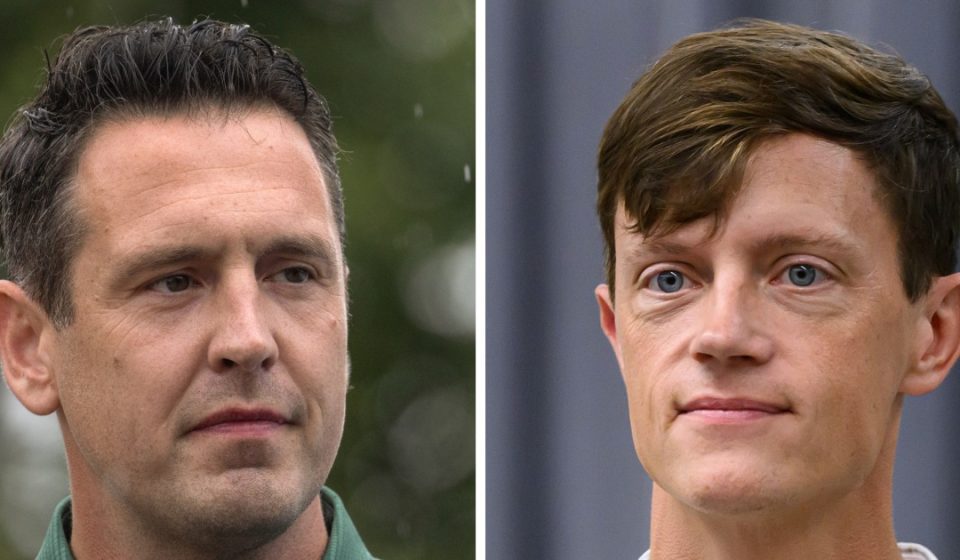
Zach Lahn’s residency story and Rob Sand’s party come under fire in first Iowa governor’s debate

Republican Zach Lahn and Democrat Rob Sand repeatedly returned to one topic during their first debate Tuesday night in the race to be Iowa’s next governor: questions about Lahn’s residency history in the state.
Sand, the state auditor, and Lahn, a businessman, met in Davenport as they run to succeed outgoing Republican Gov. Kim Reynolds in an unusually competitive race for a state that has trended right in recent years.
Iowa hasn’t had a Democrat in the governor’s mansion since Chet Culver’s defeat in 2010, and Sand is the only Democrat currently elected statewide. While Sand is running as an independent candidate, Lahn calls him a “radical liberal” and a “career politician” who supports liberal positions on taxes and immigration.
As the two argued over tax rates, economic growth, the state’s cancer crisis and other issues on NBC affiliate KWQC, both repeatedly addressed the controversy over Lahn’s reported ties to Kansas, which include public records showing he voted there in 2018, 2020 and 2022 before running in Iowa in 2024.
Lahn responded Tuesday to reports that he still frequently visits a second home in Kansas.
“I’m a sixth-generation Iowan. I live in Iowa today. I lived in Iowa. Rob lied about it, and the problem is I have a blended family and my kids share time,” he said.
The topic first came up during a conversation about education. Sand advocated for higher teacher salaries and better oversight of the use of public funds, while Lahn called for more rigorous auditing of the school voucher system and limiting the program to low-income families.
“I want to be the biggest advocate for public school children in the state,” Lahn said.
Sand responded, “I don’t think you’re going to be the biggest advocate for public school students rather than a guy who sends his kids there. When you were running ads saying that Marxists had hijacked the curriculum in Iowa, Zach, I’m pretty sure that’s just more proof that you don’t spend enough time in Iowa.”
Lahn called the attacks “the central lie of Rob Sand’s campaign.”
The controversy has been a drag on Lahn’s campaign, with Sand holding the advantage in public polls ahead of the November election.
Throughout the debate, Lahn lambasted Sand as a “liberal billionaire” backed by money from his wife’s family.
Sand’s wife, Christine, is the CEO of the family business, the Lauridsen Group, which owns several food and healthcare companies. His family has donated more than $12 million to Sand’s campaigns over the years, having supported him since he first ran for state auditor.
Earlier in the evening, candidates were asked how they would respond to Iowa’s low economic growth rate and the issue of affordability on their first day in office.
Lahn said he would prioritize local businesses and make sure state government “does not prioritize large out-of-state projects that don’t employ people, like data centers.”
He indicated he would support tax incentives for the White House-backed $15 billion steel mill project announced last week. He also praised President Donald Trump’s executive action easing restrictions on tax-exempt “red dye diesel” fuel used for agricultural vehicles, which he said he proposed to Vice President JD Vance during his visit to Iowa last month.
The rising price of diesel, now $6.05 a gallon in Iowa, is a major concern for the state’s farmers, who have also felt pressure from rising fertilizer prices and tariffs, threatening the campaigns of Republican candidates in the heartland.
Sand called for a cap on utility fees, an end to the privatization of Medicaid in Iowa, an increase in the minimum wage — which he said should be set at $12 an hour — and the importation of prescription drugs from Canada.
Lahn would not commit to raising the minimum wage, which was last raised in Iowa in 2009 and is $7.25 an hour. He said he would focus on deconsolidating the industry and reducing taxes.
“We’ve worked hard to cut taxes for Iowans, and Rob, you’ve opposed those efforts every step of the way,” Lahn told his opponent. “And so I think we have to be very honest here about where we stand. Rob supports raising taxes because that’s what liberals do: They want to raise taxes. I’m here to cut taxes.”
Asked to respond, Sand denied wanting to raise taxes.
Both candidates made a point of addressing cancer rates in their opening statements. Iowa is one of three states where cancer incidence is increasing due to environmental risks associated with chemicals used by the agricultural industry, such as glyphosate, PFAS and nitrates.
“Iowa is at a point where we’re at the bottom in terms of economic growth; we’re at the top in terms of cancer growth,” Sand said.
Lahn cited “the fastest rate of new cancers in the country” as one of three factors that motivated him to run for office.
Lahn, who is supported by prominent members of the “Make America Healthy Again” movement, has made cancer rates a centerpiece of his campaign, frequently targeting the powerful agricultural industry. He called the fight against cancer a “fundamental issue” and a “crisis of our generation.”
“For a very long time we have seen the nitrate load in our water increasing year after year,” he said. “We need to start putting real solutions in place.”
He expressed support for the state’s IWiLL (Iowa’s Water and Land Legacy) program to address water quality issues and high nitrate levels.
“I’m glad that Mr. Lahn brought up IWiLL and mentioned that he’s been supporting it and talking about it since the beginning of the campaign. I’m glad he did that,” Sand said. “I actually voted for it in 2010 because I lived here. You didn’t.”
Gn usa