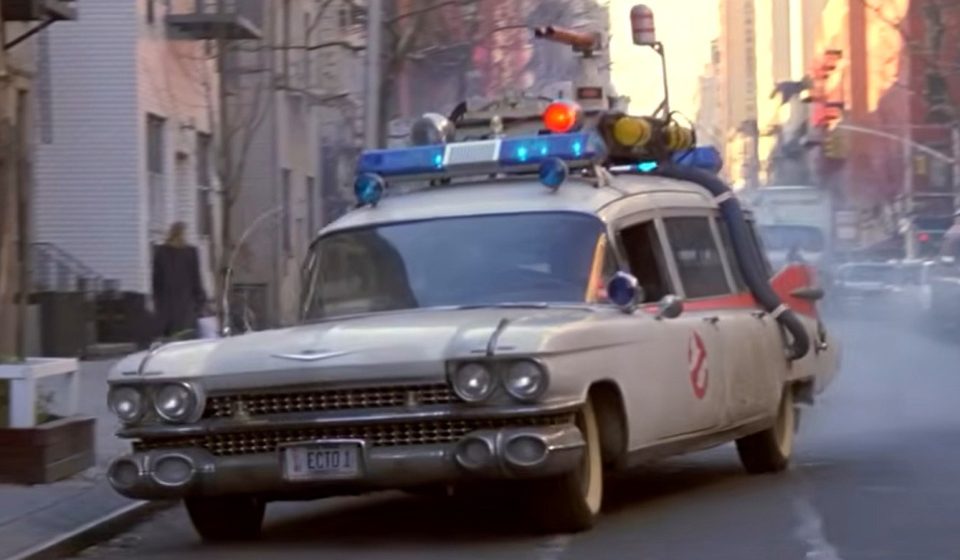

The Ghostbusters movie was a smash hit when it debuted in 1984, becoming the highest-grossing comedy at the time – until it was replaced by Home Alone in 1990. There’s no doubt that all the stars attached to the film helped matters, including Bill Murray, Dan Aykroyd, Sigourney Weaver, Rick Moranis, Harold Ramis, Ernie Hudson and, of course, Ecto-1.
The latter name refers to the Ghostbusters’ original support vehicle – a modified 1959 Cadillac wagon that provided ample space for the team’s Proton Packs, Ecto Goggles, PKE Meters, and Ghost Traps. Needless to say, the car has cast a huge shadow since the film’s release – as you’d expect from a nearly 21-foot-long vehicle – and it still inspires ghost-fighting gearheads everywhere today. Even Rivian recently got in on the action with an R1S featuring officially licensed movie sounds, games and a spooky voice assistant, as well as an Ecto-style livery.
Speaking of which, did you know that the original plans for the car would have given it a much different look? Aykroyd, who had worked on early drafts of the script with Ramis, wanted to use a black car lit by purple and white strobe lights. But since a lot of filming had to be done in the dark of night, when a black vehicle was difficult to film, white was chosen instead. This isn’t the only little-known fact about the legendary Ecto-1, either. In fact, we have five more for you here.
Accept no substitute: there is only one Ecto-1
It’s not uncommon for filmmakers to use multiple vehicles behind the scenes to embody a single car on screen. For example, for the classic film “Gone in 60 Seconds,” it turns out that 11 different cars were used to portray Eleanor in the film – don’t worry, because no actual Shelby GT500s were harmed during filming.
Now, two different Cadillac-based Miller-Meteor vehicles have appeared in the original “Ghostbusters.” But the first, a rental wearing a coat of black primer, essentially acted as the donor car for what would become the Ecto-1. In the film, the black car is upgraded to a proper anti-ghost state to become the Ecto-1. In the real world, however, it came down to the rental agency and the second car assumed the role. That said, after the original Ecto-1 broke down during the filming of “Ghostbusters II,” resulting in the production team being fined, the crew brought in a third car and modified it to replace it for the remainder of the film. As for the Ecto-1, it was reportedly ignominiously abandoned on a studio lot, where it languished, exposed to the elements for nearly 18 years. It was eventually restored by Cinema Vehicles and used to promote their 2009 Ghostbusters video game.
The Ecto-1 didn’t start out as just a hearse or ambulance
In fact, it was both! Although the media often describes the car the Ecto-1 is based on as a Cadillac ambulance, that’s not the whole story. The car is a Cadillac Miller-Meteor Futura Duplex, one of 400 units built for 1959, and the name Duplex refers to its two potential functions: the same car can change fairly quickly from an ambulance to a hearse or vice versa. Its secret appears to have been a rear compartment with ambulance seats that could fold into the floor, which in turn could be turned over to hide or expose the coffin rollers as required.
The Miller-Meteor part of the equation is explained by the company behind the conversion. The coachbuilder was formed when a bus company called Wayne Works (later Wayne Corporation) purchased Miller and then, separately, Meteor, two rivals in the livery car market. The merger of the two helped create what was, for a time, the world’s largest manufacturer of hearses and ambulances.
To be clear, though, while Miller-Meteor handled much of the bodywork, its basis was a heavy-duty Cadillac commercial chassis that was in production from 1931 to 1979. This was part of Cadillac’s long history of building funeral cars, and it meant that only the front bodywork came from the factory – well, that one and its rear fins. They were borrowed from the 1959 Cadillac Eldorado and are still the largest ever to appear on a production vehicle.
The price of the donor’s car was increased to $4,800 in the movie, but it was even higher in real life.
In the film, when Ray Stantz, played by Ackroyd, brings the car to Ghostbusters headquarters, he mentions that it has a few issues, including needing work on the suspension, shocks, brakes, pads, linings, steering box and rear end, to name a few. Yet the film’s decision-makers felt that the $1,400 paid for the car in the film was unrealistic. That’s why Stantz says he paid $4,800 instead. In today’s money, that $1,400 is $4,630, and $4,800 is $15,872. And it was a good decision, since the price of the Miller-Meteor was $10,694 in 1959, which is equivalent to a whopping $124,250 in 2026 dollars.
This is where we’d love to tell you how much one of these Futurama Duplex cars is worth today, but first we’ll have to find one. Because very few models were originally manufactured and many survivors were converted to Ecto-1 replicas, it is virtually impossible to track down an unmodified 1959 model.
The creator’s name was misspelled in the film’s credits
The Ecto-1 and much of the film’s ghost-busting gadgets were brought to life by Stephen Dane, a set designer and art director whose resume also includes contributions to vehicle-based films like “Blade Runner” (1982) and the “Adventures of Buckaroo Banzai Across the 8th Dimension” (1984). With just six weeks to complete the task, Dane worked closely with Ivan Reitman, the film’s director, to nail down the look of Ecto-1 and equipment such as proton packs, neutrino wands, and ghost traps (via Beyond the Marquee).
Of course, there was no CGI or AI trickery either. Dane drew incredibly detailed sketches for the film and carefully designed and positioned every piece of equipment on the Ecto-1’s roof rack – although some minor modifications had to be made for practical reasons. That said, Dane is quick to give credit where credit is due: he’s given props to the props department in interviews, singling them out for their workmanship and finishing. However, whoever wrote the film’s credits didn’t seem to share that kind of attention to detail. Dane, whose first name is misspelled “Steven”, is listed simply as “Computer Hardware Consultant” in the film.
The price of a replica can reach six figures
About those Ecto-1 replicas we just mentioned: The film has inspired its fair share of DIY efforts, from converted 1992 Ford Taurus station wagons made from “do-it-yourself” scraps to matching Subarus, Chevrolet HHRs, and even a Smart Fortwo. But there are also obsessive Ghostbuster fanatics who strive to be as accurate as possible. And buoyed by the popularity of the film, these machines can cost hundreds of thousands of dollars.
One, for example, sold for $297,000 at the 2025 Barrett-Jackson auction in Scottsdale, Arizona. This was also based on the real deal, as it began life as a genuine 1959 Cadillac Miller-Meteor hearse/ambulance combination. Even the 390 cubic inch V8 and Hydra-Matic automatic transmission were rebuilt to make the vehicle ready to hit the road. These engines produced 320 horsepower in the Miller-Meteor. Finally, the car’s visor was autographed by Dan Ackroyd, Ernie Hudson and William Atherton, who played EPA villain Walter Peck. Barrett-Jackson also sold a fan-made Ecto-1 based on a Cadillac Superior ambulance for $220,000 in 2021. That price covered not only the vehicle – equipped with a remote-controlled laser turret – but also four proton packs, five working cameras and eight autographs, all complemented by a heavy-duty suspension and an upgraded electrical system.
Gn tech